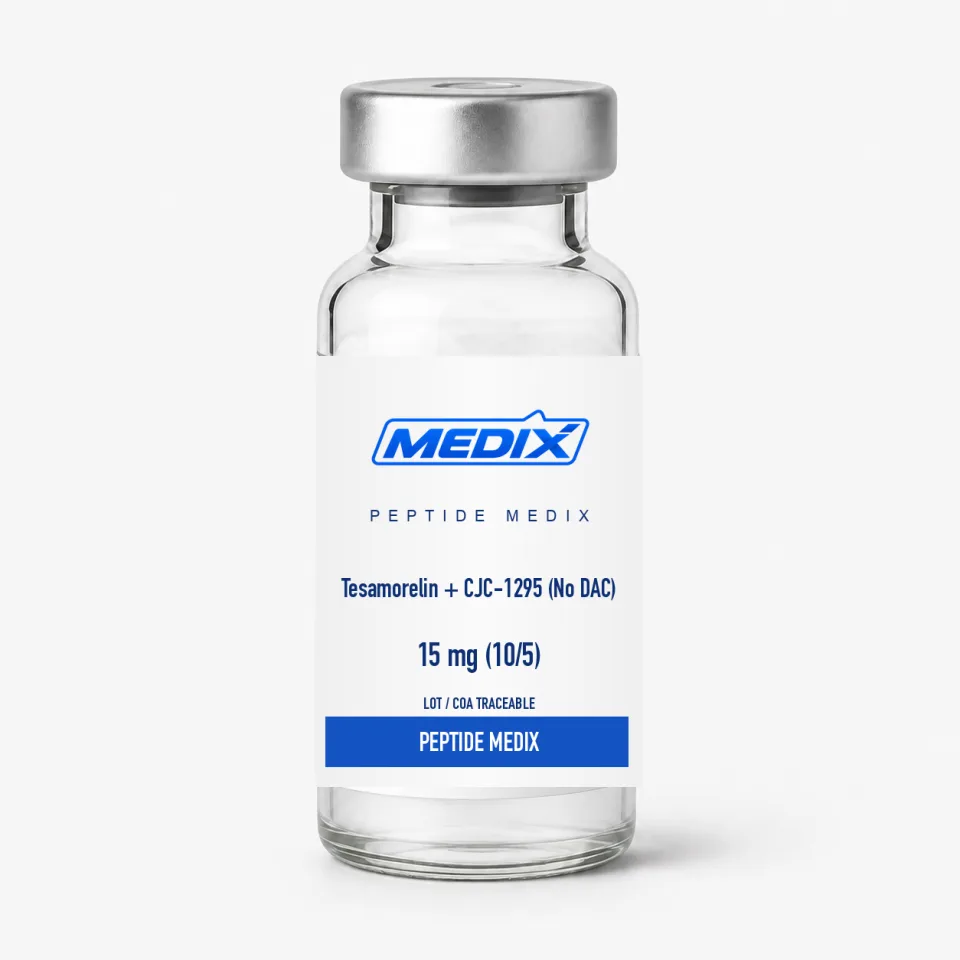
- ≥99% by HPLC per component
- Lot-matched certificate of analysis
- Ships next business day, tracked
Tesamorelin + CJC-1295 (No DAC)
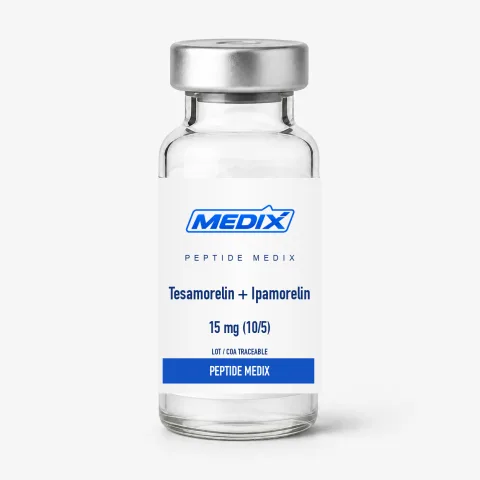
Dual GHRH-analogue blend: 10 mg tesamorelin with 5 mg Mod GRF 1-29
- FormCo-lyophilized powder, sealed glass vial with crimped stopper
- Research areasSomatotropic axis signalling, GHRH receptor structure–activity relationships, peptide stability and DPP-4 resistance, visceral adipose metabolism models
Overview
This blend co-lyophilizes two growth hormone-releasing hormone analogues in a single vial: 10 mg of tesamorelin and 5 mg of CJC-1295 without DAC, for 15 mg of total peptide. Both molecules act at the same target — the GHRH receptor on pituitary somatotrophs — but they arrive at that target from different structural starting points, which is precisely why researchers put them side by side.
Tesamorelin is a full-length GHRH(1–44) analogue carrying a trans-3-hexenoyl group on its N-terminal tyrosine. That acylation blocks cleavage by dipeptidyl peptidase-4, the enzyme that rapidly inactivates native GHRH, and adds a lipophilic anchor that changes the molecule's distribution behaviour. CJC-1295 without DAC — more accurately called Modified GRF (1-29) — takes the opposite approach: it truncates the sequence to the 29 residues that retain full receptor activity and installs four substitutions (D-Ala2, Gln8, Ala15, Leu27) that resist enzymatic degradation and oxidation. Without the drug affinity complex, it does not bind serum albumin, so its plasma persistence is short.
The pairing is unusual among catalogue blends, most of which combine a GHRH analogue with a ghrelin-receptor secretagogue. Here both components engage the same receptor, so the blend is a tool for comparative work — receptor-occupancy modelling, structure–activity comparison and formulation studies — rather than a complementary two-receptor combination. Supplied at ≥99% HPLC purity per component with a lot-matched COA.
Specifications
Identity
- Peptide class
- GHRH analogues (GHRH-R agonists)
Supply & purity
- Form
- Co-lyophilized powder, sealed glass vial with crimped stopper
- Purity
- ≥99% by HPLC per component; lot-matched COA available
- Available sizes
- 15 mg total (10 mg tesamorelin / 5 mg CJC-1295 no DAC)
- Solubility
- Bacteriostatic water or sterile water; both components dissolve readily
Handling & storage
- Storage (lyophilized)
- −20 °C, sealed and protected from light and moisture
- Storage (reconstituted)
- 2–8 °C, protected from light, used within the study window
Additional detail
- Blend ratio
- 2:1 by mass, tesamorelin to CJC-1295 no DAC
- Component 1
- Tesamorelin — CAS 218949-48-5, C221H366N72O67S, 5135.86 g/mol, 44 residues, N-terminally acylated with a C-terminal amide
- Component 2
- CJC-1295 no DAC (Modified GRF 1-29) — CAS 863288-34-0, C152H252N44O42, 3367.93 g/mol, 29 residues with a C-terminal amide
- Shared target
- Growth hormone-releasing hormone receptor (GHRH-R), a class B GPCR on pituitary somatotrophs
- Tesamorelin modification
- trans-3-hexenoyl group on the N-terminal tyrosine, conferring DPP-4 resistance
- CJC-1295 modifications
- D-Ala2, Gln8, Ala15 and Leu27 substitutions on the GRF 1-29 backbone; no drug affinity complex
- Research areas
- Somatotropic axis signalling, GHRH receptor structure–activity relationships, peptide stability and DPP-4 resistance, visceral adipose metabolism models
Working out the concentration
Because Tesamorelin + CJC-1295 (No DAC) arrives dry, its concentration is a decision rather than a specification. Run the numbers through the reconstitution calculator — vial mass in, diluent volume in, mg/mL and mass per syringe unit out.
Certificate of analysis
Every lot of Tesamorelin + CJC-1295 (No DAC) is released against a certificate of analysis: the batch-specific laboratory data for that lot, not a generic document for the compound. The lot number on the certificate matches the lot number printed on the label you receive — the vial label itself, where the product is vialled — so the record and the material it describes can always be reconciled.
Purity: ≥99% by HPLC per component — the specification for this listing. The figure for the lot you receive is the one reported on that lot’s certificate.
No lot certificate is on display on this page at the moment. That is a publishing state and not a testing one: lots are released and documented as described above whether or not the document is posted here, and we will send what exists for the lot in stock, or for a lot already on your bench, by its number.
Certificates are available on request before you order as well as after, with no account and no charge. Request the certificate for this listing, read the testing and documentation policy in full, or see how to read a peptide COA.
Questions about Tesamorelin + CJC-1295 (No DAC)
Why blend two GHRH analogues instead of pairing one with a GHRP?
Most catalogue blends pair a GHRH analogue with a ghrelin-receptor secretagogue to engage two receptors. This one is different by design: both components hit the same receptor, which makes it a comparative and formulation tool rather than a complementary combination. It is not additive in the way a two-receptor blend is.
What exactly is in the 15 mg vial?
10 mg of tesamorelin and 5 mg of CJC-1295 without DAC, co-lyophilized together — 15 mg of total peptide in a fixed 2:1 mass ratio. Because they share a vial, every aliquot drawn after reconstitution contains both peptides in that same proportion.
What is the difference between CJC-1295 with and without DAC?
The drug affinity complex is a maleimide group that binds covalently to serum albumin, extending circulating persistence substantially. The no-DAC version omits it, so it behaves as a short-acting GHRH analogue. The peptide backbone — Modified GRF (1-29) — is otherwise the same.
What purity documentation is available?
Each component is tested at ≥99% by HPLC before blending, and a lot-matched certificate of analysis is available on request covering both peptides. The COA reports the individual component purities alongside the blend's stated composition and ratio.
How should the blend be reconstituted?
With bacteriostatic or sterile water, added slowly down the vial wall and swirled — not shaken — until the cake fully dissolves. Both peptides dissolve readily. Record the diluent volume so the concentration of each component can be calculated separately from the 2:1 ratio.
Can single-component controls be run from this vial?
No — the two peptides are co-lyophilized and cannot be separated at the bench. Studies needing single-agent controls should order the standalone tesamorelin and CJC-1295 no DAC vials, which are stocked separately for exactly that purpose.
Related