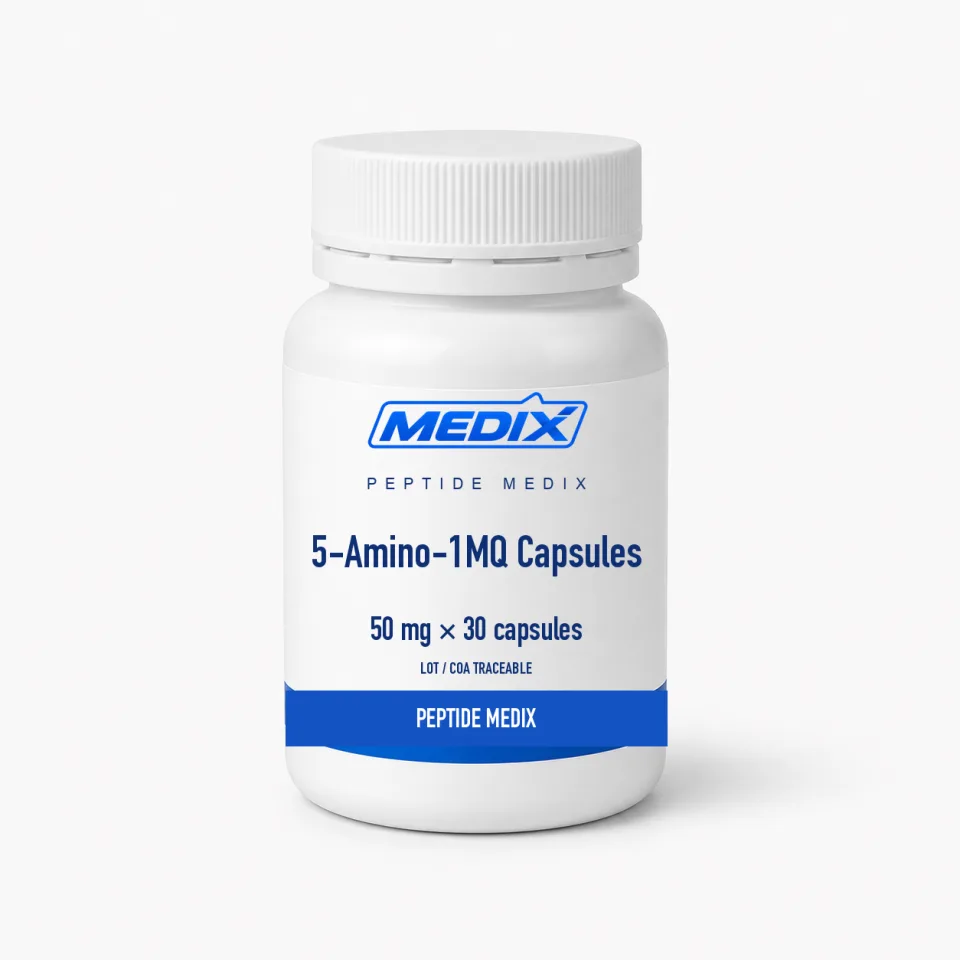
- ≥99% by HPLC
- Lot-matched certificate of analysis
- Ships next business day, tracked
5-Amino-1MQ Capsules
Oral NNMT inhibitor capsules, 50 mg per capsule, 30 or 60 count
- FormOral capsule, sealed bottle with tamper-evident closure and desiccant
- Mol. weight159.21 g/mol (cation); 286.11 g/mol (iodide salt)
- Research areasAdipocyte metabolism, NAD-plus salvage, sirtuin signalling, methyl-donor flux, oral route comparison
Overview
These capsules present 5-Amino-1MQ in a fixed-unit oral format rather than as a powder in a vial. Each capsule contains 50 mg of the compound blended with an inert carrier, and bottles are supplied in 30-count and 60-count sizes. The material is the same as in our vial listing: a small-molecule quinolinium, CAS 42464-96-0, with a cation formula of C10H11N2 plus at 159.21 g/mol, normally supplied as the iodide salt at 286.11 g/mol, tested to at least 99% by HPLC with a lot-matched certificate of analysis.
5-Amino-1MQ is not a peptide. It is a selective inhibitor of nicotinamide N-methyltransferase, the enzyme that methylates nicotinamide using S-adenosylmethionine as the methyl donor. That single reaction sits at a junction between two pathways researchers care about: it consumes methyl groups from the SAM pool, and it diverts nicotinamide away from NAD-plus salvage. NNMT expression is reported to be high in white adipose tissue and elevated in obese and insulin-resistant models, which is why inhibitors of the enzyme became a target of metabolic research.
Specifications
Identity
- CAS number
- 42464-96-0
- Molecular formula
- C10H11N2+ cation, supplied as the iodide salt C10H11IN2
- Molecular weight
- 159.21 g/mol (cation); 286.11 g/mol (iodide salt)
Supply & purity
- Form
- Oral capsule, sealed bottle with tamper-evident closure and desiccant
- Purity
- ≥99% by HPLC; lot-matched COA available
Additional detail
- Content per capsule
- 50 mg 5-Amino-1MQ
- Available counts
- 30 capsules, 60 capsules
- Compound class
- Small-molecule quinolinium NNMT inhibitor
- Full chemical name
- 5-amino-1-methylquinolinium
- Molecular target
- Nicotinamide N-methyltransferase (NNMT)
- Research areas
- Adipocyte metabolism, NAD-plus salvage, sirtuin signalling, methyl-donor flux, oral route comparison
- Storage
- Cool, dry conditions away from direct light; keep the bottle sealed with desiccant
- Preparation required
- None — fixed unit content, no reconstitution step
Units and conversions
The arithmetic on an oral format is unit arithmetic rather than dilution arithmetic. Use the milligram to microgram converter to line a per-unit figure up against a method written in different units.
Certificate of analysis
Every lot of 5-Amino-1MQ Capsules is released against a certificate of analysis: the batch-specific laboratory data for that lot, not a generic document for the compound. The lot number on the certificate matches the lot number printed on the label you receive — the vial label itself, where the product is vialled — so the record and the material it describes can always be reconciled.
Purity: ≥99% by HPLC — the specification for this listing. The figure for the lot you receive is the one reported on that lot’s certificate.
No lot certificate is on display on this page at the moment. That is a publishing state and not a testing one: lots are released and documented as described above whether or not the document is posted here, and we will send what exists for the lot in stock, or for a lot already on your bench, by its number.
Certificates are available on request before you order as well as after, with no account and no charge. Request the certificate for this listing, read the testing and documentation policy in full, or see how to read a peptide COA.
Questions about 5-Amino-1MQ Capsules
How much is in each capsule?
Each capsule contains 50 mg of 5-Amino-1MQ blended with an inert carrier, and bottles come in 30-count and 60-count sizes. Content and purity for the lot are recorded on the certificate of analysis matched to the bottle label.
Is 5-Amino-1MQ a peptide?
No. It is a small organic molecule — a quinolinium compound of 159.21 g/mol as the cation — that inhibits the enzyme nicotinamide N-methyltransferase. It is grouped with metabolic research compounds rather than with peptides despite often appearing in the same catalogues.
Why choose capsules over the vial?
A capsule fixes the unit content and removes weighing, dissolving and dilution from the workflow, which reduces preparation variability across many time points or subjects. It also makes an oral-route arm straightforward to set up against parenteral or in-vitro comparators.
How is purity verified and is a COA supplied?
Each lot is analysed by HPLC to at least 99% purity with identity confirmation. A certificate of analysis matched to the lot number on your bottle is available on request, before or after purchase, covering assay and identity for that batch.
How should the capsules be stored?
Sealed, cool and dry, out of direct light, with the desiccant in the bottle. The iodide salt is hygroscopic, so humidity is the main enemy — do not leave the container open or move capsules into unsealed vessels.
Can these be taken by people?
No. They are supplied for laboratory research only and are not a supplement, food or medicine. The compound has not been evaluated in controlled human trials and no dosing, protocol or administration guidance is provided with it.
Related