- Analytically tested
- Lot-matched certificate of analysis
- Ships next business day, tracked
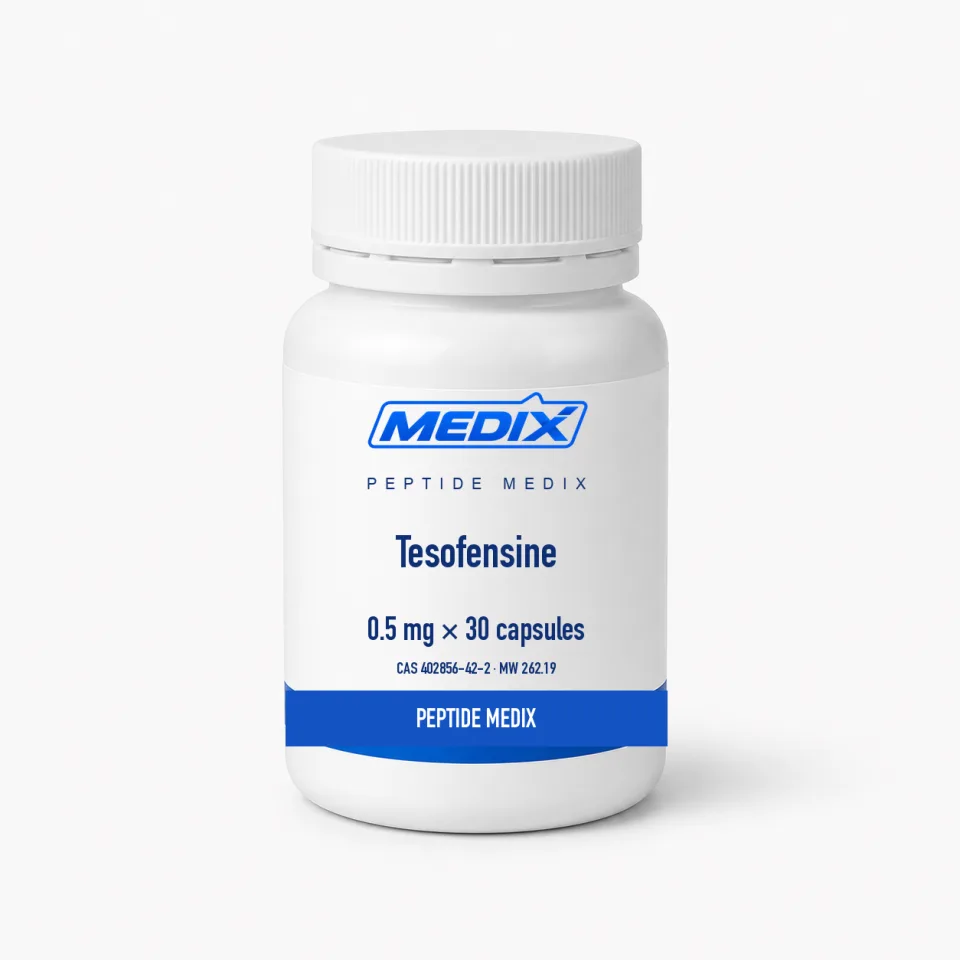
Tesofensine
Triple monoamine reuptake inhibitor supplied as 0.5 mg research capsules
- FormOral-format capsules, 0.5 mg per capsule, in a sealed bottle
- Research areasMonoamine transporter pharmacology, feeding behavior, reward and motivation circuits
Overview
Tesofensine is a synthetic small molecule that inhibits the presynaptic reuptake transporters for norepinephrine, dopamine and serotonin. It is not a peptide, despite frequently being listed among them. The compound was originally developed as a candidate for neurodegenerative indications, where trials did not meet their endpoints, and its later research interest came from appetite and body-weight observations recorded during that earlier work.
As a research compound it is useful precisely because it engages all three monoamine transporters rather than one. Laboratories use it in transporter-binding and uptake-inhibition assays to establish relative affinity across NET, DAT and SERT, in microdialysis studies measuring extracellular monoamine concentrations in specific brain regions, and in rodent feeding-behavior work where reduced intake can be traced to particular neurotransmitter systems using selective antagonists.
Specifications
Identity
- CAS number
- 402856-42-2
Supply & purity
- Form
- Oral-format capsules, 0.5 mg per capsule, in a sealed bottle
- Purity
- Analytically tested; certificate of analysis available
- Available sizes
- 30 capsules, 60 capsules
Additional detail
- Compound class
- Small-molecule triple monoamine reuptake inhibitor (non-peptide)
- Molecular targets
- Norepinephrine, dopamine and serotonin transporters (NET, DAT, SERT)
- Research areas
- Monoamine transporter pharmacology, feeding behavior, reward and motivation circuits
- Storage
- Room temperature, sealed, dry and protected from light
- Handling note
- Centrally active compound; handle with standard controlled-laboratory precautions
Units and conversions
The arithmetic on an oral format is unit arithmetic rather than dilution arithmetic. Use the milligram to microgram converter to line a per-unit figure up against a method written in different units.
Certificate of analysis
Every lot of Tesofensine is released against a certificate of analysis: the batch-specific laboratory data for that lot, not a generic document for the compound. The lot number on the certificate matches the lot number printed on the label you receive — the vial label itself, where the product is vialled — so the record and the material it describes can always be reconciled.
Purity: Analytically tested — the specification for this listing. The figure for the lot you receive is the one reported on that lot’s certificate.
No lot certificate is on display on this page at the moment. That is a publishing state and not a testing one: lots are released and documented as described above whether or not the document is posted here, and we will send what exists for the lot in stock, or for a lot already on your bench, by its number.
Certificates are available on request before you order as well as after, with no account and no charge. Request the certificate for this listing, read the testing and documentation policy in full, or see how to read a peptide COA.
Questions about Tesofensine
Is tesofensine a peptide?
No. It is a small-molecule triple monoamine reuptake inhibitor. It is frequently listed alongside metabolic peptides because of overlapping research interest in food intake, but its mechanism and chemistry are entirely different from the peptides in this catalog.
Which transporters does it act on?
Norepinephrine, dopamine and serotonin transporters — NET, DAT and SERT. The relative affinity across those three is the pharmacological feature that distinguishes it from selective reuptake inhibitors and drives the behavioral profile reported in animal studies.
What form is it supplied in?
As 0.5 mg capsules in sealed bottles of 30 or 60. This differs from most items in the catalog, which are lyophilized powders in vials, so no reconstitution step is involved for the material as supplied.
What documentation is available?
A certificate of analysis for the supplied lot is available on request, covering identity and purity. Keeping that document with your experimental record maintains traceability between analytical data and the material actually used.
Related