- ≥99% by HPLC
- Lot-matched certificate of analysis
- Ships next business day, tracked
HGH Fragment 176-191
C-terminal human growth hormone fragment peptide, 16 residues
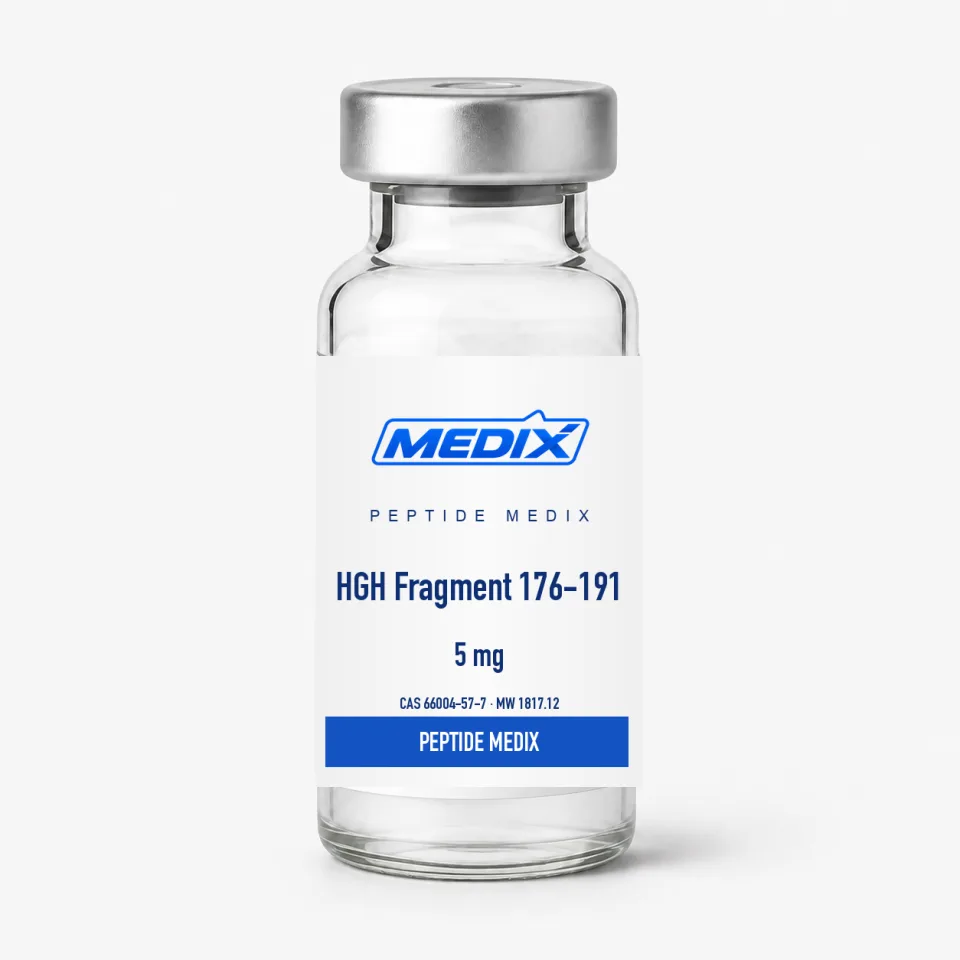
- FormLyophilized powder, sealed glass vial with flip-off seal
- Mol. weight1817.12 g/mol
- Research areasAdipocyte lipolysis, lipogenesis, growth hormone structure-function studies
Overview
HGH Fragment 176-191 is a synthetic 16-amino-acid peptide corresponding to the C-terminal segment of human growth hormone, numbered by its position in the parent hormone. Structure-function studies of growth hormone in the 1980s and 1990s indicated that the lipolytic activity of the hormone could be traced to this region, while the domains needed for growth hormone receptor dimerization and IGF-1 induction sit elsewhere in the molecule. Isolating the fragment gave researchers a way to test that separation directly.
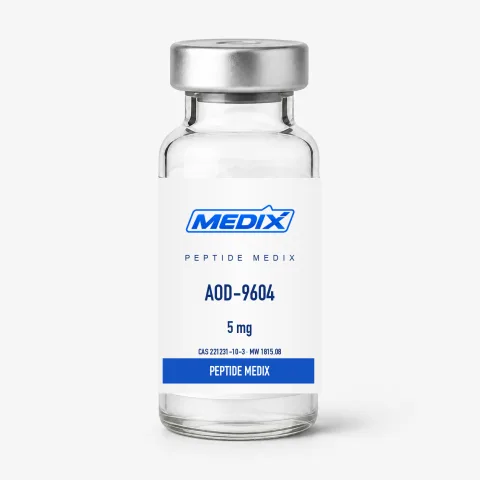
The fragment is the unmodified parent of AOD-9604, which adds an N-terminal tyrosine and a stabilizing disulfide bridge. Because the two differ in cyclization state, laboratories frequently run them in parallel to ask how conformation affects potency and stability. Reported research applications concentrate on adipocyte lipolysis and lipogenesis assays, adipose-depot studies in rodents, and structure-activity work on growth hormone fragments generally.
Specifications
Identity
- CAS number
- 66004-57-7
- Molecular formula
- C78H125N23O23S2
- Molecular weight
- 1817.12 g/mol
- Amino acid sequence
- Tyr-Leu-Arg-Ile-Val-Gln-Cys-Arg-Ser-Val-Glu-Gly-Ser-Cys-Gly-Phe
- Chain length
- 16 amino acids, hGH numbering 176-191
- Peptide class
- Growth hormone C-terminal fragment
Supply & purity
- Form
- Lyophilized powder, sealed glass vial with flip-off seal
- Purity
- ≥99% by HPLC; lot-matched COA available
- Available sizes
- 5 mg, 10 mg
- Solubility
- Bacteriostatic water; sterile water also reported
Handling & storage
- Storage (lyophilized)
- −20 °C, sealed and protected from light and moisture
- Storage (reconstituted)
- 2–8 °C, protected from light; use within the study window
Additional detail
- Research areas
- Adipocyte lipolysis, lipogenesis, growth hormone structure-function studies
Working out the concentration
Because HGH Fragment 176-191 arrives dry, its concentration is a decision rather than a specification. Run the numbers through the reconstitution calculator — vial mass in, diluent volume in, mg/mL and mass per syringe unit out.
For work specified in µM or nM rather than mg/mL, feed 1817.12 g/mol and your volume into the peptide molarity calculator.
Certificate of analysis
Every lot of HGH Fragment 176-191 is released against a certificate of analysis: the batch-specific laboratory data for that lot, not a generic document for the compound. The lot number on the certificate matches the lot number printed on the label you receive — the vial label itself, where the product is vialled — so the record and the material it describes can always be reconciled.
Purity: ≥99% by HPLC — the specification for this listing. The figure for the lot you receive is the one reported on that lot’s certificate.
No lot certificate is on display on this page at the moment. That is a publishing state and not a testing one: lots are released and documented as described above whether or not the document is posted here, and we will send what exists for the lot in stock, or for a lot already on your bench, by its number.
Certificates are available on request before you order as well as after, with no account and no charge. Request the certificate for this listing, read the testing and documentation policy in full, or see how to read a peptide COA.
Questions about HGH Fragment 176-191
What is the difference between this and AOD-9604?
AOD-9604 is this same C-terminal segment with an added N-terminal tyrosine and a Cys7-Cys15 disulfide bridge that locks it into a cyclic conformation. The unmodified fragment is linear, which is reflected in its different molecular formula and chromatographic behavior.
What purity and documentation do you supply?
Every lot is tested by HPLC to at least 99% purity with identity confirmed by mass spectrometry, and a lot-matched certificate of analysis is available. The COA corresponds to the vial number you receive, so purity data stays traceable to that material.
Why does the name use residue numbers?
The numbers refer to positions 176 through 191 of the 191-residue human growth hormone chain. Naming the fragment by its coordinates makes clear which part of the parent hormone the sequence reproduces.
Does it need special handling because of the cysteines?
Yes. The two cysteine residues can oxidize or scramble in solution, so keep exposure to air brief, avoid buffers with free thiols and store reconstituted material cold and dark. Confirming identity by mass spectrometry before a long study is good practice.
How should it be stored?
Keep the sealed lyophilized vial at −20 °C, protected from light and moisture. After reconstitution, refrigerate at 2–8 °C, protect from light and use within your documented study window. Prepare single-use aliquots to avoid freeze-thaw cycles.
Related