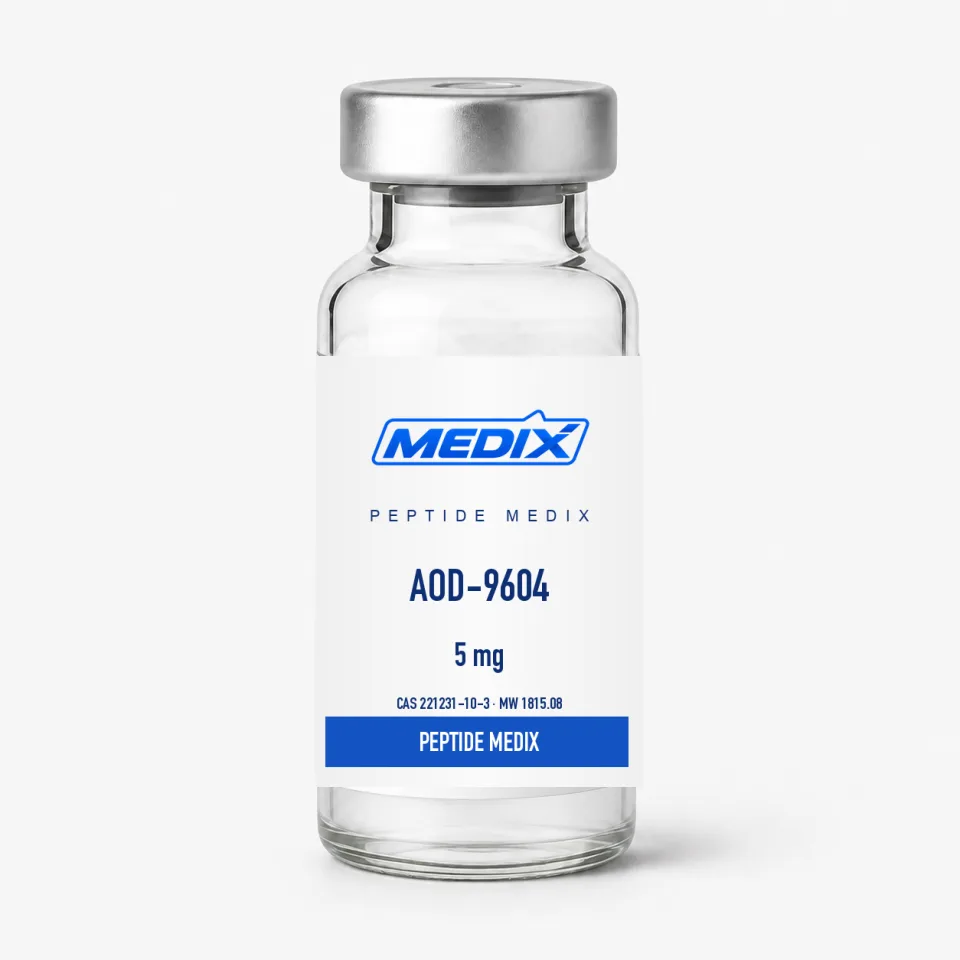
- ≥99% by HPLC
- Lot-matched certificate of analysis
- Ships next business day, tracked
AOD-9604 Peptide
Modified hGH 176-191 fragment peptide for lipolysis research
- FormLyophilized powder, sealed glass vial with flip-off seal
- Mol. weight1815.08 g/mol
- Research areasAdipocyte lipolysis, lipogenesis inhibition, metabolic signaling independent of GH receptor
Overview
AOD-9604 is a 16-residue synthetic peptide derived from the C-terminal region of human growth hormone. It reproduces the hGH 177-191 fragment with an added N-terminal tyrosine and retains the intramolecular disulfide bridge between the two cysteine residues, which holds the fragment in the loop conformation associated with its reported activity. The segment was isolated because the lipolytic region of growth hormone appears to be structurally separable from the domains that drive receptor-mediated growth signaling.
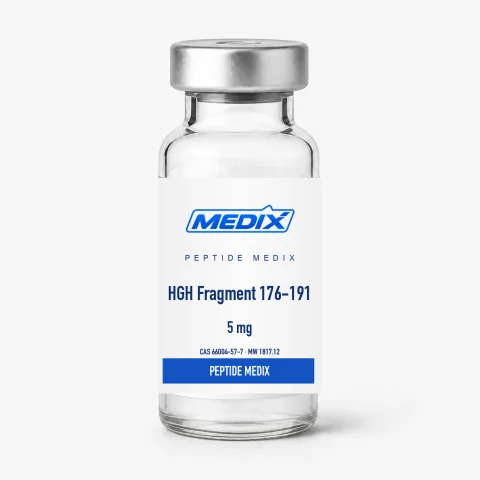
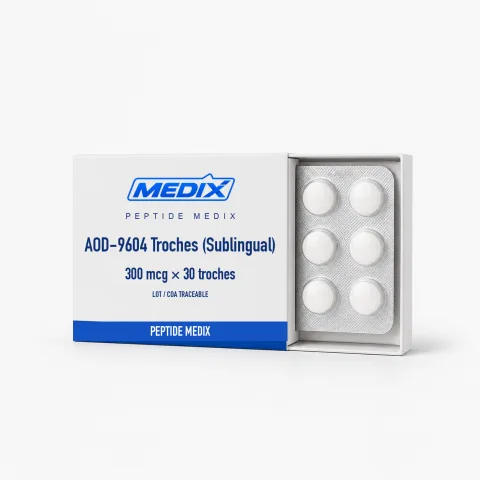
Research interest rests on the proposition that this segment can be examined separately from growth hormone's receptor-mediated effects. Work in adipocyte and adipose-tissue preparations measures lipolytic rate, lipogenic enzyme activity and interaction with beta-adrenergic stimulation, and rodent studies have looked at fat mass without the IGF-1 response that accompanies intact growth hormone. Three listings here cover the same region of the hormone and are not interchangeable: HGH Fragment 176-191 is the unmodified sequence, AOD-9604 adds the N-terminal tyrosine and the Cys7-Cys15 bridge, which changes both the molecular formula and the reversed-phase retention, and the sublingual troche presents the cyclised form by a different route. Vials are 5 mg and 10 mg, and reducing agents in a buffer will open the disulfide.
Specifications
Identity
- CAS number
- 221231-10-3
- Molecular formula
- C78H123N23O23S2
- Molecular weight
- 1815.08 g/mol
- Amino acid sequence
- Tyr-Leu-Arg-Ile-Val-Gln-Cys-Arg-Ser-Val-Glu-Gly-Ser-Cys-Gly-Phe
- Peptide class
- Growth hormone C-terminal fragment analog (hGH 176-191 series)
Supply & purity
- Form
- Lyophilized powder, sealed glass vial with flip-off seal
- Purity
- ≥99% by HPLC; lot-matched COA available
- Available sizes
- 5 mg, 10 mg
- Solubility
- Bacteriostatic water; sterile water and dilute acetic acid also reported
Handling & storage
- Storage (lyophilized)
- −20 °C, sealed and protected from light and moisture
- Storage (reconstituted)
- 2–8 °C, protected from light; use within the study window
Additional detail
- Disulfide bridge
- Cys7-Cys15, cyclized
- Research areas
- Adipocyte lipolysis, lipogenesis inhibition, metabolic signaling independent of GH receptor
Working out the concentration
The vial sizes above — 5 mg, 10 mg — describe a mass of material, not a strength. Choose a diluent volume, work it out with the reconstitution calculator, and you have the concentration for your own vial of AOD-9604 plus the volume that carries any mass you want to withdraw.
Where a method is written in molar terms instead, the molecular weight above — 1815.08 g/mol — is the input the molarity calculator needs.
Certificate of analysis
Every lot of AOD-9604 is released against a certificate of analysis: the batch-specific laboratory data for that lot, not a generic document for the compound. The lot number on the certificate matches the lot number printed on the label you receive — the vial label itself, where the product is vialled — so the record and the material it describes can always be reconciled.
Purity: ≥99% by HPLC — the specification for this listing. The figure for the lot you receive is the one reported on that lot’s certificate.
No lot certificate is on display on this page at the moment. That is a publishing state and not a testing one: lots are released and documented as described above whether or not the document is posted here, and we will send what exists for the lot in stock, or for a lot already on your bench, by its number.
Certificates are available on request before you order as well as after, with no account and no charge. Request the certificate for this listing, read the testing and documentation policy in full, or see how to read a peptide COA.
Questions about AOD-9604
How is AOD-9604 different from HGH Fragment 176-191?
They share the same core C-terminal growth hormone segment, but AOD-9604 is the cyclized, tyrosine-modified version with a Cys7-Cys15 disulfide bridge. That difference shows up in the molecular formula and in reversed-phase retention, and laboratories often compare the two directly.
What purity and documentation are supplied?
Every lot is HPLC tested to at least 99% purity with identity confirmed by mass spectrometry, and a lot-matched certificate of analysis is available. The COA is tied to the vial number shipped so purity data traces to your material.
Why avoid reducing agents?
The disulfide bridge between Cys7 and Cys15 holds the fragment in its cyclic conformation. Reducing agents in a buffer will open that bridge and produce a linear species with different chromatographic and biological behavior, which confounds assay results.
How should it be stored?
Store the sealed lyophilized vial at −20 °C, protected from light and moisture. After reconstitution, refrigerate at 2–8 °C, protect from light and use within your documented study window. Prepare aliquots to avoid repeated freeze-thaw cycles.
Related