- Lot-matched certificate of analysis
- Ships next business day, tracked
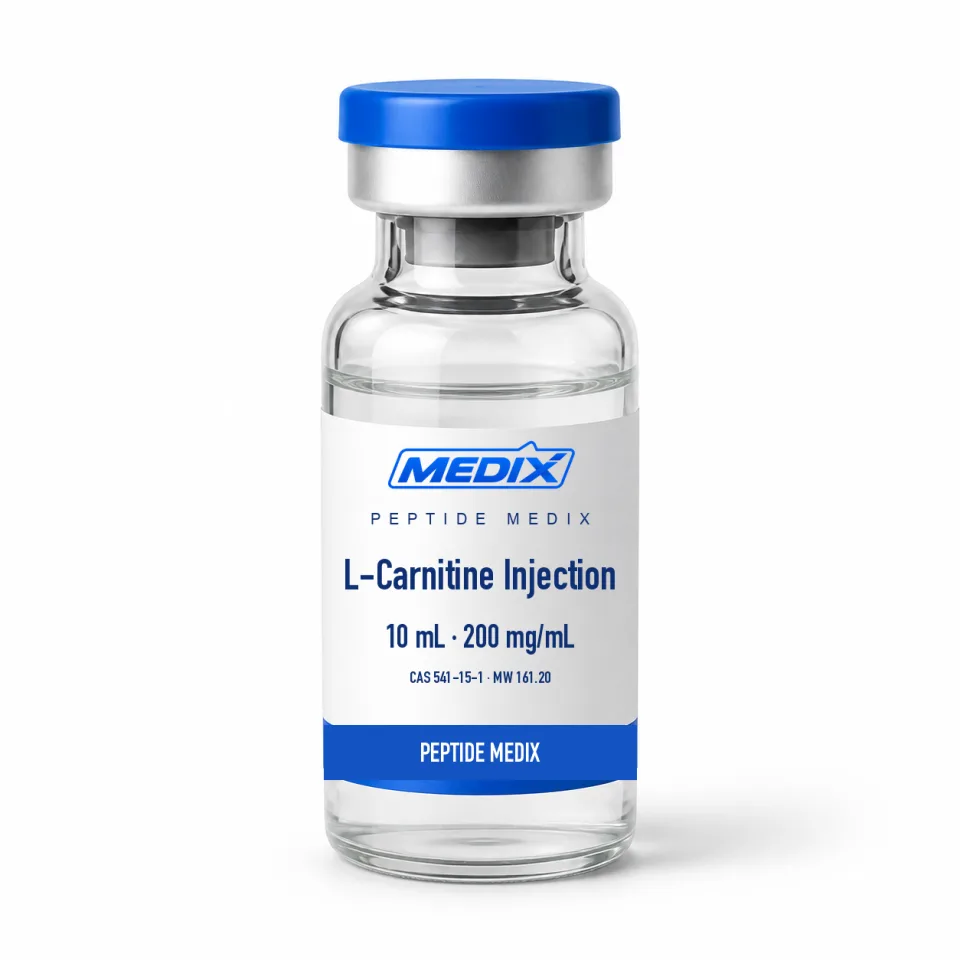
L-Carnitine Injection
Levocarnitine 200 mg/mL solution for mitochondrial fatty-acid transport research
- Mol. weight161.20 g/mol
- Research areasFatty-acid beta-oxidation, acylcarnitine profiling, mitochondrial bioenergetics, exercise-metabolism models
Overview
L-carnitine is a small quaternary ammonium compound synthesised in the body from lysine and methionine, with a hydroxyl and a carboxylate group that let it form reversible esters with fatty acyl groups. That single chemical trick is the basis of the carnitine shuttle: long-chain fatty acids cannot cross the inner mitochondrial membrane as CoA thioesters, so carnitine palmitoyltransferase 1 transfers the acyl group to carnitine, a translocase carries the acylcarnitine across, and CPT2 hands it back to coenzyme A for beta-oxidation. Only the L-enantiomer is biologically active; the D-form is an inhibitor and is not used in research preparations.
This listing is a ready-mixed aqueous solution of levocarnitine at 200 mg/mL, supplied in 10 mL and 30 mL sealed vials. The solution format removes weighing and dissolution steps for laboratories running metabolic, mitochondrial or acylcarnitine-profiling work, and it is the same concentration convention used in the compounded lipotropic preparations that combine carnitine with MIC nutrients and B12.
Specifications
Identity
- CAS number
- 541-15-1 (L-carnitine)
- Molecular formula
- C7H15NO3
- Molecular weight
- 161.20 g/mol
Supply & purity
- Available sizes
- 10 mL (2 g total), 30 mL (6 g total)
- Solubility
- Freely water soluble; the solid is strongly hygroscopic
Additional detail
- Concentration
- 200 mg/mL levocarnitine
- Chemical class
- Quaternary ammonium betaine; zwitterionic at physiological pH
- Stereochemistry
- L-enantiomer only — the D-form is biologically inactive
- Biochemical role
- Acyl-group carrier in the CPT1 / CACT / CPT2 mitochondrial shuttle
- Research areas
- Fatty-acid beta-oxidation, acylcarnitine profiling, mitochondrial bioenergetics, exercise-metabolism models
- Storage
- 15–25 °C, protected from light; refrigeration acceptable, do not freeze
- Documentation
- Lot-matched COA reporting identity and concentration
Units and conversions
This is a pre-mixed presentation: the strength is fixed at fill, and the only arithmetic between the label and the bench is a change of units. The peptide unit converter moves between mg, mcg, mL and µL without the decimal-point slip that costs a whole run.
Certificate of analysis
Every lot of L-Carnitine Injection is released against its own lot documentation, and where the manufacturer issues a certificate of analysis for it, that certificate is the record for the lot rather than a generic document for the compound. The lot number on the certificate matches the lot number printed on the label you receive — the vial label itself, where the product is vialled — so the record and the material it describes can always be reconciled.
This listing carries no purity percentage, so none is claimed for it here. Where the manufacturer issues analytical documentation for a lot of this item, it is passed on unaltered — ask and we will send whatever exists.
No lot certificate is on display on this page at the moment. That is a publishing state and not a testing one: lots are released and documented as described above whether or not the document is posted here, and we will send what exists for the lot in stock, or for a lot already on your bench, by its number.
Certificates are available on request before you order as well as after, with no account and no charge. Request the certificate for this listing, read the testing and documentation policy in full, or see how to read a peptide COA.
Questions about L-Carnitine Injection
What concentration and volumes are supplied?
Both sizes are 200 mg/mL levocarnitine in aqueous solution: a 10 mL vial containing 2 g total and a 30 mL vial containing 6 g total. The concentration is verified per lot and reported on the certificate of analysis supplied with the batch.
Why solution rather than powder?
Solid L-carnitine is strongly hygroscopic and picks up atmospheric moisture during weighing, which introduces a concentration error into every downstream dilution. A pre-mixed, lot-verified solution removes that variable and saves a preparation step in metabolic assay work.
Is a certificate of analysis available?
Yes. Each lot ships with a matching COA reporting identity and measured concentration. Quote the lot number when requesting a copy, and file it with your records so material grade can be reported alongside experimental results.
How does L-carnitine relate to Lipo-C?
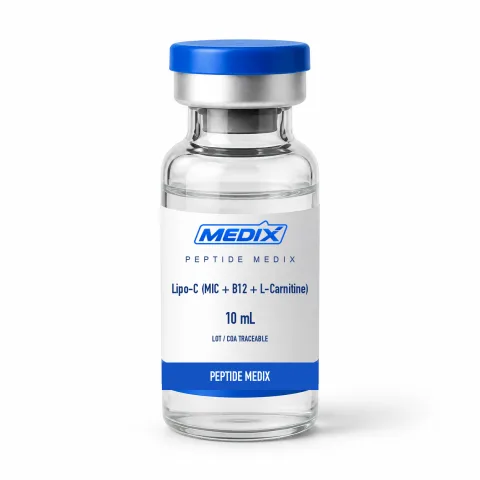
Lipo-C is a compounded lipotropic solution combining methionine, inositol and choline with vitamin B12 and L-carnitine. This listing is the single compound on its own, which is the format laboratories prefer when carnitine itself is the variable being studied rather than a mixture.
Can this be administered to people or animals?
No. It is supplied strictly for laboratory research use. It is not a drug, supplement or veterinary product as sold.
Related