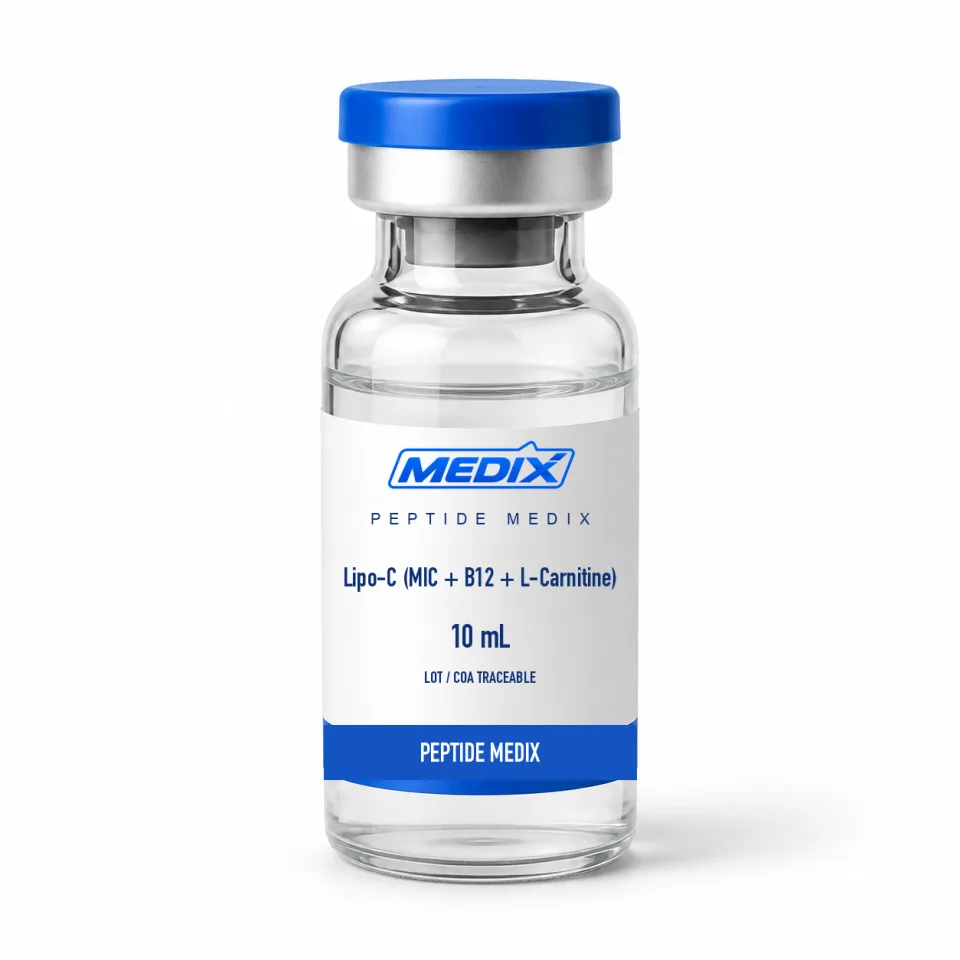
- Lot-matched certificate of analysis
- Ships next business day, tracked
Lipo-C (MIC + B12 + L-Carnitine)
MIC, vitamin B12 and L-carnitine lipotropic solution in 10 mL and 30 mL vials
- Research areasFatty-acid oxidation, mitochondrial substrate transport, one-carbon metabolism
Overview
L-carnitine is the component that changes the biochemical profile of the mixture. It is the obligatory carrier in the carnitine shuttle: carnitine palmitoyltransferase 1 on the outer mitochondrial membrane converts long-chain acyl-CoA to acylcarnitine, a translocase moves it across the inner membrane, and CPT2 regenerates acyl-CoA inside the matrix for beta-oxidation. Without that shuttle, long-chain fatty acids cannot reach the site where they are oxidized, which places carnitine at a genuine rate-influencing step rather than a peripheral one.
Around the carnitine sits the same methyl-donor base as the Lipo-B listing: methionine feeding S-adenosylmethionine, choline required for phosphatidylcholine and so for hepatic triglyceride export, inositol as the backbone of the phosphatidylinositol signalling lipids, and cyanocobalamin as cofactor precursor for methionine synthase. Carnitine is chemically unlike all four — a small zwitterionic quaternary ammonium compound, neither an amino acid nor a vitamin — which is why the two formulations are usually run as parallel arms rather than treated as two strengths of one product. Both fills, 10 mL and 30 mL, hold the same solution. The deep pink colour comes from the cobalamin, which is photosensitive, so visible fading is a usable indicator that a vial has been stored in the light.
Specifications
Supply & purity
- Available sizes
- 10 mL, 30 mL
Additional detail
- Composition
- Methionine, inositol, choline (MIC), cyanocobalamin (vitamin B12) and L-carnitine
- Product class
- Lipotropic nutrient solution with carnitine (non-peptide)
- Appearance
- Clear deep pink to red solution; colour derives from cobalamin
- L-carnitine
- Quaternary ammonium compound; carrier in the CPT1/CPT2 mitochondrial fatty-acid shuttle
- Methionine
- Essential sulfur amino acid; precursor of S-adenosylmethionine
- Inositol
- Carbocyclic sugar; backbone of phosphatidylinositol signaling lipids
- Choline
- Quaternary ammonium nutrient; required for phosphatidylcholine synthesis
- Cyanocobalamin
- Cobalt corrinoid form of vitamin B12; cofactor precursor for methionine synthase
- Research areas
- Fatty-acid oxidation, mitochondrial substrate transport, one-carbon metabolism
- Storage
- 2–8 °C, protected from light; cobalamin is photosensitive
Units and conversions
Lipo-C (MIC + B12 + L-Carnitine) arrives already made up, so there is no diluent volume to choose and no reconstitution step. What is left is unit work — percent to mg/mL, milligrams to micrograms, millilitres to microlitres — and the mcg to mg converter does all three.
Certificate of analysis
Every lot of Lipo-C (MIC + B12 + L-Carnitine) is released against its own lot documentation, and where the manufacturer issues a certificate of analysis for it, that certificate is the record for the lot rather than a generic document for the compound. The lot number on the certificate matches the lot number printed on the label you receive — the vial label itself, where the product is vialled — so the record and the material it describes can always be reconciled.
This listing carries no purity percentage, so none is claimed for it here. Where the manufacturer issues analytical documentation for a lot of this item, it is passed on unaltered — ask and we will send whatever exists.
No lot certificate is on display on this page at the moment. That is a publishing state and not a testing one: lots are released and documented as described above whether or not the document is posted here, and we will send what exists for the lot in stock, or for a lot already on your bench, by its number.
Certificates are available on request before you order as well as after, with no account and no charge. Request the certificate for this listing, read the testing and documentation policy in full, or see how to read a peptide COA.
Questions about Lipo-C (MIC + B12 + L-Carnitine)
What does Lipo-C add over Lipo-B?
L-carnitine. Lipo-B contains methionine, inositol, choline and vitamin B12; Lipo-C adds carnitine, the carrier that moves long-chain fatty acids across the inner mitochondrial membrane so they can be oxidized.
Why is carnitine mechanistically interesting?
It sits at an obligatory step. Long-chain acyl-CoA cannot enter mitochondria without conversion to acylcarnitine by CPT1, and CPT1 is itself inhibited by malonyl-CoA, which ties fatty-acid oxidation to the fed and fasted state of the cell.
Does adding carnitine always increase fat oxidation?
Not necessarily. In carnitine-deficient systems the effect is clear, but in tissue with adequate carnitine the shuttle is usually not rate-limiting. Careful studies measure baseline carnitine and acylcarnitine profiles before interpreting any change.
How should it be stored?
Refrigerate at 2–8 °C, protected from light, and do not freeze. The cobalamin component is photosensitive, so keep the vial in its carton or a dark container and note the date the vial was first entered.
Related