- Purity (active): ≥99% by HPLC before compounding
- Lot-matched certificate of analysis
- Ships next business day, tracked
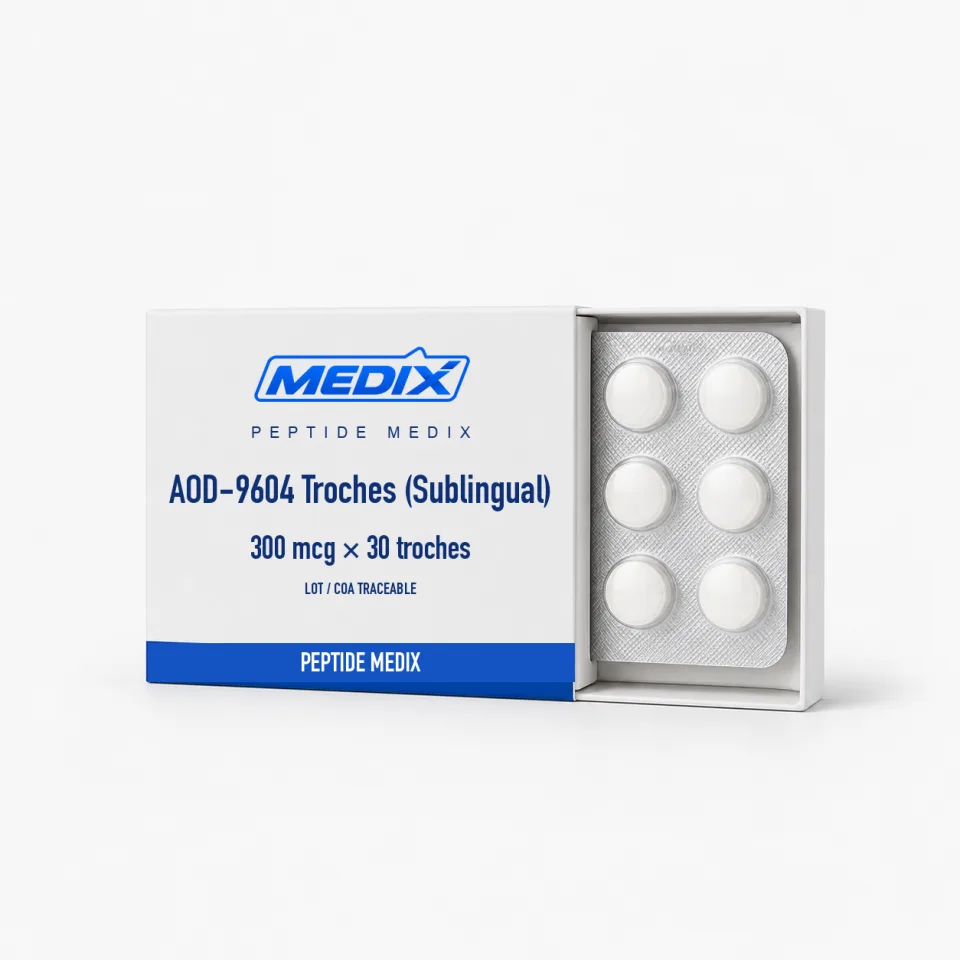
AOD-9604 Troches (Sublingual)
Sublingual troche format of the modified hGH 176-191 fragment peptide
- FormSublingual troche in a dissolvable compounding base
- Research areasTransmucosal peptide delivery, formulation stability, adipocyte lipolysis models
Overview
This product supplies AOD-9604 in a sublingual troche format rather than as a lyophilized powder for reconstitution. Each troche contains 300 mcg of the peptide in a soft dissolvable base designed to release its contents against oral mucosa as it melts, and the bottle holds 30 troches. The active compound is identical to our vialed AOD-9604: a 16-residue analog of the human growth hormone C-terminal region, carrying an added N-terminal tyrosine and a Cys7-Cys15 disulfide bridge.
The reason a troche format exists in research settings is that transmucosal delivery is itself a research question. Peptides of this size cross oral mucosa poorly and are vulnerable to proteolysis in saliva, so studies of buccal and sublingual absorption use troche formats to measure how much peptide survives, how formulation base and residence time affect that fraction, and how mucosal delivery compares with parenteral routes in animal models.
Specifications
Identity
- Amino acid sequence
- Tyr-Leu-Arg-Ile-Val-Gln-Cys-Arg-Ser-Val-Glu-Gly-Ser-Cys-Gly-Phe, Cys7-Cys15 disulfide
Supply & purity
- Form
- Sublingual troche in a dissolvable compounding base
Additional detail
- Peptide content
- 300 mcg AOD-9604 per troche
- Available size
- 30 troches
- Active component
- AOD-9604, modified human growth hormone fragment 176-191
- CAS number (active)
- 221231-10-3
- Molecular formula (active)
- C78H123N23O23S2
- Molecular weight (active)
- 1815.08 g/mol
- Purity (active)
- ≥99% by HPLC before compounding; COA available
- Research areas
- Transmucosal peptide delivery, formulation stability, adipocyte lipolysis models
- Storage
- Cool, dry and dark; avoid heat, which softens the troche base
Units and conversions
Capsule and troche strengths are stated per unit, so the figure a method needs is usually a conversion rather than a dilution. The mcg to mg converter handles the milligram-to-microgram step, and the millilitre arithmetic if you are working from a solution format instead.
Certificate of analysis
Every lot of AOD-9604 Troches (Sublingual) is released against a certificate of analysis: the batch-specific laboratory data for that lot, not a generic document for the compound. The lot number on the certificate matches the lot number printed on the label you receive — the vial label itself, where the product is vialled — so the record and the material it describes can always be reconciled.
Purity (active): ≥99% by HPLC before compounding — the specification for this listing. The figure for the lot you receive is the one reported on that lot’s certificate.
No lot certificate is on display on this page at the moment. That is a publishing state and not a testing one: lots are released and documented as described above whether or not the document is posted here, and we will send what exists for the lot in stock, or for a lot already on your bench, by its number.
Certificates are available on request before you order as well as after, with no account and no charge. Request the certificate for this listing, read the testing and documentation policy in full, or see how to read a peptide COA.
Questions about AOD-9604 Troches (Sublingual)
How does this differ from the AOD-9604 vial?
The active peptide is identical. The difference is format: this product is a 300 mcg sublingual troche in a dissolvable base, while the vial is a lyophilized powder that a laboratory reconstitutes itself. The troche format exists for transmucosal delivery research.
How much peptide actually crosses the mucosa?
That is the research question rather than a settled figure. Peptides in this molecular-weight range generally show modest transmucosal permeation, and measuring the fraction that crosses under given formulation conditions is precisely what troche-format studies are designed to establish.
What documentation is available?
A certificate of analysis covering the peptide content is available for the supplied lot. The active material is HPLC tested to at least 99% purity before compounding, and keeping the COA with your record maintains traceability.
Why does storage temperature matter so much?
The troche base softens with heat and takes up moisture from air, both of which deform the article and accelerate peptide degradation. Cool, dry and dark storage in a closed container keeps the formulation physically and chemically stable over its working window.
Can the troches be dissolved for other assays?
Laboratories do extract peptide from compounded formats for analysis, but excipients in the base can interfere with chromatography and with some assay chemistries. Extraction and clean-up should be validated before quantitative work rather than assumed.
Related