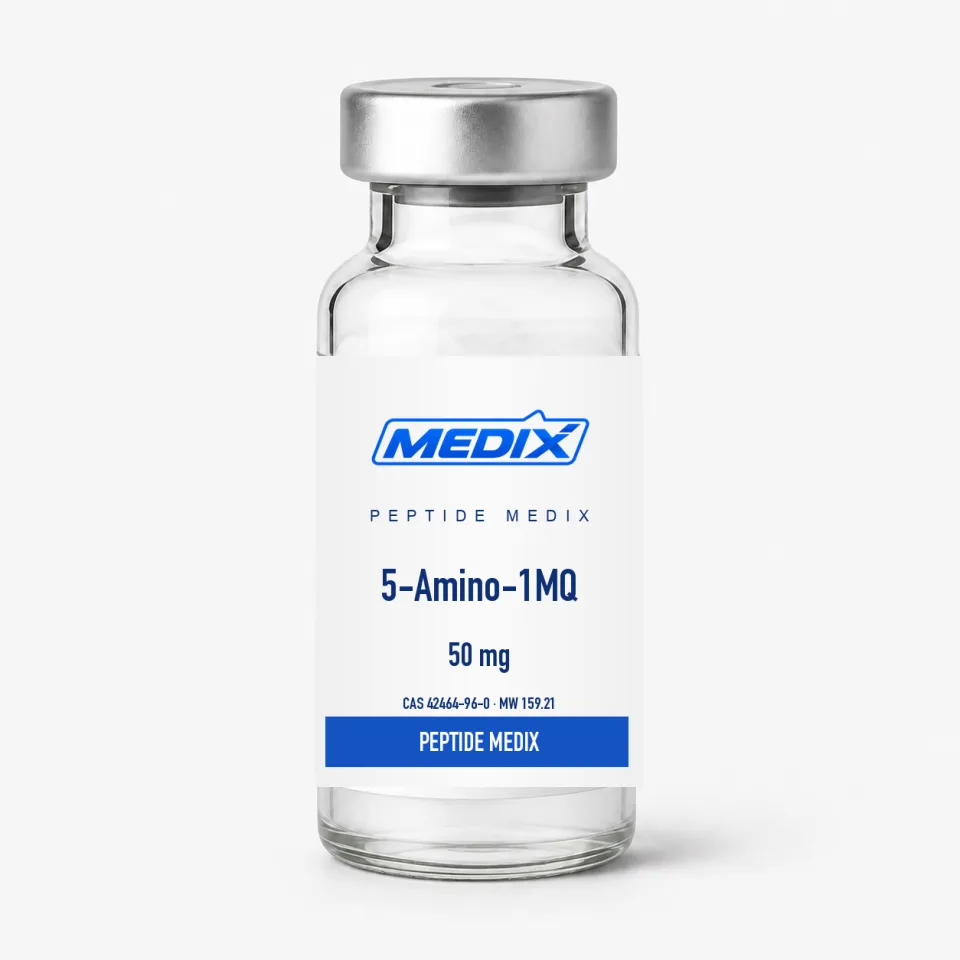
- ≥99% by HPLC
- Lot-matched certificate of analysis
- Ships next business day, tracked
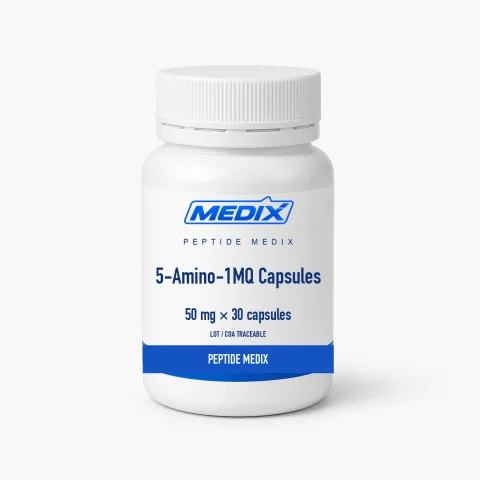
5-Amino-1MQ
Small-molecule NNMT inhibitor for adipocyte and NAD metabolism research
- FormLyophilized powder, sealed glass vial with flip-off seal
- Mol. weight159.21 g/mol (cation); 286.11 g/mol (iodide salt)
- Research areasAdipocyte metabolism, NAD-plus salvage, sirtuin signaling, methyl-donor flux
Overview
5-Amino-1MQ is a small-molecule inhibitor of nicotinamide N-methyltransferase (NNMT), not a peptide. NNMT transfers a methyl group from S-adenosylmethionine to nicotinamide, producing 1-methylnicotinamide and consuming both a methyl donor and a precursor that would otherwise feed NAD-plus salvage. Because the enzyme is markedly overexpressed in adipose tissue in obesity models, blocking it became an obvious way to test whether that methylation flux is a driver of metabolic slowdown or merely a marker of it.
The compound is a quinolinium species, supplied as its iodide salt, and the permanently charged cationic core is the feature that shapes how researchers use it. Published work has centered on adipocyte cultures, where investigators measure intracellular NAD-plus, sirtuin activity, lipolysis and mitochondrial function after NNMT inhibition, and on rodent diet-induced obesity models examining fat-pad mass and metabolic markers. It is also used as a chemical probe when NNMT's role in a given tissue is uncertain.
Specifications
Identity
- CAS number
- 42464-96-0
- Molecular formula
- C10H11N2+ cation, supplied as the iodide salt C10H11IN2
- Molecular weight
- 159.21 g/mol (cation); 286.11 g/mol (iodide salt)
Supply & purity
- Form
- Lyophilized powder, sealed glass vial with flip-off seal
- Purity
- ≥99% by HPLC; lot-matched COA available
- Available sizes
- 50 mg, 100 mg
- Solubility
- Water and bacteriostatic water; DMSO used for concentrated stocks in cell assays
Additional detail
- Compound class
- Small-molecule quinolinium NNMT inhibitor
- Molecular target
- Nicotinamide N-methyltransferase (NNMT)
- Research areas
- Adipocyte metabolism, NAD-plus salvage, sirtuin signaling, methyl-donor flux
- Storage (solid)
- −20 °C, sealed and protected from light and moisture
- Storage (in solution)
- 2–8 °C, protected from light; use within the study window
Working out the concentration
Because 5-Amino-1MQ arrives dry, its concentration is a decision rather than a specification. Run the numbers through the reconstitution calculator — vial mass in, diluent volume in, mg/mL and mass per syringe unit out.
Where a method is written in molar terms instead, the molecular weight above — 159.21 g/mol (cation) — is the input the molarity calculator needs.
Certificate of analysis
Every lot of 5-Amino-1MQ is released against a certificate of analysis: the batch-specific laboratory data for that lot, not a generic document for the compound. The lot number on the certificate matches the lot number printed on the label you receive — the vial label itself, where the product is vialled — so the record and the material it describes can always be reconciled.
Purity: ≥99% by HPLC — the specification for this listing. The figure for the lot you receive is the one reported on that lot’s certificate.
No lot certificate is on display on this page at the moment. That is a publishing state and not a testing one: lots are released and documented as described above whether or not the document is posted here, and we will send what exists for the lot in stock, or for a lot already on your bench, by its number.
Certificates are available on request before you order as well as after, with no account and no charge. Request the certificate for this listing, read the testing and documentation policy in full, or see how to read a peptide COA.
Questions about 5-Amino-1MQ
Is 5-Amino-1MQ a peptide?
No. It is a small-molecule quinolinium compound that inhibits the enzyme NNMT. It is grouped with metabolic research compounds because of its research context, but chemically it has nothing in common with the peptides in this catalog.
Why are two molecular weights listed?
The active species is the quinolinium cation at 159.21 g/mol, but the material is supplied as the iodide salt at 286.11 g/mol. Calculations should account for salt mass, which is why both figures appear on the specification.
What purity and documentation do you provide?
Every lot is HPLC tested to at least 99% purity, and a lot-matched certificate of analysis is available. The COA corresponds to the specific vial number shipped so analytical data remains traceable to the material used in your work.
How is target engagement confirmed in research?
Investigators typically measure the reaction product 1-methylnicotinamide, or use genetic knockdown of NNMT as a parallel comparison. Downstream readouts such as NAD-plus levels or lipolysis alone do not establish that the enzyme itself was inhibited.
How should it be stored?
Keep the sealed solid at −20 °C, protected from light and moisture. Solutions should be refrigerated at 2–8 °C, protected from light and used within your documented study window. Aliquot stocks so they are not repeatedly warmed.
Related