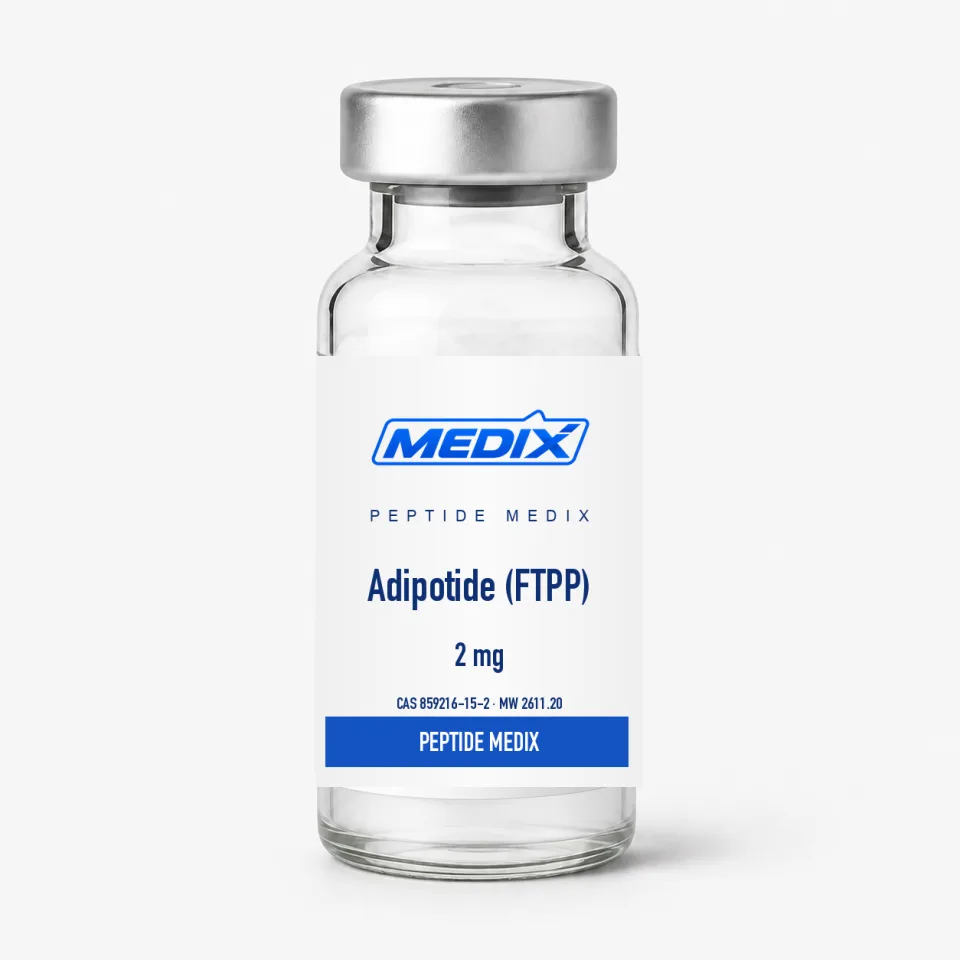
- ≥99% by HPLC
- Lot-matched certificate of analysis
- Ships next business day, tracked
Adipotide (FTPP) Peptide
Peptidomimetic FTPP conjugate studied in adipose-vasculature targeting models
- FormLyophilized powder in a sealed glass vial
- Mol. weight≈2611.20 g/mol (trifluoroacetate salt content varies by lot)
- Research areasAdipose vascular targeting, ligand-directed peptide delivery, prohibitin biology, tumour-homing constructs
Overview
Adipotide, also written FTPP (fat-targeted proapoptotic peptide), is a synthetic peptidomimetic built from two functional halves joined into a single molecule. One half is a cyclic nine-residue homing motif, CKGGRAKDC, identified by phage-display screening as a binder of a prohibitin-1 / annexin A2 complex reported on the endothelium of white adipose tissue. The other half is D(KLAKLAK)2, an amphipathic sequence assembled from D-amino acids that disrupts mitochondrial membranes once it reaches the inside of a cell. The design intent described in the literature is address-plus-payload: the homing motif supplies vascular selectivity, the effector domain supplies the activity.
The effector half is worth understanding on its own terms. D(KLAKLAK)2 is an amphipathic sequence built entirely from D-amino acids, which makes it protease-resistant while leaving its activity intact, because membrane disruption depends on the amphipathic helix rather than on a stereospecific receptor contact; it is comparatively inactive outside cells and acts once internalised, which is what makes it usable as a payload. Published work with the conjugate spans phage-display mapping of the homing motif, prohibitin biology, and rodent models of adipose vascular targeting, alongside the wider tumour-homing literature the same design strategy came from. Fills are 2 mg and 5 mg, and the stated mass near 2611 g/mol shifts with trifluoroacetate content, which varies by lot and bears on any molar calculation.
Specifications
Identity
- CAS number
- 859216-15-2
- Molecular weight
- ≈2611.20 g/mol (trifluoroacetate salt content varies by lot)
Supply & purity
- Form
- Lyophilized powder in a sealed glass vial
- Purity
- ≥99% by HPLC; lot-matched COA available
- Available sizes
- 2 mg, 5 mg
- Solubility
- Sterile or bacteriostatic water; dilute buffers are commonly used for working solutions
Handling & storage
- Storage (lyophilized)
- −20 °C, sealed and protected from light and moisture
- Storage (reconstituted)
- 2–8 °C for short-term use; aliquot and freeze at −20 °C for longer holds
Additional detail
- Construct
- CKGGRAKDC-GG-D(KLAKLAK)2 — cyclic homing motif joined through a glycine linker to a pro-apoptotic domain
- Compound class
- Chimeric peptidomimetic (vascular-homing peptide plus membrane-disrupting effector)
- Homing motif
- CKGGRAKDC, reported to recognise a prohibitin-1 / annexin A2 complex on white adipose endothelium
- Effector domain
- D(KLAKLAK)2, an amphipathic D-amino acid sequence that perturbs mitochondrial membranes
- Research areas
- Adipose vascular targeting, ligand-directed peptide delivery, prohibitin biology, tumour-homing constructs
Working out the concentration
Reconstitution is where the arithmetic lives. The same vial made up with 1 mL or with 3 mL of diluent gives three-fold different numbers, which is why a reconstitution volume calculator is more use here than a fixed table: enter the vial mass and your diluent volume and read the concentration back.
For work specified in µM or nM rather than mg/mL, feed ≈2611.20 g/mol (trifluoroacetate salt content varies by lot) and your volume into the peptide molarity calculator.
Certificate of analysis
Every lot of Adipotide (FTPP) is released against a certificate of analysis: the batch-specific laboratory data for that lot, not a generic document for the compound. The lot number on the certificate matches the lot number printed on the label you receive — the vial label itself, where the product is vialled — so the record and the material it describes can always be reconciled.
Purity: ≥99% by HPLC — the specification for this listing. The figure for the lot you receive is the one reported on that lot’s certificate.
No lot certificate is on display on this page at the moment. That is a publishing state and not a testing one: lots are released and documented as described above whether or not the document is posted here, and we will send what exists for the lot in stock, or for a lot already on your bench, by its number.
Certificates are available on request before you order as well as after, with no account and no charge. Request the certificate for this listing, read the testing and documentation policy in full, or see how to read a peptide COA.
Questions about Adipotide (FTPP)
What is Adipotide (FTPP)?
It is a synthetic peptidomimetic that links a cyclic CKGGRAKDC homing motif to a D(KLAKLAK)2 membrane-disrupting domain. The design is described in the literature as a way to direct a cytotoxic effector toward the vasculature of white adipose tissue for experimental purposes.
Is Adipotide a GLP-1 or fat-loss peptide?
No. It does not act at the GLP-1 receptor and does not signal through lipolytic pathways. Its published rationale concerns vascular targeting via prohibitin, which makes it mechanistically unrelated to incretin analogues or growth-hormone fragments despite appearing in similar research categories.
What purity and documentation do you supply?
Every lot is purified to ≥99% by HPLC and released with a lot-matched certificate of analysis showing purity and identity data. Request the COA for your specific lot number and it will be sent as a PDF.
What sizes are available?
Adipotide is stocked as 2 mg and 5 mg lyophilized vials. Both are sealed glass vials shipped from a United States facility with the lot number printed on the label.
How should it be stored?
Keep the lyophilized powder at −20 °C, sealed and away from light and moisture. Once reconstituted, hold the solution at 2–8 °C for near-term work or aliquot and freeze at −20 °C so the material is not repeatedly thawed.
Can I buy Adipotide online for personal use?
No. This listing is a research reagent sold for laboratory use only. It is not a supplement, drug or cosmetic.
Related