- ≥99% by HPLC on both peptides
- Lot-matched certificate of analysis
- Ships next business day, tracked
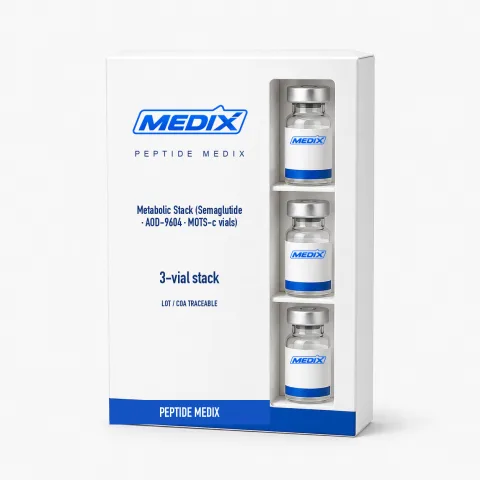
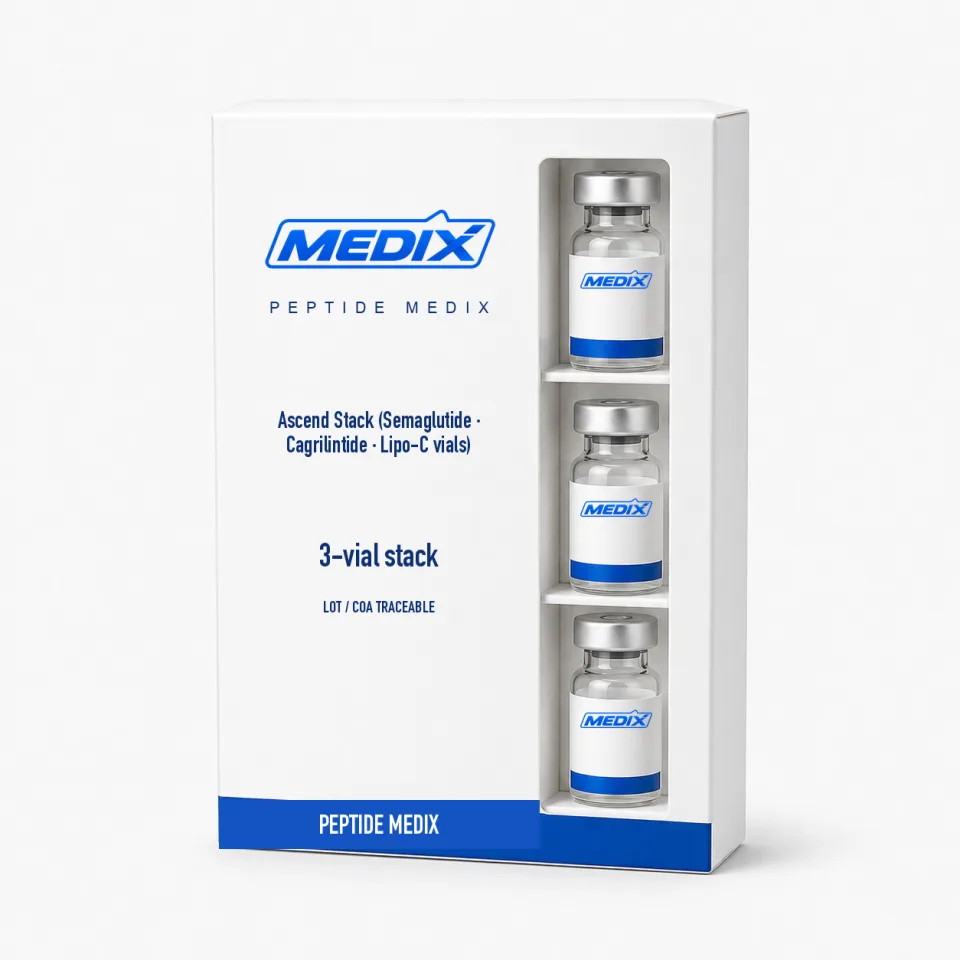
Ascend Stack (Semaglutide · Cagrilintide · Lipo-C vials)
Three-vial metabolic kit pairing semaglutide and cagrilintide with a Lipo-C solution
- FormLyophilized powder for the peptides; Lipo-C supplied as a liquid
- Research areasIncretin and amylin receptor signalling, lipid metabolism, energy balance models
Overview
The Ascend Stack combines two long-acting metabolic peptides with a lipotropic compounded solution, supplied as three separate vials. It is the only kit in this range that mixes formats: semaglutide and cagrilintide arrive as lyophilized powders requiring reconstitution, while Lipo-C is supplied as a ready-made liquid.
Semaglutide is an acylated GLP-1 receptor agonist carrying an aminoisobutyric acid substitution at position 8 to resist DPP-4 cleavage and a C18 fatty diacid side chain that binds serum albumin. Cagrilintide is a long-acting analogue of amylin, the pancreatic hormone co-secreted with insulin, engineered for solubility and stability where native amylin aggregates readily. Lipo-C is not a peptide at all: it is a lipotropic solution combining methionine, inositol and choline with cyanocobalamin and L-carnitine, and it is characterised as a formulation rather than by a single molecular weight or CAS number.
The two peptides are HPLC-assayed to ≥99% purity with individual lot-matched certificates of analysis; the Lipo-C solution is released against its own formulation specification. Because one component is a liquid and two are powders, separate supply is the only sensible format.
Specifications
Supply & purity
- Form
- Lyophilized powder for the peptides; Lipo-C supplied as a liquid
- Purity
- ≥99% by HPLC on both peptides; lot-matched COA for each
Additional detail
- Product type
- Multi-vial research kit — two lyophilized peptides plus one solution
- Kit contents
- One semaglutide vial, one cagrilintide vial, one Lipo-C solution vial
- Semaglutide
- CAS 910463-68-2 · C187H291N45O59 · 4113.58 g/mol
- Cagrilintide
- CAS 1415456-99-3 · C194H309N55O59S2 · 4409.07 g/mol
- Lipo-C composition
- Methionine, inositol and choline with cyanocobalamin and L-carnitine
- Semaglutide class
- Acylated GLP-1 receptor agonist, Aib substitution at position 8
- Cagrilintide class
- Long-acting amylin and calcitonin receptor agonist, 32 residues
- Research areas
- Incretin and amylin receptor signalling, lipid metabolism, energy balance models
- Reconstitution
- Peptide vials prepared separately; Lipo-C requires no reconstitution
- Storage (lyophilized peptides)
- −20 °C, protected from light and moisture
- Storage (Lipo-C solution)
- 2–8 °C, protected from light
Working out the concentration
Reconstitution is where the arithmetic lives. The same vial made up with 1 mL or with 3 mL of diluent gives three-fold different numbers, which is why a reconstitution volume calculator is more use here than a fixed table: enter the vial mass and your diluent volume and read the concentration back.
Certificate of analysis
Every lot of Ascend Stack (Semaglutide · Cagrilintide · Lipo-C vials) is released against a certificate of analysis: the batch-specific laboratory data for that lot, not a generic document for the compound. The lot number on the certificate matches the lot number printed on the label you receive — the vial label itself, where the product is vialled — so the record and the material it describes can always be reconciled.
Purity: ≥99% by HPLC on both peptides — the specification for this listing. The figure for the lot you receive is the one reported on that lot’s certificate.
No lot certificate is on display on this page at the moment. That is a publishing state and not a testing one: lots are released and documented as described above whether or not the document is posted here, and we will send what exists for the lot in stock, or for a lot already on your bench, by its number.
Certificates are available on request before you order as well as after, with no account and no charge. Request the certificate for this listing, read the testing and documentation policy in full, or see how to read a peptide COA.
Questions about Ascend Stack (Semaglutide · Cagrilintide · Lipo-C vials)
Why is one component supplied as a liquid?
Lipo-C is a compounded lipotropic solution rather than a lyophilized peptide, so it ships ready to use. The two peptides, semaglutide and cagrilintide, are supplied as powders because that is the stable form for large acylated peptides in storage.
What is actually in Lipo-C?
Methionine, inositol and choline — the classic lipotropic trio — combined with cyanocobalamin, a form of vitamin B12, and L-carnitine. It is characterised by its formulation specification rather than by a single CAS number or molecular weight, since it is a mixture.
Does each component have a certificate of analysis?
The two peptide vials are released with lot-matched COAs reporting HPLC identity and purity. The Lipo-C solution is released against its own formulation specification rather than a single-peptide purity assay, since it is a compounded mixture.
Why pair a GLP-1 agonist with an amylin analogue?
They act through separate receptor families that reach overlapping brain regions. Semaglutide engages the GLP-1 receptor; cagrilintide acts at amylin and calcitonin receptor complexes. Research designs examining both arms need a molecule from each, held in separate vials.
How should the Lipo-C solution be stored?
Refrigerated at 2 to 8 degrees Celsius and protected from light. The cyanocobalamin component is light-sensitive, which is why these solutions are typically supplied in amber or otherwise shielded containers and should not be left out on a bench.
Related