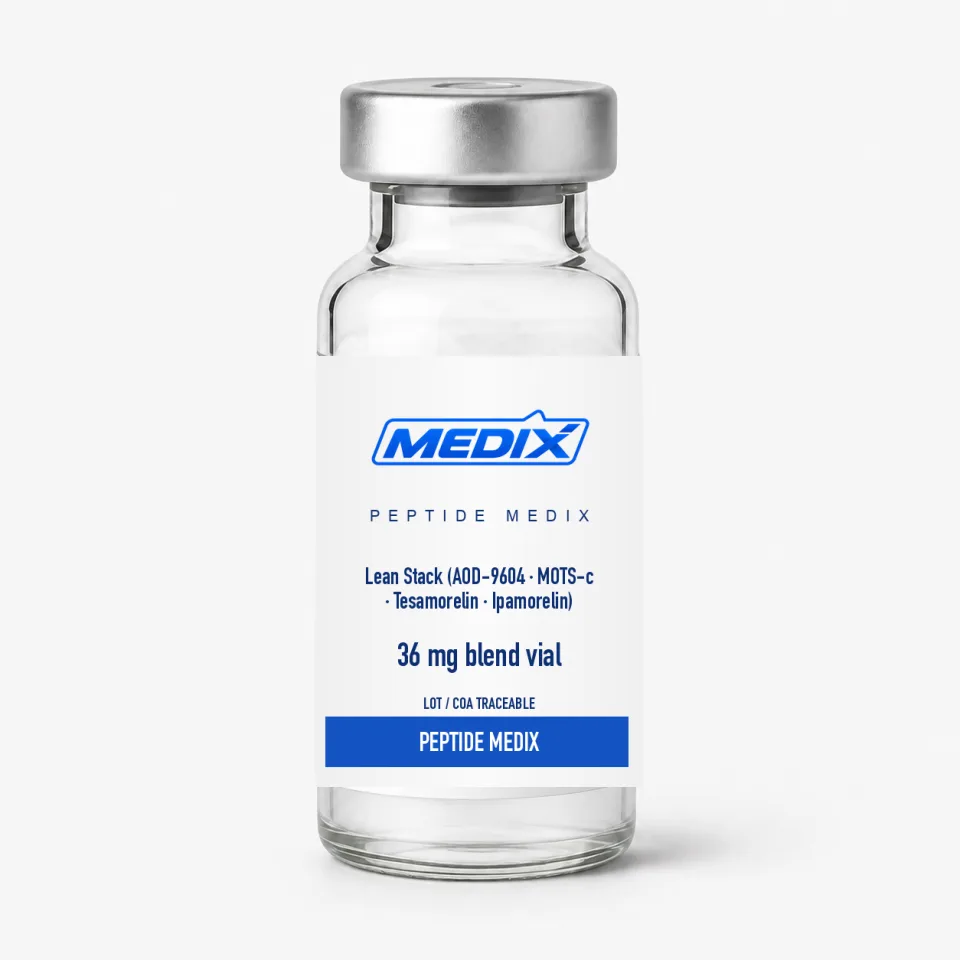
- ≥99% by HPLC per component
- Lot-matched certificate of analysis
- Ships next business day, tracked
Lean Stack (AOD-9604 · MOTS-c · Tesamorelin · Ipamorelin)
Four-peptide 36 mg vial: AOD-9604, MOTS-c, tesamorelin and ipamorelin
- FormLyophilized powder, sealed glass vial
- Research areasGH-axis signalling, mitochondrial metabolism, lipid and energy handling models
Overview
Lean Stack is a four-component research blend supplied in a single 36 mg lyophilized vial. It brings together two growth-hormone-axis peptides, one mitochondrial-derived peptide and one growth-hormone fragment analogue: tesamorelin and ipamorelin at 10 mg each, MOTS-c at 10 mg, and AOD-9604 at 6 mg.
The four are drawn from different families. Tesamorelin is a stabilised analogue of growth hormone-releasing hormone that acts at the GHRH receptor on the pituitary. Ipamorelin is a selective pentapeptide agonist at the ghrelin receptor, GHS-R1a, working through a separate secretagogue pathway. MOTS-c is a 16-residue peptide encoded within mitochondrial DNA and studied for its relationship to AMPK signalling. AOD-9604 is a modified fragment of the human growth hormone C-terminal region, investigated independently of the receptor-mediated growth hormone response.
Consolidating four peptides into one vial suits laboratories running multi-pathway metabolic panels where preparing four separate solutions would introduce avoidable variance. Peptide Medix supplies the blend as a lyophilized powder assayed to ≥99% purity per component by HPLC, with a lot-matched certificate of analysis reporting each peptide separately. It is a research chemical for laboratory use only.
Specifications
Supply & purity
- Form
- Lyophilized powder, sealed glass vial
- Purity
- ≥99% by HPLC per component; lot-matched COA
- Solubility
- Bacteriostatic water or sterile water
Handling & storage
- Storage (lyophilized)
- −20 °C, protected from light and moisture
- Storage (reconstituted)
- 2–8 °C, used within the study window
Additional detail
- Product type
- Four-peptide metabolic research blend (AOD-9604, MOTS-c, tesamorelin, ipamorelin)
- Total peptide content
- 36 mg per vial
- Component split
- Tesamorelin 10 mg · MOTS-c 10 mg · Ipamorelin 10 mg · AOD-9604 6 mg
- Tesamorelin
- CAS 218949-48-5 · C221H366N72O67S · 5135.86 g/mol
- Ipamorelin
- CAS 170851-70-4 · C38H49N9O5 · 711.85 g/mol
- MOTS-c
- CAS 1627580-64-6 · C101H152N28O22S2 · 2174.55 g/mol
- AOD-9604
- CAS 221231-10-3 · C78H123N23O23S2 · 1815.08 g/mol
- Research areas
- GH-axis signalling, mitochondrial metabolism, lipid and energy handling models
Working out the concentration
A lyophilized vial carries a mass on the label and no concentration anywhere, so the first calculation of any protocol is the reconstitution one. The peptide concentration calculator converts vial mass plus diluent volume into mg/mL, and back into the draw volume for a given mass.
Certificate of analysis
Every lot of Lean Stack (AOD-9604 · MOTS-c · Tesamorelin · Ipamorelin) is released against a certificate of analysis: the batch-specific laboratory data for that lot, not a generic document for the compound. The lot number on the certificate matches the lot number printed on the label you receive — the vial label itself, where the product is vialled — so the record and the material it describes can always be reconciled.
Purity: ≥99% by HPLC per component — the specification for this listing. The figure for the lot you receive is the one reported on that lot’s certificate.
No lot certificate is on display on this page at the moment. That is a publishing state and not a testing one: lots are released and documented as described above whether or not the document is posted here, and we will send what exists for the lot in stock, or for a lot already on your bench, by its number.
Certificates are available on request before you order as well as after, with no account and no charge. Request the certificate for this listing, read the testing and documentation policy in full, or see how to read a peptide COA.
Questions about Lean Stack (AOD-9604 · MOTS-c · Tesamorelin · Ipamorelin)
What is in the 36 mg?
Tesamorelin 10 mg, MOTS-c 10 mg, ipamorelin 10 mg and AOD-9604 6 mg. The exact per-component content for the lot supplied is stated on that lot's certificate of analysis, which is the authoritative record for the vial you receive.
Why include both tesamorelin and ipamorelin?
They engage the growth hormone axis through different receptors. Tesamorelin binds the GHRH receptor; ipamorelin is a selective ghrelin receptor agonist. Including both lets a study design cover two upstream mechanisms within a single preparation rather than two.
Is each peptide tested individually?
Yes. The lot-matched certificate of analysis reports HPLC identity and purity for all four components separately rather than as a single blended figure. Request the current lot COA if you would like to review it before placing an order.
Is this the same as buying four vials?
Not quite. A blend fixes the ratio between components and cannot be adjusted, but it removes three reconstitutions and three dilution calculations. Separate vials remain the right format when a protocol needs to vary one peptide against the others.
How should the reconstituted vial be stored?
At 2–8 °C, protected from light, with the reconstitution date recorded. Aliquot into smaller volumes if the protocol calls for repeated withdrawals, since repeated warming and freeze-thaw cycling is a common cause of peptide loss in solution.
Related