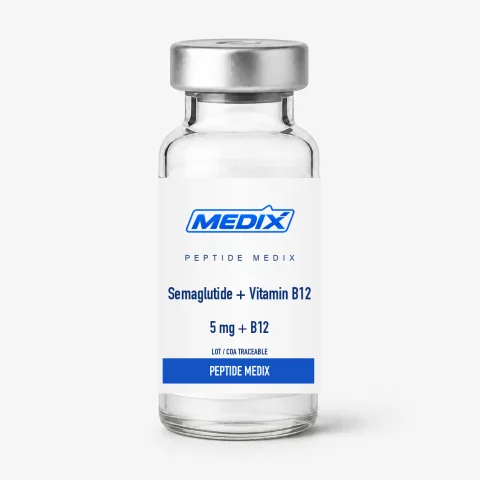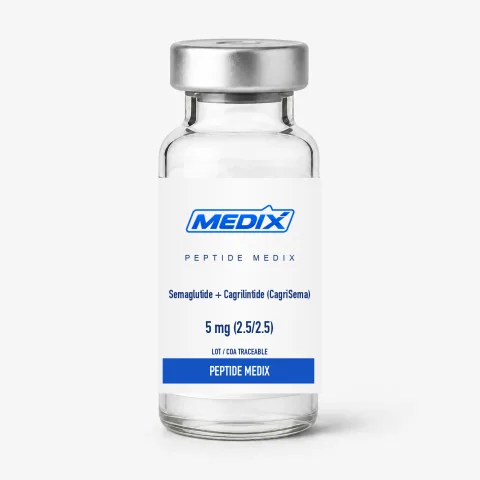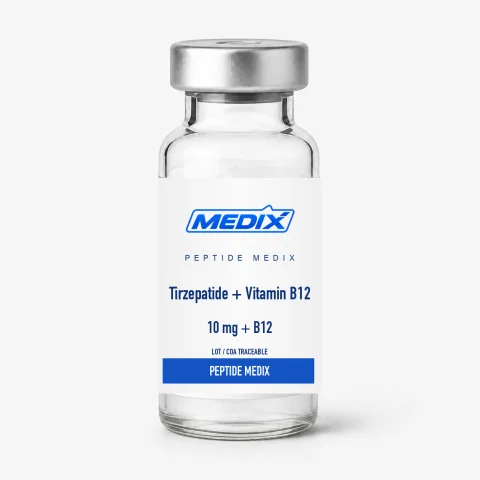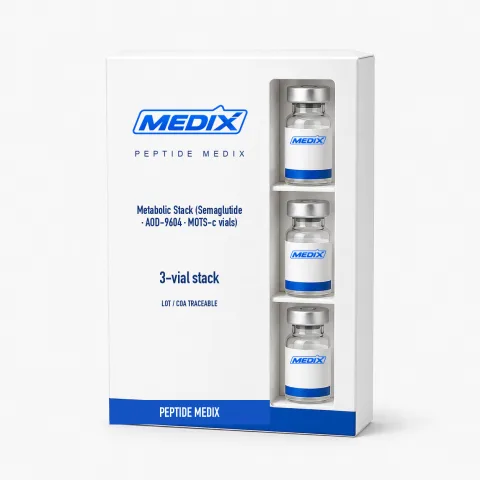
- ≥99% by HPLC for each peptide
- Lot-matched certificate of analysis
- Ships next business day, tracked
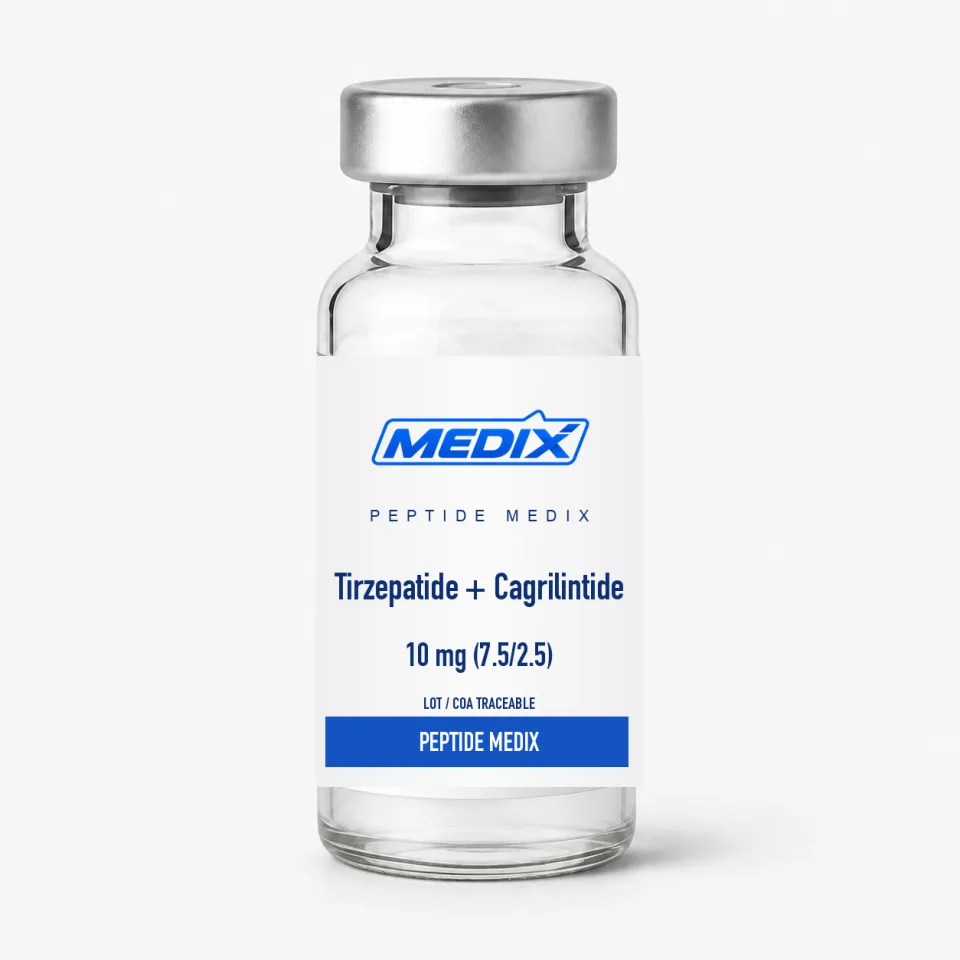
Tirzepatide + Cagrilintide
Co-lyophilized dual GIP/GLP-1 agonist with a long-acting amylin analog
- FormCo-lyophilized powder, sealed glass vial with flip-off seal
- Research areasIncretin-amylin combination pharmacology, satiation signalling, gastric emptying, adipose and glucose-handling models
Overview
This blend co-lyophilizes two metabolic research peptides in one vial: tirzepatide, a 39-residue acylated dual GIP and GLP-1 receptor agonist, and cagrilintide, a long-acting acylated analog of amylin (islet amyloid polypeptide). The pairing exists because incretin and amylin signalling reach energy-balance circuits through different receptor systems, and combination pharmacology is one of the most active questions in current metabolic research.
Tirzepatide is built on a GIP-based backbone with aminoisobutyric acid substitutions for protease resistance and a C20 diacid chain attached through a gamma-Glu-(AEEA)2 linker at Lys20, which drives albumin binding and a long circulating half-life. Cagrilintide uses an amylin backbone with anti-fibrillation substitutions, an intramolecular disulfide and its own lipid side chain, and is studied at the calcitonin receptor together with the RAMP-defined AMY1–AMY3 receptor complexes.
Specifications
Supply & purity
- Form
- Co-lyophilized powder, sealed glass vial with flip-off seal
- Purity
- ≥99% by HPLC for each peptide; lot-matched COA available
- Available sizes
- 10 mg total (7.5 mg tirzepatide / 2.5 mg cagrilintide); 20 mg total (15 mg / 5 mg)
- Solubility
- Bacteriostatic water; dilute alkaline or phosphate buffers where assay pH matters
Handling & storage
- Storage (lyophilized)
- −20 °C, sealed and protected from light and moisture
- Storage (reconstituted)
- 2–8 °C, protected from light; use within the study window
Additional detail
- Blend ratio
- 3:1 tirzepatide to cagrilintide by mass
- Component 1
- Tirzepatide — CAS 2023788-19-2, C225H348N48O68, 4813.45 g/mol
- Component 2
- Cagrilintide — CAS 1415456-99-3, 4409.07 g/mol
- Tirzepatide class
- Acylated dual GIP/GLP-1 receptor agonist (twincretin), 39 residues
- Cagrilintide class
- Long-acting acylated amylin (IAPP) analog
- Key modifications
- Aib substitutions and a C20 diacid on tirzepatide; anti-fibrillation substitutions, disulfide and lipid chain on cagrilintide
- Receptors studied
- GIP receptor, GLP-1 receptor, calcitonin receptor and AMY1–AMY3 complexes
- Research areas
- Incretin-amylin combination pharmacology, satiation signalling, gastric emptying, adipose and glucose-handling models
Working out the concentration
A lyophilized vial carries a mass on the label and no concentration anywhere, so the first calculation of any protocol is the reconstitution one. The peptide concentration calculator converts vial mass plus diluent volume into mg/mL, and back into the draw volume for a given mass.
Certificate of analysis
Every lot of Tirzepatide + Cagrilintide is released against a certificate of analysis: the batch-specific laboratory data for that lot, not a generic document for the compound. The lot number on the certificate matches the lot number printed on the label you receive — the vial label itself, where the product is vialled — so the record and the material it describes can always be reconciled.
Purity: ≥99% by HPLC for each peptide — the specification for this listing. The figure for the lot you receive is the one reported on that lot’s certificate.
No lot certificate is on display on this page at the moment. That is a publishing state and not a testing one: lots are released and documented as described above whether or not the document is posted here, and we will send what exists for the lot in stock, or for a lot already on your bench, by its number.
Certificates are available on request before you order as well as after, with no account and no charge. Request the certificate for this listing, read the testing and documentation policy in full, or see how to read a peptide COA.
Questions about Tirzepatide + Cagrilintide
How much of each peptide is in a vial?
The 10 mg vial contains 7.5 mg tirzepatide and 2.5 mg cagrilintide; the 20 mg vial contains 15 mg and 5 mg. Both are a 3:1 mass ratio, and the exact fill is restated on the lot-matched Certificate of Analysis so calculations can be verified.
Are the peptides mixed together or supplied separately?
They are co-lyophilized in a single vial, so one reconstitution produces a fixed-ratio working solution. If your design needs to vary the ratio, use the individual tirzepatide and cagrilintide vials instead, which are stocked separately.
Why are an incretin agonist and an amylin analog studied together?
They engage different receptor systems — GIP and GLP-1 receptors versus calcitonin receptor–RAMP amylin complexes — and reach energy-balance circuits by partly separate routes. Combination arms let researchers test whether readouts are additive rather than driven by one pathway.
Is the blend third-party tested?
Yes. Each peptide is analysed by HPLC to confirm ≥99% purity with identity testing, and a lot-matched COA covering the batch you receive is available. Match the lot on the vial to the COA before recording results.
What is used to reconstitute it?
Bacteriostatic water is the usual diluent for multi-draw laboratory preparations; dilute alkaline or phosphate buffers are used where assay pH matters. Add the diluent slowly against the vial wall and swirl rather than shake, because acylated peptides foam readily.
How does this compare with the semaglutide + cagrilintide blend?
The amylin component is the same class; the incretin component differs. Semaglutide is a single GLP-1 receptor agonist, whereas tirzepatide engages both GIP and GLP-1 receptors. Researchers pick between them depending on which receptor question the experiment is asking.
Related