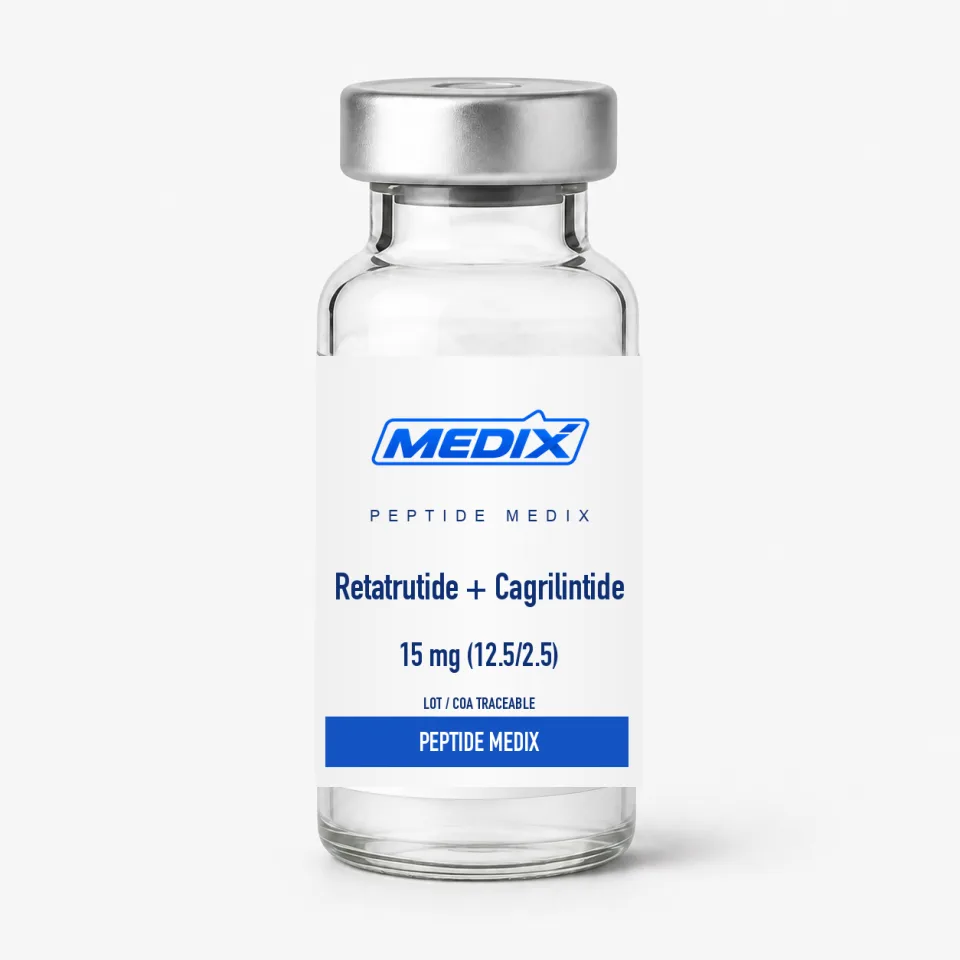
- ≥99% by HPLC per component
- Lot-matched certificate of analysis
- Ships next business day, tracked
Retatrutide + Cagrilintide
Co-formulated 15 mg vial pairing a triple incretin agonist with an amylin analogue
- FormLyophilized powder, sealed glass vial
- Research areasIncretin and amylin receptor signalling, energy balance, metabolic models
Overview
This co-formulated vial pairs two of the most actively researched metabolic peptides of the past decade. Retatrutide is a synthetic 39-residue analogue engineered to engage three receptors at once — GIP, GLP-1 and glucagon — and carries a lipidated side chain that extends its circulating half-life. Cagrilintide is a long-acting analogue of amylin, the pancreatic hormone co-secreted with insulin, and acts through amylin and calcitonin receptor populations.
Peptide Medix supplies the blend as a lyophilized powder in a sealed glass vial, assayed to ≥99% purity per component by HPLC and released against a lot-matched certificate of analysis. Both components are large, structurally complex peptides, and the certificate reports each separately. The material is sold as a research chemical for laboratory investigation only and is not a drug, is not approved for any use in humans, and carries no dosing guidance.
Specifications
Supply & purity
- Form
- Lyophilized powder, sealed glass vial
- Purity
- ≥99% by HPLC per component; lot-matched COA
- Solubility
- Bacteriostatic water; add slowly and avoid agitation
Handling & storage
- Storage (lyophilized)
- −20 °C, protected from light and moisture
- Storage (reconstituted)
- 2–8 °C, protected from light
Additional detail
- Product type
- Two-peptide metabolic research blend, single vial
- Components
- Retatrutide (LY3437943) and cagrilintide (AM833)
- Total peptide content
- 15 mg per vial — retatrutide 12.5 mg, cagrilintide 2.5 mg
- Retatrutide
- CAS 2381089-83-2 · C221H342N46O68 · 4731.30 g/mol
- Cagrilintide
- CAS 1415456-99-3 · C194H309N55O59S2 · 4409.07 g/mol
- Retatrutide class
- GIP / GLP-1 / glucagon triple receptor agonist, 39 residues
- Cagrilintide class
- Long-acting amylin and calcitonin receptor agonist, 32 residues
- Research areas
- Incretin and amylin receptor signalling, energy balance, metabolic models
Working out the concentration
A lyophilized vial carries a mass on the label and no concentration anywhere, so the first calculation of any protocol is the reconstitution one. The peptide concentration calculator converts vial mass plus diluent volume into mg/mL, and back into the draw volume for a given mass.
Certificate of analysis
Every lot of Retatrutide + Cagrilintide is released against a certificate of analysis: the batch-specific laboratory data for that lot, not a generic document for the compound. The lot number on the certificate matches the lot number printed on the label you receive — the vial label itself, where the product is vialled — so the record and the material it describes can always be reconciled.
Purity: ≥99% by HPLC per component — the specification for this listing. The figure for the lot you receive is the one reported on that lot’s certificate.
No lot certificate is on display on this page at the moment. That is a publishing state and not a testing one: lots are released and documented as described above whether or not the document is posted here, and we will send what exists for the lot in stock, or for a lot already on your bench, by its number.
Certificates are available on request before you order as well as after, with no account and no charge. Request the certificate for this listing, read the testing and documentation policy in full, or see how to read a peptide COA.
Questions about Retatrutide + Cagrilintide
What is the ratio in this vial?
Retatrutide 12.5 mg to cagrilintide 2.5 mg, a 5:1 split by mass across a 15 mg total. Because the two peptides have similar molecular weights, around 4,731 and 4,409 g/mol, the molar ratio is close to the mass ratio.
Why combine an incretin agonist with an amylin analogue?
They act through separate receptor families. Retatrutide engages GIP, GLP-1 and glucagon receptors; cagrilintide acts at amylin and calcitonin receptors. Research designs that want both signalling arms present in a single preparation use a co-formulation rather than two vials.
Is the certificate of analysis component-specific?
Yes. Because this is a blend, the lot-matched COA reports HPLC identity and purity for retatrutide and cagrilintide separately rather than as one combined figure. The current lot document can be requested before ordering.
Can the components be used at different ratios?
Not from this vial. A co-formulation fixes the ratio at 12.5 to 2.5 mg. Study designs that need to vary one peptide independently should use separate retatrutide and cagrilintide vials, which Peptide Medix also stocks in several sizes.
Related