- Analytically tested
- Lot-matched certificate of analysis
- Ships next business day, tracked
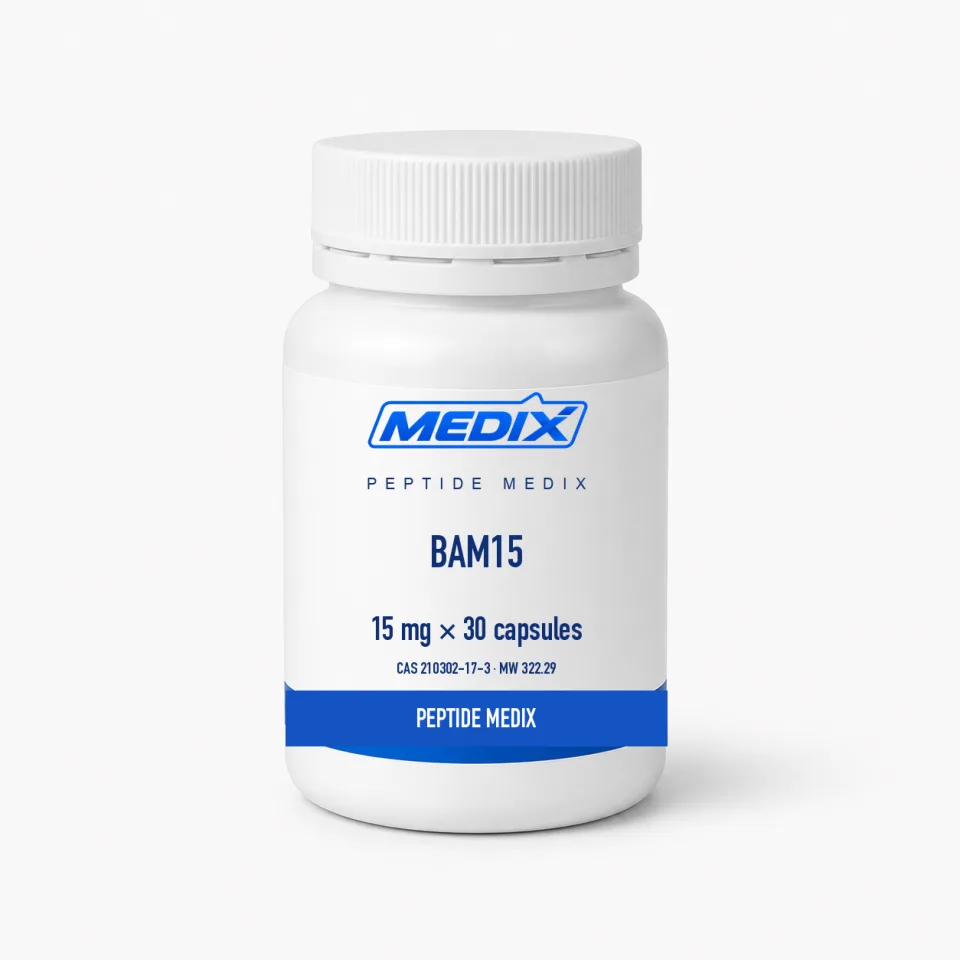
BAM15
Mitochondria-selective protonophore research capsules, 15 mg × 30
- FormOral capsule in a sealed bottle with tamper-evident closure
- Mol. weight322.29 g/mol
- Research areasMitochondrial bioenergetics, energy expenditure, diet-induced obesity models, hepatic steatosis models, ischaemia–reperfusion injury
Overview
BAM15 is a small-molecule mitochondrial protonophore from the oxadiazolopyrazine class, supplied here as 15 mg capsules in a sealed 30-count bottle. It is not a peptide. Its interest in the literature comes from a single mechanistic property: it carries protons back across the inner mitochondrial membrane, dissipating part of the proton-motive force as heat instead of letting it drive ATP synthase. Substrate oxidation therefore continues while ATP output per unit of fuel falls — the definition of chemical uncoupling.
Uncoupler pharmacology is concentration-dependent in a way that shapes every experiment with this class. Mild uncoupling raises respiration and lowers mitochondrial membrane potential without collapsing it, while excess uncoupling abolishes ATP synthesis altogether, so concentration-ranging against a measured oxygen consumption rate is part of basic characterisation rather than an optional refinement. The reported selectivity of this compound — depolarising the inner mitochondrial membrane at concentrations leaving plasma-membrane potential broadly intact — is what separates it from earlier protonophores. Published models include diet-induced obesity, hepatic steatosis and ischaemia–reperfusion injury. The capsule fixes content at 15 mg across a thirty-count bottle and needs no cold chain, whereas in-vitro work starts from a DMSO stock, the compound being poorly water-soluble.
Specifications
Identity
- CAS number
- 210302-17-3
- Molecular weight
- 322.29 g/mol
Supply & purity
- Form
- Oral capsule in a sealed bottle with tamper-evident closure
- Purity
- Analytically tested; certificate of analysis available
- Solubility
- Poorly water soluble; DMSO is the usual solvent for in vitro stock preparation
Additional detail
- Content per capsule
- 15 mg BAM15
- Available size
- 30 capsules
- Chemical class
- Oxadiazolopyrazine (furazano-pyrazine) diamine — small molecule, non-peptide
- Mechanism studied
- Protonophore; transports protons across the inner mitochondrial membrane, uncoupling respiration from ATP synthesis
- Selectivity note
- Reported to depolarise mitochondrial but not plasma membrane at comparable concentrations
- Research areas
- Mitochondrial bioenergetics, energy expenditure, diet-induced obesity models, hepatic steatosis models, ischaemia–reperfusion injury
- Storage
- Room temperature, sealed, dry and protected from light
- Preparation required
- None — fixed unit content, no reconstitution step
Units and conversions
There is no reconstitution step for a solid oral format: the mass per unit of BAM15 is fixed on the label. Where a published method is written in micrograms and the label is in milligrams, the peptide unit converter does the conversion.
Certificate of analysis
Every lot of BAM15 is released against a certificate of analysis: the batch-specific laboratory data for that lot, not a generic document for the compound. The lot number on the certificate matches the lot number printed on the label you receive — the vial label itself, where the product is vialled — so the record and the material it describes can always be reconciled.
Purity: Analytically tested — the specification for this listing. The figure for the lot you receive is the one reported on that lot’s certificate.
No lot certificate is on display on this page at the moment. That is a publishing state and not a testing one: lots are released and documented as described above whether or not the document is posted here, and we will send what exists for the lot in stock, or for a lot already on your bench, by its number.
Certificates are available on request before you order as well as after, with no account and no charge. Request the certificate for this listing, read the testing and documentation policy in full, or see how to read a peptide COA.
Questions about BAM15
What exactly does BAM15 do at the molecular level?
It shuttles protons across the inner mitochondrial membrane, bypassing ATP synthase. The proton gradient built by the electron transport chain is partially dissipated as heat, so respiration increases while ATP produced per unit of substrate falls. That is chemical uncoupling, and it is measured in the literature as an increase in oxygen consumption rate.
How is it different from DNP?
Both are protonophores, but published characterisation describes BAM15 as mitochondria-selective — depolarising the inner mitochondrial membrane at concentrations that leave plasma-membrane potential broadly intact — whereas DNP acts on both. DNP has a documented history of fatal hyperthermia and is not a usable reference compound for whole-organism research.
Do you provide a certificate of analysis?
Yes. Material is analytically tested and a lot-matched certificate of analysis is available covering identity and purity of the compound used in the capsule fill. Quote the lot number printed on the bottle label when requesting it.
How should the capsules be stored?
Sealed at room temperature, dry, and away from direct light and heat. Unlike lyophilized peptides, this compound does not require freezer storage or cold-chain shipping. Keep the bottle closed between handling sessions and record the date it was first opened.
Related