- Peptide purity: ≥99% by HPLC
- Lot-matched certificate of analysis
- Ships next business day, tracked
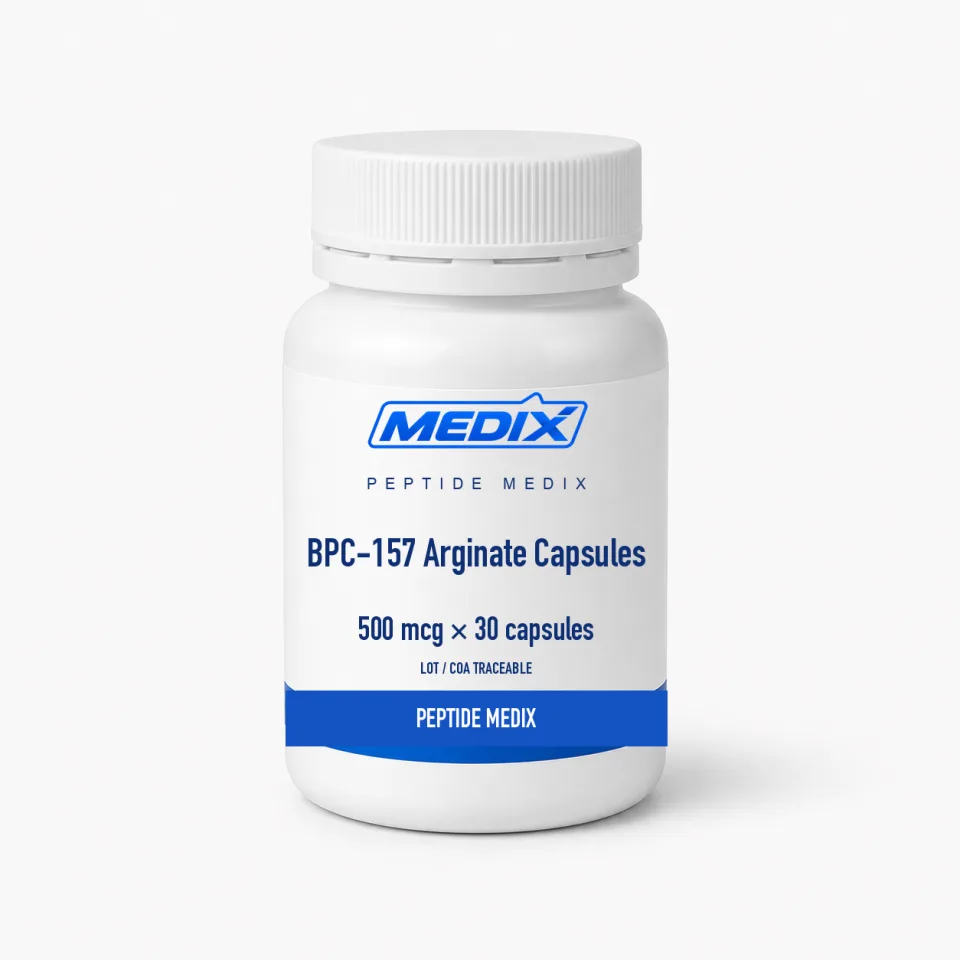
BPC-157 Arginate Capsules
Arginate salt form of BPC-157, 500 mcg per capsule, 30 or 60 count
- FormOral capsule, sealed bottle with tamper-evident closure
- Research areasGastric and intestinal mucosal integrity, barrier function, gastrointestinal stability of peptides, oral presentation comparisons
Overview
BPC-157 arginate capsules supply the pentadecapeptide BPC-157 as its arginine salt, pre-measured at 500 mcg of peptide per capsule in 30-count and 60-count bottles. BPC-157 itself is a 15-amino-acid sequence — Gly-Glu-Pro-Pro-Pro-Gly-Lys-Pro-Ala-Asp-Asp-Ala-Gly-Leu-Val — first described as a partial sequence of a protein isolated from gastric juice, which is why gastrointestinal research models feature so heavily in the literature around it.
The arginate designation refers to the counter-ion rather than the peptide backbone: the acidic peptide is paired with arginine instead of the more common acetate. Salt form is a standard formulation variable in peptide chemistry, affecting hygroscopicity, dissolution behaviour and the residual counter-ion that appears on analysis, and vendors of oral formats often specify it for that reason. The peptide sequence, molecular formula and mass are unchanged from the free-peptide vial product.
Specifications
Identity
- Amino acid sequence
- Gly-Glu-Pro-Pro-Pro-Gly-Lys-Pro-Ala-Asp-Asp-Ala-Gly-Leu-Val
Supply & purity
- Form
- Oral capsule, sealed bottle with tamper-evident closure
Additional detail
- Peptide per capsule
- 500 mcg BPC-157 (as arginate salt)
- Available counts
- 30 capsules, 60 capsules
- Salt form
- Arginate — arginine counter-ion rather than acetate
- Peptide purity
- ≥99% by HPLC; lot-matched COA available
- Active peptide
- BPC-157, a 15-amino-acid pentadecapeptide
- CAS number (free peptide)
- 137525-51-0
- Molecular formula (free peptide)
- C62H98N16O22
- Molecular weight (free peptide)
- 1419.55 g/mol
- Excipients
- Inert capsule fill and shell material; no active co-ingredients
- Research areas
- Gastric and intestinal mucosal integrity, barrier function, gastrointestinal stability of peptides, oral presentation comparisons
- Preparation required
- None — fixed unit content, no reconstitution step
- Storage
- Cool, dry conditions away from direct light; refrigeration extends shelf stability
Units and conversions
There is no reconstitution step for a solid oral format: the mass per unit of BPC-157 Arginate Capsules is fixed on the label. Where a published method is written in micrograms and the label is in milligrams, the peptide unit converter does the conversion.
Certificate of analysis
Every lot of BPC-157 Arginate Capsules is released against a certificate of analysis: the batch-specific laboratory data for that lot, not a generic document for the compound. The lot number on the certificate matches the lot number printed on the label you receive — the vial label itself, where the product is vialled — so the record and the material it describes can always be reconciled.
Peptide purity: ≥99% by HPLC — the specification for this listing. The figure for the lot you receive is the one reported on that lot’s certificate.
No lot certificate is on display on this page at the moment. That is a publishing state and not a testing one: lots are released and documented as described above whether or not the document is posted here, and we will send what exists for the lot in stock, or for a lot already on your bench, by its number.
Certificates are available on request before you order as well as after, with no account and no charge. Request the certificate for this listing, read the testing and documentation policy in full, or see how to read a peptide COA.
Questions about BPC-157 Arginate Capsules
What does 'arginate' mean here?
It identifies the counter-ion. The peptide is supplied as an arginine salt rather than the more common acetate. The BPC-157 sequence, molecular formula and molecular mass are unchanged; salt form influences properties such as hygroscopicity and dissolution behaviour, not peptide identity.
How much peptide is in each capsule?
Each capsule contains 500 mcg of BPC-157, stated as peptide mass. Bottles are supplied in 30-count and 60-count sizes, and the per-capsule content is restated on the lot-matched Certificate of Analysis so it can be checked against your records.
How do these differ from the standard BPC-157 capsules?
Both deliver 500 mcg of the same 15-residue peptide per capsule. The difference is the counter-ion — arginate versus the standard salt form — which is a formulation variable researchers sometimes hold as the experimental factor when comparing dissolution or stability.
Is the peptide third-party tested?
Yes. The BPC-157 input is analysed by an independent laboratory using HPLC to confirm ≥99% purity along with identity testing, and a lot-matched COA is available for the batch supplied. Match the lot on the bottle to the COA before recording data.
How should the capsules be stored?
Store them in the sealed bottle in cool, dry conditions away from direct light. Refrigeration extends shelf stability; keep the desiccant in place and let a refrigerated bottle warm before opening so that condensation does not reach the capsule contents.
Does oral BPC-157 reach the bloodstream?
That is an open research question. Part of the published literature reports stability in gastric juice, which motivates oral-format experiments, but systemic exposure has not been well characterised. Studies addressing it normally include a parenteral reference arm and direct plasma measurement.
Related