- Peptide purity: ≥99% by HPLC
- Lot-matched certificate of analysis
- Ships next business day, tracked
KPV Capsules (Oral)
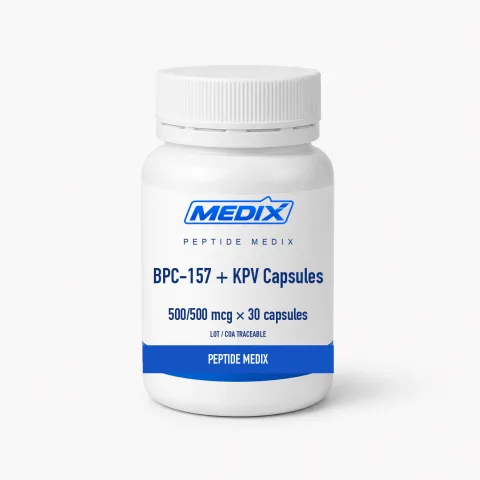
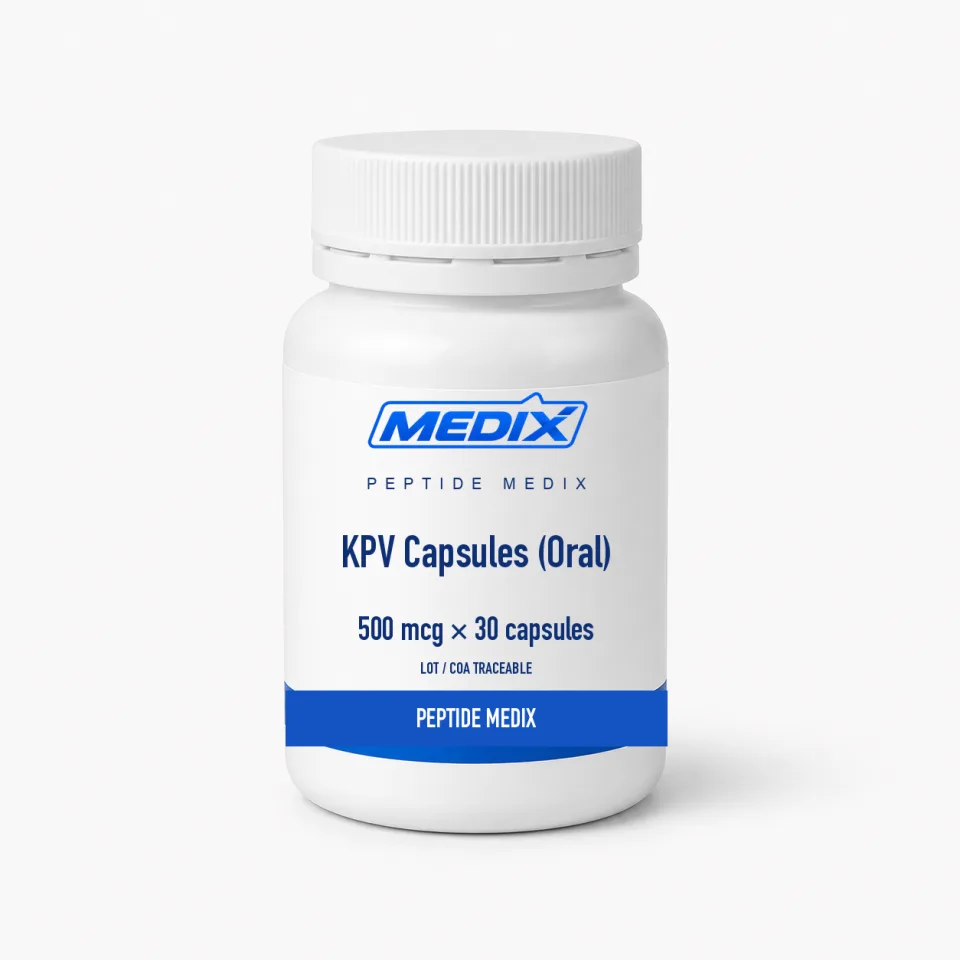
Oral KPV research capsules, 500 mcg tripeptide per capsule
- FormOral capsule, sealed bottle with tamper-evident closure
- Mol. weight342.43 g/mol
- Research areasIntestinal inflammation models, NF-kappa B signalling, epithelial barrier studies
Overview
KPV capsules deliver the lysine-proline-valine tripeptide in a fixed 500 microgram oral unit, bottled in 30 and 60 capsule counts. The peptide is the C-terminal fragment of alpha-melanocyte-stimulating hormone, synthesised by solid-phase methods and purified by reversed-phase HPLC to at least 99% before filling, with a certificate of analysis matched to the lot number on the bottle.
There is a specific reason an oral format makes sense for this sequence. A recurring finding in the KPV literature is uptake through PepT1, an oligopeptide transporter expressed on intestinal epithelium and reported to be upregulated in inflamed tissue. Because the transporter sits where the peptide is most studied, oral delivery in gastrointestinal models is a deliberate design choice rather than a convenience substitution.
KPV is also exceptionally small at 342 g/mol, so a 500 microgram unit represents a substantial molar quantity compared with the same mass of a long peptide. For laboratories, the capsule removes weighing at the sub-milligram scale, where small absolute errors translate into large proportional ones. Supplied as research material only, not as a supplement or drug.
Specifications
Identity
- CAS number
- 67727-97-3
- Molecular formula
- C16H30N4O4
- Molecular weight
- 342.43 g/mol
- Amino acid sequence
- Lys-Pro-Val
Supply & purity
- Form
- Oral capsule, sealed bottle with tamper-evident closure
Additional detail
- Peptide per capsule
- 500 mcg KPV
- Available counts
- 30 capsules, 60 capsules
- Peptide purity
- ≥99% by HPLC; lot-matched COA available
- Active peptide
- KPV, a three-residue melanocortin-derived tripeptide
- Reported transport route
- PepT1 oligopeptide transporter on intestinal epithelium
- Research areas
- Intestinal inflammation models, NF-kappa B signalling, epithelial barrier studies
- Storage
- Cool, dry conditions away from direct light; keep desiccant in the bottle
Units and conversions
There is no reconstitution step for a solid oral format: the mass per unit of KPV Capsules (Oral) is fixed on the label. Where a published method is written in micrograms and the label is in milligrams, the peptide unit converter does the conversion.
Certificate of analysis
Every lot of KPV Capsules (Oral) is released against a certificate of analysis: the batch-specific laboratory data for that lot, not a generic document for the compound. The lot number on the certificate matches the lot number printed on the label you receive — the vial label itself, where the product is vialled — so the record and the material it describes can always be reconciled.
Peptide purity: ≥99% by HPLC — the specification for this listing. The figure for the lot you receive is the one reported on that lot’s certificate.
No lot certificate is on display on this page at the moment. That is a publishing state and not a testing one: lots are released and documented as described above whether or not the document is posted here, and we will send what exists for the lot in stock, or for a lot already on your bench, by its number.
Certificates are available on request before you order as well as after, with no account and no charge. Request the certificate for this listing, read the testing and documentation policy in full, or see how to read a peptide COA.
Questions about KPV Capsules (Oral)
How much KPV is in each capsule?
Each capsule contains 500 micrograms of the Lys-Pro-Val tripeptide blended with an inert carrier for a consistent fill weight. Bottles come in 30 and 60 capsule counts, sealed with a tamper-evident closure and packed with desiccant.
Why supply KPV orally rather than as a vial?
Published work reports that KPV is taken up by PepT1, an oligopeptide transporter on intestinal epithelium whose expression is described as increased in inflamed tissue. Since gut inflammation is the peptide's most-studied context, oral delivery aligns the route with the tissue of interest.
Is 500 micrograms a small amount for a peptide?
By mass it is small, but KPV weighs only 342 g/mol, so a 500 microgram unit is a far larger molar quantity than the same mass of a thirty-residue peptide. It also removes the need for sub-milligram weighing, where absolute errors become proportionally large.
What purity is the peptide and is a COA available?
The tripeptide is purified by reversed-phase HPLC to at least 99% with mass confirmation before filling. A certificate of analysis matched to the lot number printed on your bottle label is available on request, before or after ordering.
How should the capsules be stored?
Keep the bottle closed, cool, dry and out of direct light with the desiccant left in place. Peptide powder absorbs atmospheric moisture readily, so minimise how often the container is opened in humid conditions and do not transfer capsules to unsealed containers.
Related