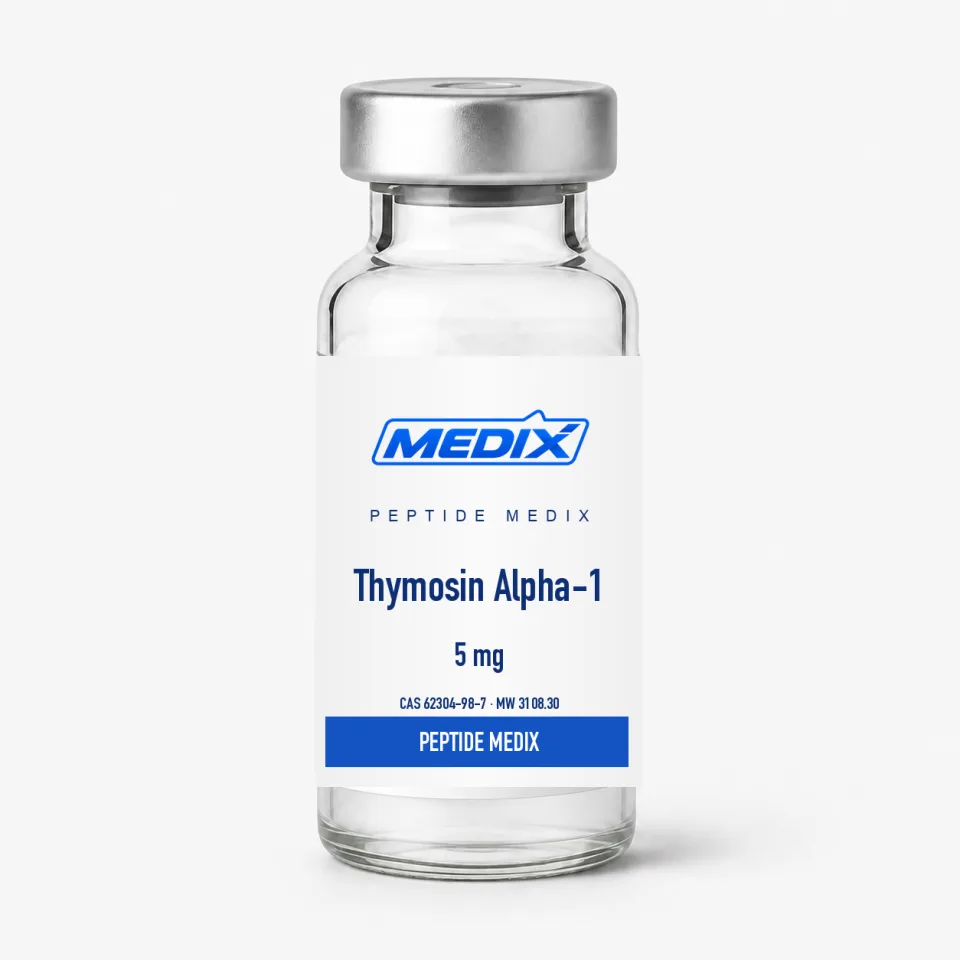
- ≥99% by HPLC
- Lot-matched certificate of analysis
- Ships next business day, tracked
Thymosin Alpha-1 Peptide
Acetylated 28-residue thymic peptide from prothymosin alpha
- FormLyophilized powder, sealed glass vial with crimped stopper
- Mol. weight3108.30 g/mol
- Research areasT cell maturation, Toll-like receptor signalling, antiviral and vaccine adjuvant models
Overview
Thymosin Alpha-1 is a twenty-eight amino acid, N-terminally acetylated peptide corresponding to the first 28 residues of prothymosin alpha. It was isolated from calf thymus extract in the 1970s during the effort to identify the active constituents of thymosin fraction 5, and it remains the best-characterised single molecule to emerge from that work.
Our material is produced by solid-phase synthesis, purified by reversed-phase HPLC to at least 99% and supplied as a lyophilized powder in sealed 5 mg, 10 mg and 20 mg vials with a lot-matched certificate of analysis. Research use concentrates on T cell maturation, Toll-like receptor signalling and immune modulation. Sold for laboratory research only.
Specifications
Identity
- CAS number
- 62304-98-7
- Molecular formula
- C129H215N33O55
- Molecular weight
- 3108.30 g/mol
- Amino acid sequence
- Ac-Ser-Asp-Ala-Ala-Val-Asp-Thr-Ser-Ser-Glu-Ile-Thr-Thr-Lys-Asp-Leu-Lys-Glu-Lys-Lys-Glu-Val-Val-Glu-Glu-Ala-Glu-Asn
- Chain length
- 28 amino acids, N-terminally acetylated
- Peptide class
- Thymic immunomodulatory peptide
Supply & purity
- Form
- Lyophilized powder, sealed glass vial with crimped stopper
- Purity
- ≥99% by HPLC; lot-matched COA available
- Available sizes
- 5 mg, 10 mg, 20 mg
Handling & storage
- Storage (lyophilized)
- −20 °C, sealed and protected from light and moisture
- Storage (reconstituted)
- 2–8 °C, protected from light, used within the study window
Additional detail
- Parent protein
- Prothymosin alpha (residues 1–28)
- Research areas
- T cell maturation, Toll-like receptor signalling, antiviral and vaccine adjuvant models
Working out the concentration
Because Thymosin Alpha-1 arrives dry, its concentration is a decision rather than a specification. Run the numbers through the reconstitution calculator — vial mass in, diluent volume in, mg/mL and mass per syringe unit out.
Certificate of analysis
Every lot of Thymosin Alpha-1 is released against a certificate of analysis: the batch-specific laboratory data for that lot, not a generic document for the compound. The lot number on the certificate matches the lot number printed on the label you receive — the vial label itself, where the product is vialled — so the record and the material it describes can always be reconciled.
Purity: ≥99% by HPLC — the specification for this listing. The figure for the lot you receive is the one reported on that lot’s certificate.
No lot certificate is on display on this page at the moment. That is a publishing state and not a testing one: lots are released and documented as described above whether or not the document is posted here, and we will send what exists for the lot in stock, or for a lot already on your bench, by its number.
Certificates are available on request before you order as well as after, with no account and no charge. Request the certificate for this listing, read the testing and documentation policy in full, or see how to read a peptide COA.
Questions about Thymosin Alpha-1
What is Thymosin Alpha-1?
It is a synthetic twenty-eight amino acid peptide with an acetylated N-terminus, matching the first 28 residues of prothymosin alpha. Originally identified in calf thymus extract, it is supplied here as a lyophilized research powder for immune signalling studies.
How is it different from Thymalin or Thymulin?
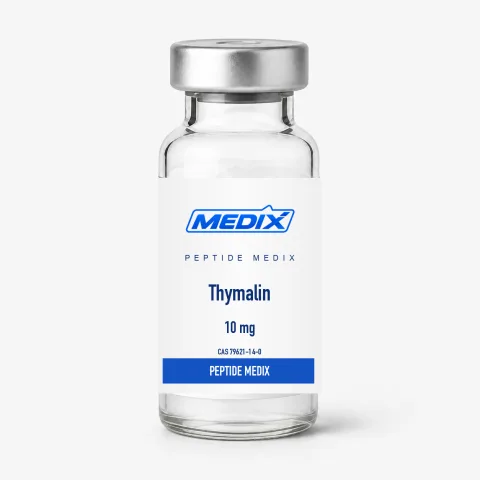
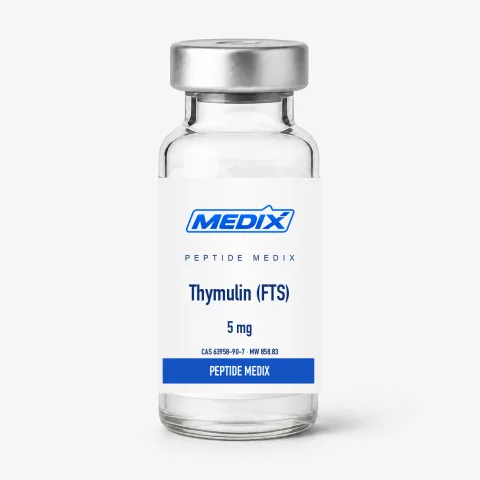
Thymosin Alpha-1 is a single defined molecule with a known sequence and mass. Thymalin is a mixture of thymic polypeptides rather than one compound, and Thymulin is a separate nine-residue peptide whose activity is described as zinc-dependent. All three come from thymic research but are chemically distinct.
What purity do you supply and is a COA included?
Each lot is purified and analysed by reversed-phase HPLC to at least 99% with mass-spectrometric confirmation against the expected 3108.30 g/mol mass. A certificate of analysis matched to the lot number on your vial is available on request at any time.
How should it be stored after reconstitution?
Hold the solution at 2–8 °C, protected from light, and use it within the planned study window rather than storing indefinitely. Aliquot immediately after reconstitution so that individual tubes are thawed once rather than the whole stock being cycled repeatedly.
Related