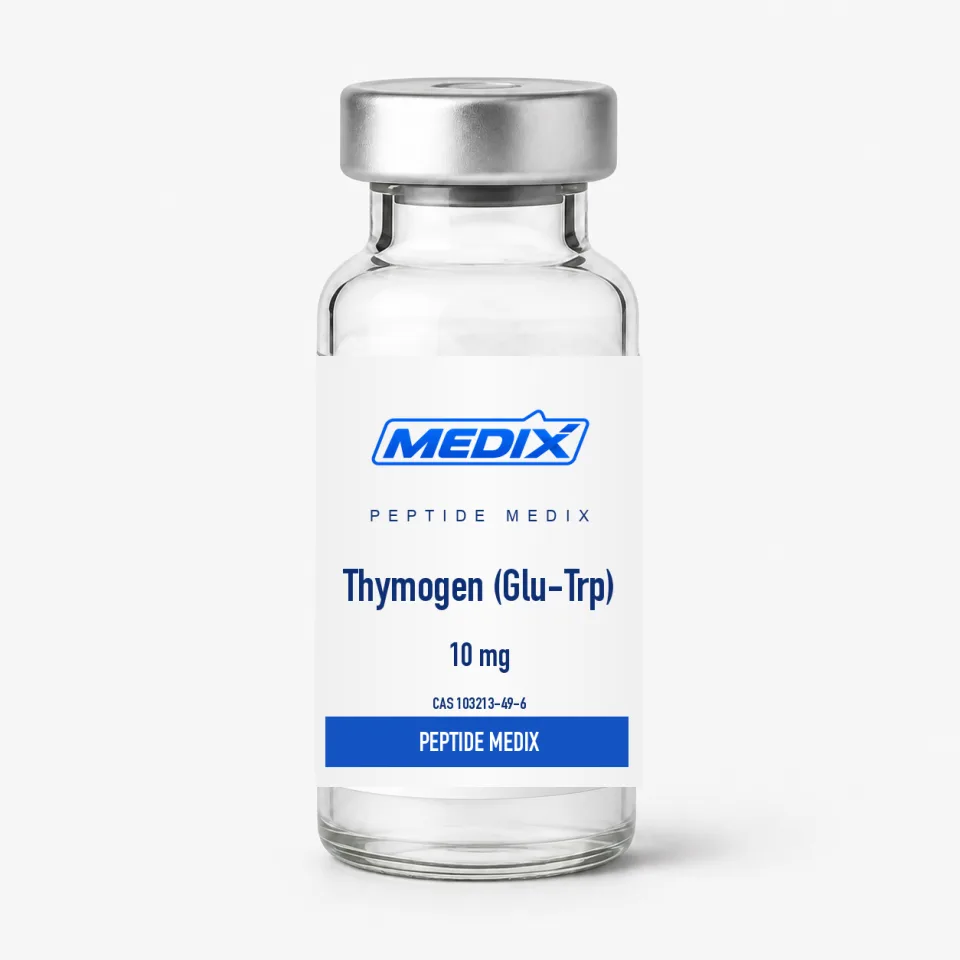
- ≥99% by HPLC
- Lot-matched certificate of analysis
- Ships next business day, tracked
Thymogen (Glu-Trp) Peptide
Synthetic Glu-Trp dipeptide studied in thymic immune regulation models
- FormLyophilized powder, sealed glass vial with flip-off seal
- Mol. weight333.34 g/mol
- Research areasLymphocyte differentiation, thymic immune signalling, cytokine expression models
Overview
Thymogen is a synthetic dipeptide, L-glutamyl-L-tryptophan, and one of the shortest peptides in the immune research catalog — just two residues, Glu-Trp, with formula C16H19N3O5 and a mass of 333.34 g/mol under CAS 103213-49-6. It emerged from Soviet-era work at the Military Medical Academy in Leningrad, where researchers fractionating thymic extracts sought the minimal active sequence rather than the whole polypeptide mixture, and identified this pair as a candidate.
That heritage places Thymogen in the same lineage as Thymalin and the broader family of peptide bioregulators associated with Vladimir Khavinson and Vyacheslav Morozov: short synthetic sequences intended to reproduce the activity attributed to a tissue-derived extract in a defined, reproducible chemical form. Where Thymalin is a peptide complex isolated from calf thymus, Thymogen is a single synthetic molecule of exactly known structure — which is what makes it a cleaner reagent for controlled work.
Specifications
Identity
- CAS number
- 103213-49-6
- Molecular formula
- C16H19N3O5
- Molecular weight
- 333.34 g/mol
- Amino acid sequence
- H-Glu-Trp-OH (L-glutamyl-L-tryptophan)
- Chain length
- 2 amino acids (dipeptide)
- Peptide class
- Synthetic thymic peptide bioregulator
Supply & purity
- Form
- Lyophilized powder, sealed glass vial with flip-off seal
- Purity
- ≥99% by HPLC; lot-matched COA available
- Available sizes
- 10 mg, 20 mg
- Solubility
- Readily soluble in water and bacteriostatic water
Handling & storage
- Storage (lyophilized)
- −20 °C, sealed and protected from light and moisture
- Storage (reconstituted)
- 2–8 °C, protected from light; use within the study window
Additional detail
- Also known as
- Thymogen, Glu-Trp, EW dipeptide
- Research areas
- Lymphocyte differentiation, thymic immune signalling, cytokine expression models
Working out the concentration
Thymogen (Glu-Trp) ships as a lyophilized powder, so nothing on this page can state a concentration: the figure you work with is the one you create when you add diluent. Put the vial mass and the volume you intend to use into the peptide reconstitution calculator and it returns mg/mL, mcg/mL and the mass sitting at each mark on a U-100 syringe.
Where a method is written in molar terms instead, the molecular weight above — 333.34 g/mol — is the input the molarity calculator needs.
Certificate of analysis
Every lot of Thymogen (Glu-Trp) is released against a certificate of analysis: the batch-specific laboratory data for that lot, not a generic document for the compound. The lot number on the certificate matches the lot number printed on the label you receive — the vial label itself, where the product is vialled — so the record and the material it describes can always be reconciled.
Purity: ≥99% by HPLC — the specification for this listing. The figure for the lot you receive is the one reported on that lot’s certificate.
No lot certificate is on display on this page at the moment. That is a publishing state and not a testing one: lots are released and documented as described above whether or not the document is posted here, and we will send what exists for the lot in stock, or for a lot already on your bench, by its number.
Certificates are available on request before you order as well as after, with no account and no charge. Request the certificate for this listing, read the testing and documentation policy in full, or see how to read a peptide COA.
Questions about Thymogen (Glu-Trp)
What is Thymogen?
Thymogen is a synthetic dipeptide, L-glutamyl-L-tryptophan (Glu-Trp), developed from Soviet-era research that fractionated thymus extracts to find the shortest sequence retaining activity. It has a defined structure of just two amino acids, CAS 103213-49-6 and a mass of 333.34 g/mol.
How does it differ from Thymalin?
Thymalin is a peptide complex extracted from calf thymus — a mixture whose exact composition varies between preparations. Thymogen is a single synthetic molecule of known structure, so identity and purity can be verified analytically lot after lot.
How is purity verified and is a COA supplied?
Each lot is analysed by reversed-phase HPLC to at least 99% purity, with identity confirmed against the expected 333.34 g/mol mass. A certificate of analysis matched to the lot number on your vial is available on request before or after purchase.
Which vial size should a laboratory choose?
The 10 mg vial covers assay development and short pilots, while 20 mg reduces the number of vial openings across longer or multi-arm work. Since the peptide is inexpensive to synthesise, most laboratories choose based on study length rather than cost per milligram.
Why does light matter for this peptide?
The tryptophan residue absorbs strongly in the ultraviolet and is prone to photo-oxidation. That absorbance is convenient for quantifying the peptide near 280 nm, but it also means solutions left in clear vessels under laboratory lighting can degrade, so amber or foil-wrapped storage is standard.
How should it be stored and reconstituted?
Keep the lyophilized vial at −20 °C, sealed and dry. Reconstitute with bacteriostatic or sterile water, swirling rather than shaking; it dissolves readily. Hold the reconstituted solution at 2–8 °C protected from light and use it within the planned study window.
Related