- Peptide purity: ≥99% by HPLC before compounding
- Lot-matched certificate of analysis
- Ships next business day, tracked
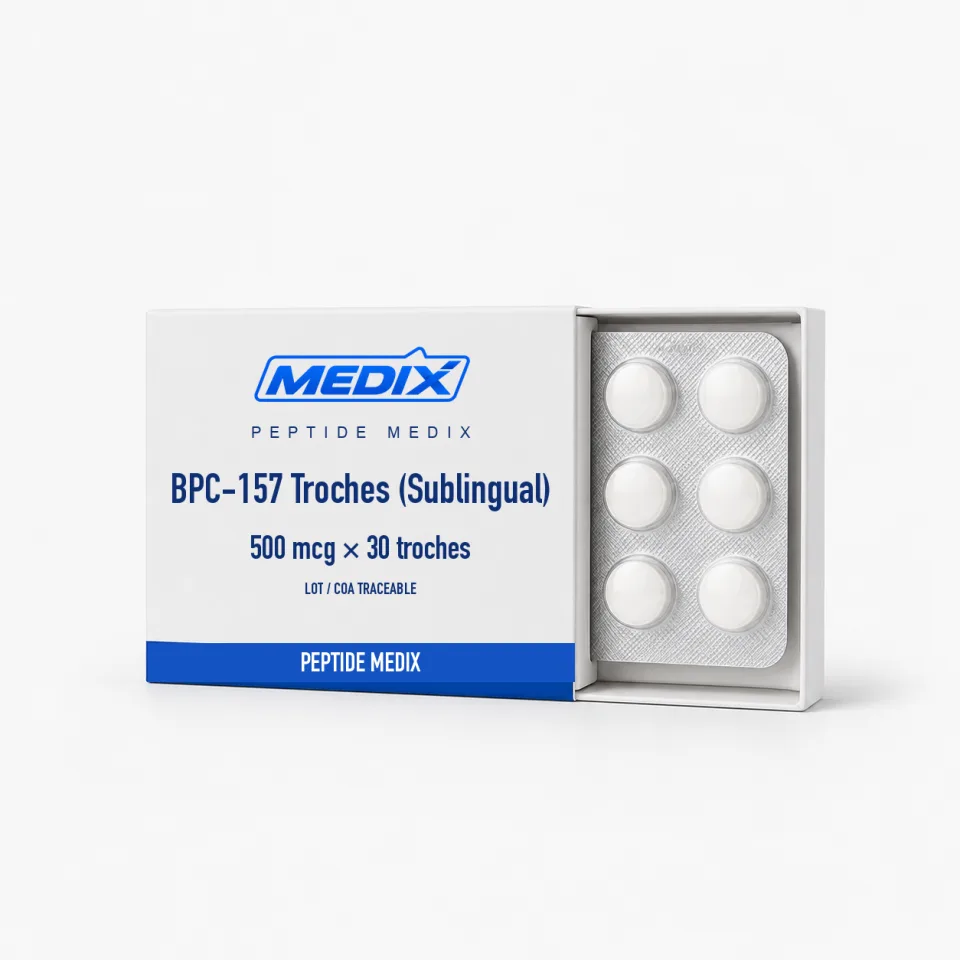
BPC-157 Troches (Sublingual)
Sublingual troche format of the gastric pentadecapeptide, 500 mcg per unit
- FormSublingual troche in a slowly dissolving compounding base
- Research areasGastrointestinal mucosal integrity, barrier function, transmucosal peptide delivery, formulation stability
Overview
These troches present BPC-157 in a slowly dissolving sublingual base rather than as a lyophilized powder for reconstitution. Each unit carries 500 micrograms of the pentadecapeptide and the pack holds thirty. The peptide itself is identical to the material in our vials and capsules: the 15-residue sequence Gly-Glu-Pro-Pro-Pro-Gly-Lys-Pro-Ala-Asp-Asp-Ala-Gly-Leu-Val, corresponding to a partial fragment of body protection compound from human gastric juice, made by solid-phase synthesis and purified to at least 99% by HPLC.
BPC-157 is an unusual candidate for transmucosal work because it is unusually stable for a peptide of its length. Its parent protein is native to the stomach, and published stability work reports that the fragment tolerates acidic aqueous conditions that would rapidly degrade most peptides. That property is precisely why oral, intragastric and now transmucosal routes appear in the literature instead of parenteral administration alone.
Specifications
Supply & purity
- Form
- Sublingual troche in a slowly dissolving compounding base
Additional detail
- Peptide content
- 500 mcg BPC-157 per troche
- Available size
- 30 troches per pack
- Active component
- BPC-157, synthetic gastric pentadecapeptide
- Amino acid sequence (active)
- Gly-Glu-Pro-Pro-Pro-Gly-Lys-Pro-Ala-Asp-Asp-Ala-Gly-Leu-Val
- CAS number (active)
- 137525-51-0
- Molecular formula (active)
- C62H98N16O22
- Molecular weight (active)
- 1419.55 g/mol
- Peptide purity
- ≥99% by HPLC before compounding; lot-matched COA available
- Delivery route studied
- Sublingual and buccal mucosal absorption
- Research areas
- Gastrointestinal mucosal integrity, barrier function, transmucosal peptide delivery, formulation stability
- Preparation required
- None — fixed unit content, no reconstitution or dilution step
- Storage
- Cool, dry and dark in the closed pack; refrigeration extends shelf stability
Units and conversions
Capsule and troche strengths are stated per unit, so the figure a method needs is usually a conversion rather than a dilution. The mcg to mg converter handles the milligram-to-microgram step, and the millilitre arithmetic if you are working from a solution format instead.
Certificate of analysis
Every lot of BPC-157 Troches (Sublingual) is released against a certificate of analysis: the batch-specific laboratory data for that lot, not a generic document for the compound. The lot number on the certificate matches the lot number printed on the label you receive — the vial label itself, where the product is vialled — so the record and the material it describes can always be reconciled.
Peptide purity: ≥99% by HPLC before compounding — the specification for this listing. The figure for the lot you receive is the one reported on that lot’s certificate.
No lot certificate is on display on this page at the moment. That is a publishing state and not a testing one: lots are released and documented as described above whether or not the document is posted here, and we will send what exists for the lot in stock, or for a lot already on your bench, by its number.
Certificates are available on request before you order as well as after, with no account and no charge. Request the certificate for this listing, read the testing and documentation policy in full, or see how to read a peptide COA.
Questions about BPC-157 Troches (Sublingual)
How do the troches differ from BPC-157 capsules?
Both are fixed 500 mcg units of the same peptide, but release site differs. A capsule delivers its contents into the gastrointestinal tract; a troche dissolves against oral mucosa, so a fraction of the peptide can cross that epithelium directly and bypass first-pass hepatic metabolism.
Is the peptide the same as the vialed powder?
Yes. The same solid-phase synthesised, HPLC-purified BPC-157 is used for our vials, capsules and troches. Only the presentation differs, which is what makes matched format-comparison experiments possible without introducing a second material variable.
How much peptide crosses the mucosa?
That is the research question rather than a published constant. Peptides in this molecular-weight range generally show modest transmucosal permeation, and measuring the crossing fraction under defined formulation conditions is exactly what troche-format studies are designed to establish.
What purity documentation is available?
The peptide used in manufacture is released at ≥99% purity by reversed-phase HPLC and a lot-matched certificate of analysis is available. Keeping that COA with your record maintains traceability between the compounded units and the peptide lot they contain.
Why is storage temperature emphasised?
Troche bases soften with heat and absorb atmospheric moisture, which deforms the units and accelerates peptide degradation. Cool, dry, dark storage in a closed pack keeps both the physical form and the peptide content stable across the intended working window.
Related