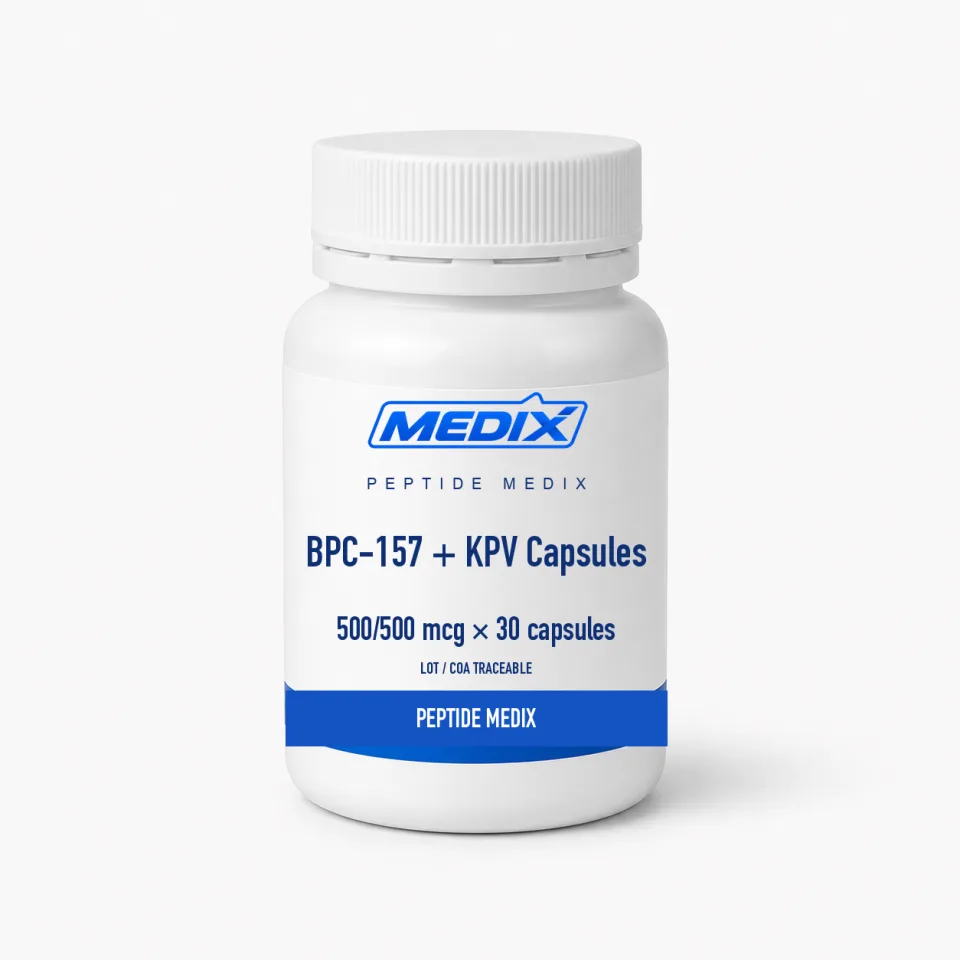
- ≥99% by HPLC per component
- Lot-matched certificate of analysis
- Ships next business day, tracked
BPC-157 + KPV Capsules
Oral capsules combining 500 mcg BPC-157 with 500 mcg KPV per unit
- FormOral capsule, sealed bottle with tamper-evident closure
- Research areasIntestinal mucosal models, inflammatory signalling, epithelial barrier studies
Overview
This capsule combines two peptides that dominate different parts of the gastrointestinal research literature. Each unit contains 500 micrograms of BPC-157, the fifteen-residue fragment of a gastric protection protein, and 500 micrograms of KPV, the three-residue C-terminal fragment of alpha-melanocyte-stimulating hormone. Bottles are supplied in 30 and 60 capsule counts.
The pairing is not arbitrary. BPC-157 is examined mainly in mucosal repair and angiogenic signalling models, while KPV is studied through nuclear factor kappa B suppression and cytokine output. Both sequences have a specific reason to be given orally: BPC-157 is reported as unusually acid-stable for a peptide of its length, and KPV has documented uptake through the PepT1 transporter on intestinal epithelium. The route matches the tissue for both.
Each peptide is synthesised and purified to at least 99% by reversed-phase HPLC separately, then blended and filled, so the certificate of analysis reports the two components individually rather than as a mixture. For a laboratory, one capsule replaces two units and eliminates any ratio error between them. Supplied as research material only, not as a supplement or drug.
Specifications
Supply & purity
- Form
- Oral capsule, sealed bottle with tamper-evident closure
- Purity
- ≥99% by HPLC per component; lot-matched COA available
Additional detail
- Content per capsule
- 500 mcg BPC-157 and 500 mcg KPV
- Available counts
- 30 capsules, 60 capsules
- Component ratio
- 1:1 by mass
- BPC-157 sequence
- Gly-Glu-Pro-Pro-Pro-Gly-Lys-Pro-Ala-Asp-Asp-Ala-Gly-Leu-Val
- BPC-157 identifiers
- CAS 137525-51-0; C62H98N16O22; 1419.55 g/mol
- KPV sequence
- Lys-Pro-Val
- KPV identifiers
- CAS 67727-97-3; C16H30N4O4; 342.43 g/mol
- Research areas
- Intestinal mucosal models, inflammatory signalling, epithelial barrier studies
- Storage
- Cool, dry conditions away from direct light; keep desiccant in the bottle
- Preparation required
- None — fixed unit content, no reconstitution or weighing
Units and conversions
There is no reconstitution step for a solid oral format: the mass per unit of BPC-157 + KPV Capsules is fixed on the label. Where a published method is written in micrograms and the label is in milligrams, the peptide unit converter does the conversion.
Certificate of analysis
Every lot of BPC-157 + KPV Capsules is released against a certificate of analysis: the batch-specific laboratory data for that lot, not a generic document for the compound. The lot number on the certificate matches the lot number printed on the label you receive — the vial label itself, where the product is vialled — so the record and the material it describes can always be reconciled.
Purity: ≥99% by HPLC per component — the specification for this listing. The figure for the lot you receive is the one reported on that lot’s certificate.
No lot certificate is on display on this page at the moment. That is a publishing state and not a testing one: lots are released and documented as described above whether or not the document is posted here, and we will send what exists for the lot in stock, or for a lot already on your bench, by its number.
Certificates are available on request before you order as well as after, with no account and no charge. Request the certificate for this listing, read the testing and documentation policy in full, or see how to read a peptide COA.
Questions about BPC-157 + KPV Capsules
What does each capsule contain?
Each capsule holds 500 micrograms of BPC-157 and 500 micrograms of KPV, a 1:1 combination by mass, blended with an inert carrier for consistent fill weight. Bottles are available in 30 and 60 capsule counts with a tamper-evident seal.
Why combine BPC-157 with KPV?
The two are studied through different mechanisms in overlapping gastrointestinal models: BPC-157 in mucosal repair and angiogenic signalling, KPV in nuclear factor kappa B suppression and cytokine output. Combining them puts a repair-associated and an inflammation-associated sequence into one unit.
How is purity documented for a two-peptide capsule?
Each peptide is synthesised and purified independently to at least 99% by reversed-phase HPLC before blending. The certificate of analysis therefore reports BPC-157 and KPV separately, matched to the lot number printed on your bottle label.
Can the ratio between the peptides be adjusted?
Not within the capsule, which is filled at a fixed 1:1 content. That removes ratio variance from a study but also removes flexibility. Research designs that need to vary the proportions should use the separate BPC-157 and KPV capsules instead.
Related