- ≥99% by HPLC
- Lot-matched certificate of analysis
- Ships next business day, tracked
Larazotide Acetate Peptide
Larazotide acetate, an eight-residue tight-junction research octapeptide
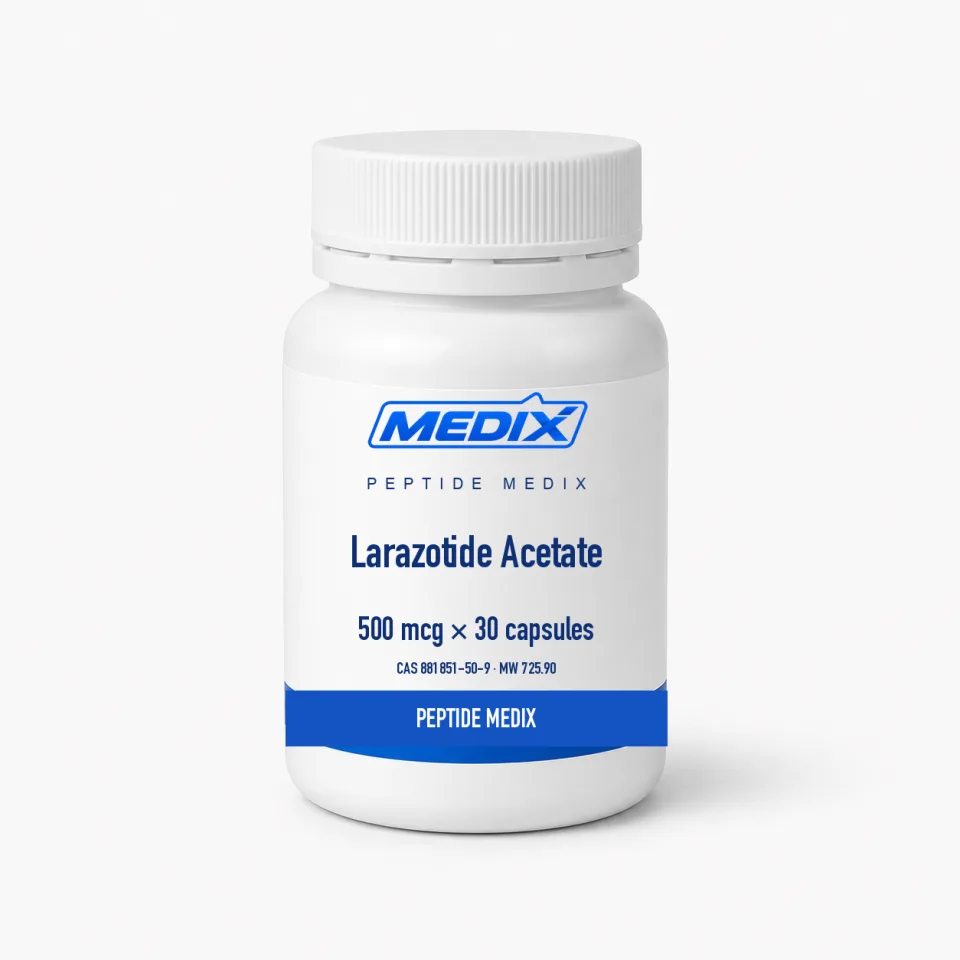
- FormOral capsule, sealed bottle with tamper-evident closure
- Mol. weight725.90 g/mol
- Research areasIntestinal permeability, tight-junction proteins, celiac and barrier models
Overview
Larazotide acetate is a synthetic octapeptide, sequence Gly-Gly-Val-Leu-Val-Gln-Pro-Gly, developed as an antagonist at the zonulin receptor pathway that regulates intestinal tight junctions. Zonulin is the human protein that loosens the junctional complexes between epithelial cells, and larazotide was designed to oppose that loosening rather than to act on any downstream inflammatory target.
Two features distinguish it from most peptides in this catalogue. First, it is minimally absorbed by design: the intent is action within the gut lumen at the epithelial surface, not systemic exposure, which is why it is supplied here as an oral capsule at 500 micrograms per unit in 30 and 60 counts. Second, it carries a comparatively substantial human trial record for a peptide of this kind, with phase 2 studies in celiac disease.
The peptide is produced by solid-phase synthesis and purified by reversed-phase HPLC to at least 99% before filling, with a certificate of analysis matched to the lot number on the bottle. Research use centres on epithelial barrier permeability, tight-junction protein behaviour and the zonulin pathway. Supplied strictly as research material.
Specifications
Identity
- CAS number
- 881851-50-9
- Molecular formula
- C32H55N9O10
- Molecular weight
- 725.90 g/mol
- Amino acid sequence
- Gly-Gly-Val-Leu-Val-Gln-Pro-Gly
- Chain length
- 8 amino acids (octapeptide), acetate salt
- Peptide class
- Tight-junction regulator; zonulin pathway antagonist
Supply & purity
- Form
- Oral capsule, sealed bottle with tamper-evident closure
- Purity
- ≥99% by HPLC; lot-matched COA available
Additional detail
- Peptide per capsule
- 500 mcg larazotide acetate
- Available counts
- 30 capsules, 60 capsules
- Absorption profile
- Reported as minimally absorbed; acts locally within the gut lumen
- Research areas
- Intestinal permeability, tight-junction proteins, celiac and barrier models
- Storage
- Cool, dry conditions away from direct light; keep desiccant in the bottle
Units and conversions
The arithmetic on an oral format is unit arithmetic rather than dilution arithmetic. Use the milligram to microgram converter to line a per-unit figure up against a method written in different units.
Certificate of analysis
Every lot of Larazotide Acetate is released against a certificate of analysis: the batch-specific laboratory data for that lot, not a generic document for the compound. The lot number on the certificate matches the lot number printed on the label you receive — the vial label itself, where the product is vialled — so the record and the material it describes can always be reconciled.
Purity: ≥99% by HPLC — the specification for this listing. The figure for the lot you receive is the one reported on that lot’s certificate.
No lot certificate is on display on this page at the moment. That is a publishing state and not a testing one: lots are released and documented as described above whether or not the document is posted here, and we will send what exists for the lot in stock, or for a lot already on your bench, by its number.
Certificates are available on request before you order as well as after, with no account and no charge. Request the certificate for this listing, read the testing and documentation policy in full, or see how to read a peptide COA.
Questions about Larazotide Acetate
What is larazotide acetate?
It is a synthetic octapeptide, Gly-Gly-Val-Leu-Val-Gln-Pro-Gly, developed as an antagonist of the zonulin pathway that regulates intestinal tight junctions. It is supplied here as a 500 microgram oral research capsule and is studied in epithelial barrier permeability models.
How does larazotide differ from other gut research peptides?
It has a specific structural target rather than a broadly described mechanism, and it is intended to act within the gut lumen instead of systemically. It also carries a comparatively substantial human trial record, including phase 2 studies in celiac disease.
What did the celiac trials show?
Phase 2 work examined it during controlled gluten challenge, and a phase 2b programme in patients with residual symptoms despite a gluten-free diet reported that the primary endpoint was not met while several secondary and symptom endpoints reached significance. It holds no marketing approval.
Why is minimal absorption a design feature?
Because the target is at the apical surface of intestinal epithelium, not in circulation. The pharmacological aim is residence in the gut lumen where tight junctions can be reached, so low systemic uptake is intended rather than a limitation of the molecule.
Is a certificate of analysis available?
Yes. The peptide is purified by reversed-phase HPLC to at least 99% with mass confirmation against the expected 725.90 g/mol mass, and a certificate matched to the lot number on your bottle label is available on request before or after ordering.
Related