- ≥99% by HPLC
- Lot-matched certificate of analysis
- Ships next business day, tracked
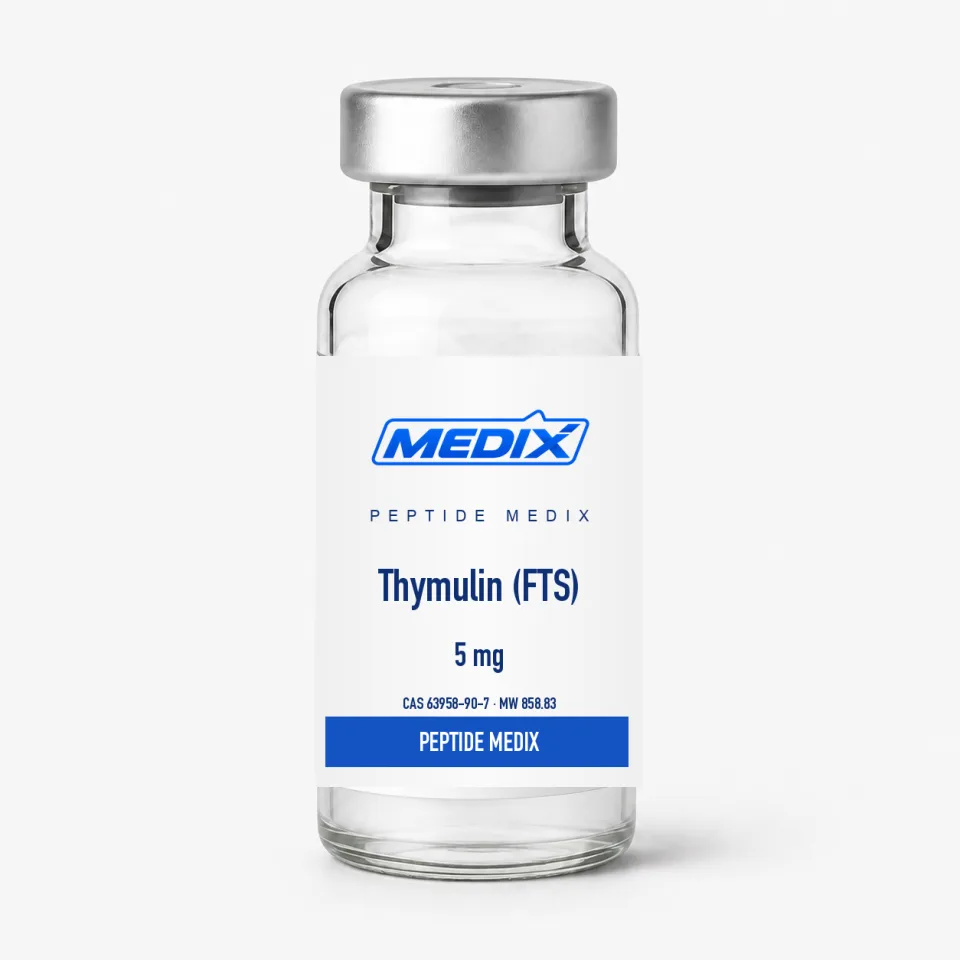
Thymulin (FTS)
Thymulin (FTS), a zinc-dependent nine-residue thymic nonapeptide
- FormLyophilized powder, sealed glass vial with crimped stopper
- Mol. weight858.83 g/mol
- Research areasZinc status and immunity, thymic involution, neuroendocrine-immune interaction
Overview
Thymulin, historically called facteur thymique sérique or FTS, is a nine-residue peptide produced by thymic epithelial cells. Its defining feature is a strict metal dependence: the peptide is biologically inactive on its own and acquires activity only when it binds a zinc ion. That property, described in the founding literature from the 1970s and 1980s, is why the zinc-bound form is sometimes listed as a distinct entity.
The zinc requirement gave the peptide a persistent role in immunology research, because circulating thymulin activity tracks zinc status. Studies of zinc deficiency, thymic involution with age and endocrine influences on thymic function all use thymulin activity as a readout, which makes it a reagent with a specific analytical purpose rather than only a subject of study.
Our material is produced by solid-phase synthesis, purified by reversed-phase HPLC to at least 99% and supplied as a lyophilized powder in sealed 5 mg and 10 mg vials with a lot-matched certificate of analysis. Note that vials supply the peptide itself; whether zinc is present in a given experimental system is determined by the buffer and study design. Sold for laboratory research only.
Specifications
Identity
- CAS number
- 63958-90-7
- Molecular formula
- C33H54N12O15
- Molecular weight
- 858.83 g/mol
- Amino acid sequence
- Pyr-Ala-Lys-Ser-Gln-Gly-Gly-Ser-Asn
- Chain length
- 9 amino acids, N-terminal pyroglutamate
Supply & purity
- Form
- Lyophilized powder, sealed glass vial with crimped stopper
- Purity
- ≥99% by HPLC; lot-matched COA available
- Available sizes
- 5 mg, 10 mg
Handling & storage
- Storage (lyophilized)
- −20 °C, sealed and protected from light and moisture
Additional detail
- Other names
- FTS, facteur thymique sérique, serum thymic factor
- Metal dependence
- Activity reported only in the zinc-bound form
- Source
- Produced natively by thymic epithelial cells
- Research areas
- Zinc status and immunity, thymic involution, neuroendocrine-immune interaction
Working out the concentration
Thymulin (FTS) ships as a lyophilized powder, so nothing on this page can state a concentration: the figure you work with is the one you create when you add diluent. Put the vial mass and the volume you intend to use into the peptide reconstitution calculator and it returns mg/mL, mcg/mL and the mass sitting at each mark on a U-100 syringe.
Certificate of analysis
Every lot of Thymulin (FTS) is released against a certificate of analysis: the batch-specific laboratory data for that lot, not a generic document for the compound. The lot number on the certificate matches the lot number printed on the label you receive — the vial label itself, where the product is vialled — so the record and the material it describes can always be reconciled.
Purity: ≥99% by HPLC — the specification for this listing. The figure for the lot you receive is the one reported on that lot’s certificate.
No lot certificate is on display on this page at the moment. That is a publishing state and not a testing one: lots are released and documented as described above whether or not the document is posted here, and we will send what exists for the lot in stock, or for a lot already on your bench, by its number.
Certificates are available on request before you order as well as after, with no account and no charge. Request the certificate for this listing, read the testing and documentation policy in full, or see how to read a peptide COA.
Questions about Thymulin (FTS)
What is Thymulin?
Thymulin, historically called facteur thymique sérique or FTS, is a nine-residue peptide produced by thymic epithelial cells. It is supplied here as a lyophilized research powder and is studied in zinc status, thymic involution and neuroendocrine-immune research.
Why is zinc so important for Thymulin?
Published work reports that the peptide is inactive on its own and acquires activity only when it binds a zinc ion in a one-to-one complex. That dependence is the reason thymulin activity has been used as a functional readout of zinc availability in nutritional immunology studies.
Do your vials contain zinc?
No. The vial supplies the peptide itself. Whether the active zinc-bound form is present in a given experiment depends on the trace metal content of your buffer system and on any chelating agents used, so this becomes part of the study design rather than the product specification.
How does Thymulin differ from Thymalin?
Thymulin is a single defined nonapeptide with a known sequence, formula and mass that can be verified analytically. Thymalin is a complex of multiple thymic polypeptides with no single structure. They share a tissue of origin but are not interchangeable in research.
What purity is supplied and is a COA available?
Each lot is purified and analysed by reversed-phase HPLC to at least 99% with mass confirmation against the expected 858.83 g/mol mass. A certificate of analysis matched to the lot number printed on your vial is available on request before or after ordering.
Related