- ≥99% by HPLC
- Lot-matched certificate of analysis
- Ships next business day, tracked
KPV Peptide
Lys-Pro-Val tripeptide from the alpha-MSH C-terminus, lyophilized vials
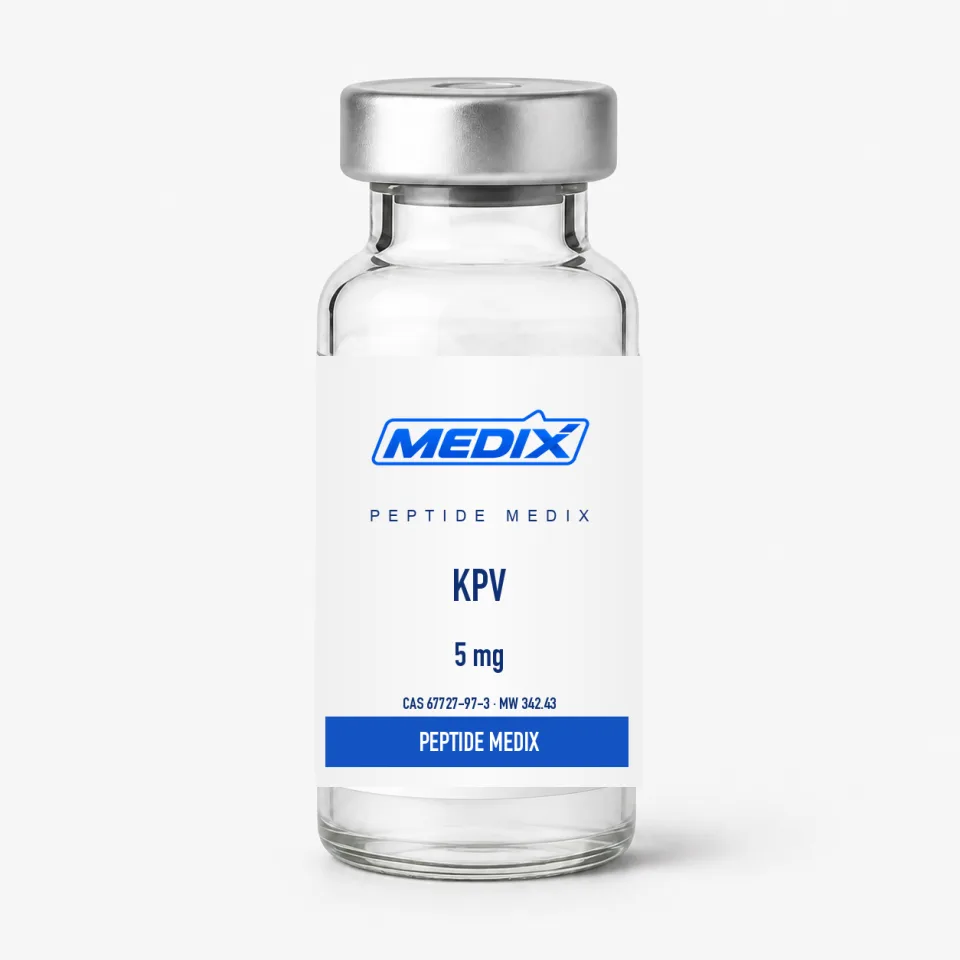
- FormLyophilized powder, sealed glass vial with crimped stopper
- Mol. weight342.43 g/mol
- Research areasInflammatory signalling, NF-kappa B pathway, intestinal and dermal inflammation models
Overview
KPV is a tripeptide of lysine, proline and valine that reproduces the C-terminal three residues of alpha-melanocyte-stimulating hormone. It is one of the shortest sequences in active inflammation research, and that brevity is the point: the fragment retains the anti-inflammatory character attributed to the parent hormone in cell work while carrying none of the melanocortin receptor activity responsible for alpha-MSH pigmentation effects.
The peptide is produced by solid-phase synthesis, purified by reversed-phase HPLC to at least 99% and supplied as a lyophilized powder in a sealed glass vial in 5 mg and 10 mg sizes. Because the molecule weighs only 342 g/mol, a single milligram represents a large molar quantity relative to longer peptides, so these vial sizes cover a considerable amount of plate-based or animal work.
Specifications
Identity
- CAS number
- 67727-97-3
- Molecular formula
- C16H30N4O4
- Molecular weight
- 342.43 g/mol
- Amino acid sequence
- Lys-Pro-Val
- Chain length
- 3 amino acids (tripeptide)
- Peptide class
- Melanocortin-derived tripeptide; C-terminal fragment of alpha-MSH (11–13)
Supply & purity
- Form
- Lyophilized powder, sealed glass vial with crimped stopper
- Purity
- ≥99% by HPLC; lot-matched COA available
- Available sizes
- 5 mg, 10 mg
- Solubility
- Freely soluble in bacteriostatic or sterile water
Handling & storage
- Storage (lyophilized)
- −20 °C, sealed and protected from light and moisture
- Storage (reconstituted)
- 2–8 °C, protected from light, used within the study window
Additional detail
- Research areas
- Inflammatory signalling, NF-kappa B pathway, intestinal and dermal inflammation models
Working out the concentration
Reconstitution is where the arithmetic lives. The same vial made up with 1 mL or with 3 mL of diluent gives three-fold different numbers, which is why a reconstitution volume calculator is more use here than a fixed table: enter the vial mass and your diluent volume and read the concentration back.
If the protocol asks for a molar concentration, the molar concentration calculator converts between 342.43 g/mol, the mass you weigh out and the volume you dissolve it in.
Certificate of analysis
Every lot of KPV is released against a certificate of analysis: the batch-specific laboratory data for that lot, not a generic document for the compound. The lot number on the certificate matches the lot number printed on the label you receive — the vial label itself, where the product is vialled — so the record and the material it describes can always be reconciled.
Purity: ≥99% by HPLC — the specification for this listing. The figure for the lot you receive is the one reported on that lot’s certificate.
No lot certificate is on display on this page at the moment. That is a publishing state and not a testing one: lots are released and documented as described above whether or not the document is posted here, and we will send what exists for the lot in stock, or for a lot already on your bench, by its number.
Certificates are available on request before you order as well as after, with no account and no charge. Request the certificate for this listing, read the testing and documentation policy in full, or see how to read a peptide COA.
Questions about KPV
What is KPV?
KPV is a synthetic tripeptide made of lysine, proline and valine that corresponds to the last three residues of alpha-melanocyte-stimulating hormone. It is supplied as a lyophilized research powder and is studied mainly in models of inflammatory signalling and intestinal epithelial function.
How does KPV differ from alpha-MSH?
Alpha-MSH is a thirteen-residue hormone that acts at melanocortin receptors and influences pigmentation as well as inflammation. KPV is only its final three residues. Research reports retention of the anti-inflammatory character without the receptor-mediated pigmentation activity of the full sequence.
Is a certificate of analysis available?
Yes. Every lot is analysed by reversed-phase HPLC to at least 99% purity with mass confirmation of the expected 342.43 g/mol mass, and a certificate matched to the lot number on your vial label is available on request before or after ordering.
Which size should I order?
Both the 5 mg and 10 mg vials go a long way because the peptide is so light: at 342 g/mol, a milligram is a far larger molar quantity than a milligram of a thirty-residue peptide. Choose the 5 mg for pilot work and 10 mg for extended series.
What is KPV usually dissolved in?
Laboratories most commonly reconstitute with bacteriostatic or sterile water, in which the tripeptide dissolves readily to give a clear solution. Buffered systems are used where an assay requires controlled pH. The choice of solvent belongs to the study design and is made by the researcher.
Related