- ≥99% by HPLC
- Lot-matched certificate of analysis
- Ships next business day, tracked
VIP (Vasoactive Intestinal Peptide)
Vasoactive intestinal peptide, a 28-residue amidated neuropeptide
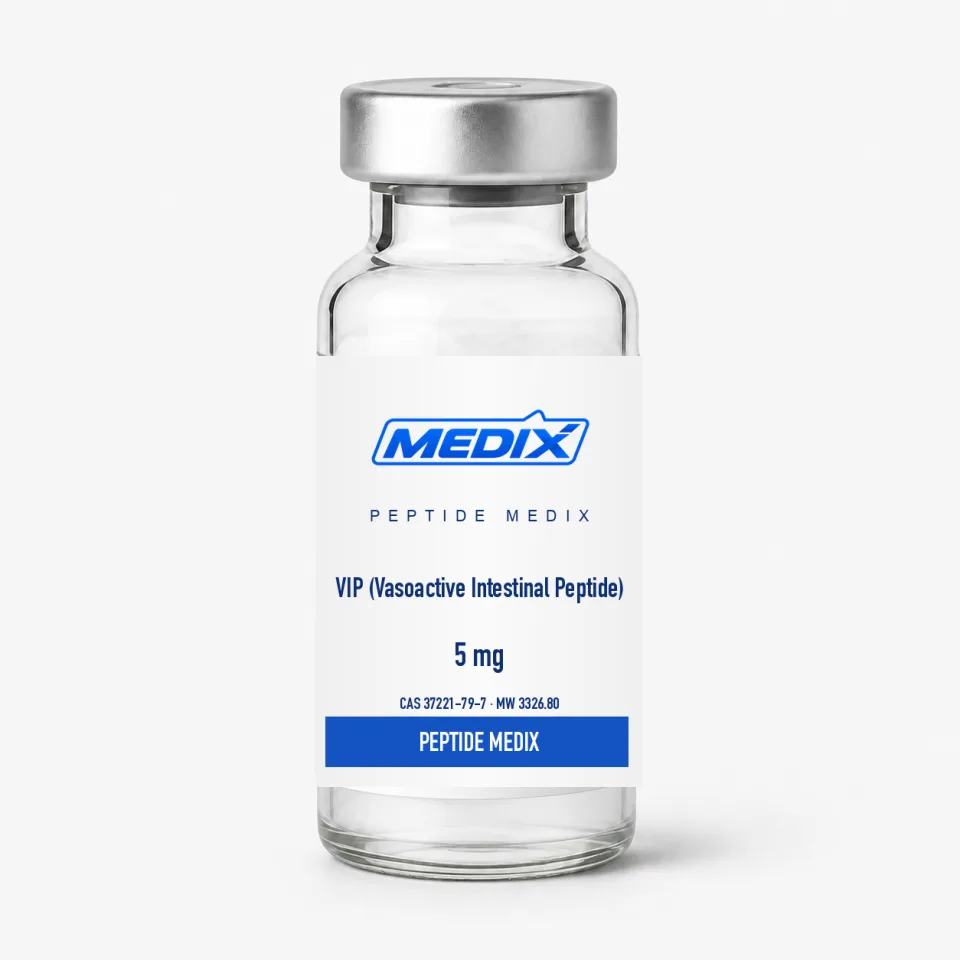
- FormLyophilized powder, sealed glass vial with crimped stopper
- Mol. weight3326.80 g/mol
- Research areasVasodilation and smooth muscle, airway physiology, circadian biology, immune modulation
Overview
Vasoactive intestinal peptide is a twenty-eight residue neuropeptide first isolated from porcine intestine and later shown to be widely distributed through the central and peripheral nervous systems, the gastrointestinal tract, the lungs and immune tissue. It belongs to the secretin-glucagon superfamily, sharing structural features with PACAP, secretin and glucagon, and is amidated at its C-terminus, a modification required for full receptor engagement.
Its signalling runs primarily through two G protein-coupled receptors, VPAC1 and VPAC2, both of which raise intracellular cyclic AMP. The breadth of receptor distribution explains why VIP appears in such varied literatures — smooth muscle relaxation and vasodilation, circadian regulation in the suprachiasmatic nucleus, airway and gut physiology, and immune cell modulation all draw on the same molecule.
The peptide supplied here is made by solid-phase synthesis, purified by reversed-phase HPLC to at least 99% and filled as a lyophilized powder into sealed 5 mg and 10 mg glass vials, each with a lot-matched certificate of analysis. Because of its length and its C-terminal amide, it is a comparatively demanding synthesis. Sold for laboratory research only.
Specifications
Identity
- CAS number
- 37221-79-7
- Molecular weight
- 3326.80 g/mol
- Amino acid sequence
- HSDAVFTDNYTRLRKQMAVKKYLNSILN-NH2
- Chain length
- 28 amino acids, C-terminally amidated
- Peptide class
- Neuropeptide of the secretin-glucagon (VIP/PACAP) superfamily
Supply & purity
- Form
- Lyophilized powder, sealed glass vial with crimped stopper
- Purity
- ≥99% by HPLC; lot-matched COA available
- Available sizes
- 5 mg, 10 mg
Handling & storage
- Storage (lyophilized)
- −20 °C, sealed and protected from light and moisture
- Storage (reconstituted)
- 2–8 °C, protected from light, used within the study window
Additional detail
- Receptors
- VPAC1 and VPAC2 G protein-coupled receptors; signals via cyclic AMP
- Native distribution
- Central and enteric nervous systems, lung, gut, immune tissue
- Research areas
- Vasodilation and smooth muscle, airway physiology, circadian biology, immune modulation
Working out the concentration
VIP (Vasoactive Intestinal Peptide) ships as a lyophilized powder, so nothing on this page can state a concentration: the figure you work with is the one you create when you add diluent. Put the vial mass and the volume you intend to use into the peptide reconstitution calculator and it returns mg/mL, mcg/mL and the mass sitting at each mark on a U-100 syringe.
Certificate of analysis
Every lot of VIP (Vasoactive Intestinal Peptide) is released against a certificate of analysis: the batch-specific laboratory data for that lot, not a generic document for the compound. The lot number on the certificate matches the lot number printed on the label you receive — the vial label itself, where the product is vialled — so the record and the material it describes can always be reconciled.
Purity: ≥99% by HPLC — the specification for this listing. The figure for the lot you receive is the one reported on that lot’s certificate.
No lot certificate is on display on this page at the moment. That is a publishing state and not a testing one: lots are released and documented as described above whether or not the document is posted here, and we will send what exists for the lot in stock, or for a lot already on your bench, by its number.
Certificates are available on request before you order as well as after, with no account and no charge. Request the certificate for this listing, read the testing and documentation policy in full, or see how to read a peptide COA.
Questions about VIP (Vasoactive Intestinal Peptide)
What is VIP?
VIP is vasoactive intestinal peptide, a twenty-eight amino acid neuropeptide of the secretin-glucagon superfamily. Originally isolated from intestine, it is expressed throughout the nervous system, lung, gut and immune tissue, and signals through the VPAC1 and VPAC2 receptors.
Why does the sequence end in NH2?
The native peptide is amidated at its C-terminus, a post-translational modification that the published pharmacology associates with full receptor binding and activity. Synthetic material intended for research reproduces that amide rather than leaving a free carboxyl terminus.
What receptors does VIP act on?
Principally VPAC1 and VPAC2, two closely related G protein-coupled receptors that activate adenylate cyclase and raise intracellular cyclic AMP. Because native VIP engages both, much pharmacological work uses selective analogues to separate the contributions of each receptor subtype.
What purity is supplied and is a COA available?
Each lot is purified and analysed by reversed-phase HPLC to at least 99% with mass confirmation against the expected mass of 3326.80 g/mol. A certificate of analysis matched to the lot number on your vial label is available on request before or after purchase.
How stable is reconstituted VIP?
Less stable than short, rigid peptides. It is peptidase-sensitive and, like most longer amidated sequences, prone to aggregation and surface adsorption. Laboratories generally aliquot immediately after reconstitution, keep stocks cold and protected from light, and prepare working dilutions fresh on the day.
Related