- Peptide purity input: ≥99% by HPLC
- Lot-matched certificate of analysis
- Ships next business day, tracked
Tissue Repair & Healing Peptides
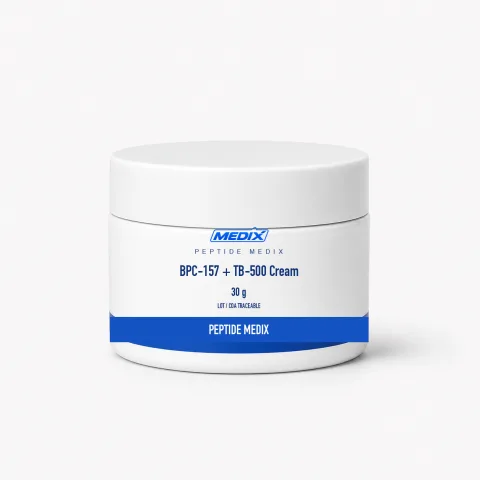
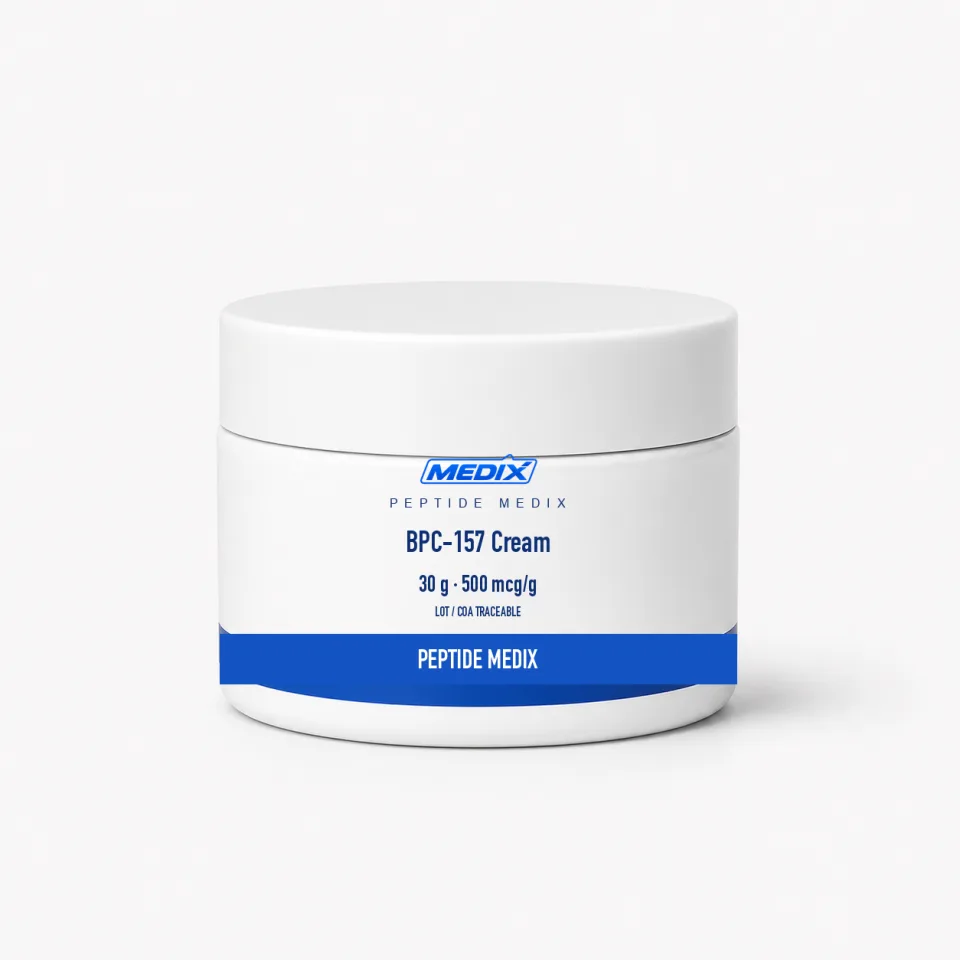
BPC-157 Cream
500 mcg/g BPC-157 in an emollient cream base — 30 g and 50 g jars
- FormEmollient oil-in-water cream in a screw-top jar
- Research areasVehicle and occlusion effects, percutaneous penetration of large hydrophilic peptides, ex vivo skin models, fibroblast and wound-model work
Overview
This is BPC-157 dispersed in an emollient oil-in-water cream base at 500 micrograms per gram, equivalent to 0.05% w/w, supplied in 30 g and 50 g jars. The peptide is the same synthetic 15-amino-acid gastric pentadecapeptide used in our lyophilized vials, sequence Gly-Glu-Pro-Pro-Pro-Gly-Lys-Pro-Ala-Asp-Asp-Ala-Gly-Leu-Val, built from ≥99% HPLC-purity material with a lot-matched certificate of analysis. A 30 g jar therefore contains roughly 15 mg of peptide and a 50 g jar roughly 25 mg.
The open question this presentation is built around is whether a molecule of 1419.55 g/mol and pronounced hydrophilicity crosses intact stratum corneum at all; it sits well above the several-hundred-dalton range in which passive permeation is generally observed. Percutaneous studies with peptides of this size therefore treat vehicle composition, occlusion, contact time and barrier integrity as the variables, using Franz-cell and ex vivo skin systems, with fibroblast and wound-model work downstream of that. Holding the loading fixed at 500 micrograms per gram across both jar sizes keeps those comparisons free of a concentration difference. The emulsion is the thing to protect: heat cycling can break an oil-in-water base, so jars are kept cool, dark and closed, with a clean spatula used for each aliquot.
Specifications
Identity
- Amino acid sequence
- Gly-Glu-Pro-Pro-Pro-Gly-Lys-Pro-Ala-Asp-Asp-Ala-Gly-Leu-Val
Supply & purity
- Form
- Emollient oil-in-water cream in a screw-top jar
- Available sizes
- 30 g · 500 mcg/g; 50 g · 500 mcg/g
Additional detail
- Active concentration
- 500 mcg BPC-157 per gram (0.05% w/w)
- Approximate peptide content
- ≈15 mg per 30 g jar; ≈25 mg per 50 g jar
- Active
- BPC-157, synthetic gastric pentadecapeptide
- Peptide purity input
- ≥99% by HPLC; lot-matched COA available
- CAS number (active)
- 137525-51-0
- Molecular formula (active)
- C62H98N16O22
- Molecular weight (active)
- 1419.55 g/mol
- Vehicle
- Emollient oil-in-water base, no added fragrance or colourant
- Research areas
- Vehicle and occlusion effects, percutaneous penetration of large hydrophilic peptides, ex vivo skin models, fibroblast and wound-model work
- Storage
- Cool and dark, ideally 2–8 °C; keep the jar closed between uses
- Preparation required
- None — fixed loading per gram, no reconstitution step
Units and conversions
BPC-157 Cream arrives already made up, so there is no diluent volume to choose and no reconstitution step. What is left is unit work — percent to mg/mL, milligrams to micrograms, millilitres to microlitres — and the mcg to mg converter does all three.
Certificate of analysis
Every lot of BPC-157 Cream is released against a certificate of analysis: the batch-specific laboratory data for that lot, not a generic document for the compound. The lot number on the certificate matches the lot number printed on the label you receive — the vial label itself, where the product is vialled — so the record and the material it describes can always be reconciled.
Peptide purity input: ≥99% by HPLC — the specification for this listing. The figure for the lot you receive is the one reported on that lot’s certificate.
No lot certificate is on display on this page at the moment. That is a publishing state and not a testing one: lots are released and documented as described above whether or not the document is posted here, and we will send what exists for the lot in stock, or for a lot already on your bench, by its number.
Certificates are available on request before you order as well as after, with no account and no charge. Request the certificate for this listing, read the testing and documentation policy in full, or see how to read a peptide COA.
Questions about BPC-157 Cream
How much BPC-157 is in each jar?
The cream is loaded at 500 micrograms per gram, so a 30 g jar contains approximately 15 mg of peptide and a 50 g jar approximately 25 mg. Both sizes use the same concentration, which means results are comparable between them within a single study.
Does BPC-157 actually penetrate skin?
That is the open question this format exists to investigate. At about 1420 g/mol and strongly hydrophilic, BPC-157 is well above the size range that passively crosses intact stratum corneum. Penetration studies therefore focus on vehicle, occlusion, contact time and barrier state rather than assuming systemic transfer.
Is the peptide the same as in the vials?
Yes. The cream is formulated from the same ≥99% HPLC-purity BPC-157, with identical CAS number, molecular formula and 15-residue sequence. Only the presentation differs — a fixed loading per gram in an emulsion rather than lyophilized powder requiring reconstitution.
Do you provide a certificate of analysis?
Yes. A lot-matched COA is available for the peptide used in the batch, covering HPLC purity and mass-spectrometric identity confirmation. Quote the jar lot number when requesting the document; the COA describes the peptide input rather than the finished emulsion.
How should the cream be stored?
Cool, dark and closed, with refrigeration preferred for extended storage. Avoid heat cycling, which can break the emulsion. Use a clean spatula for each aliquot, keep the lid on between uses, and log the date the jar was first opened so in-use time can be accounted for.
Related