- ≥99% by HPLC
- Lot-matched certificate of analysis
- Ships next business day, tracked
Tissue Repair & Healing Peptides
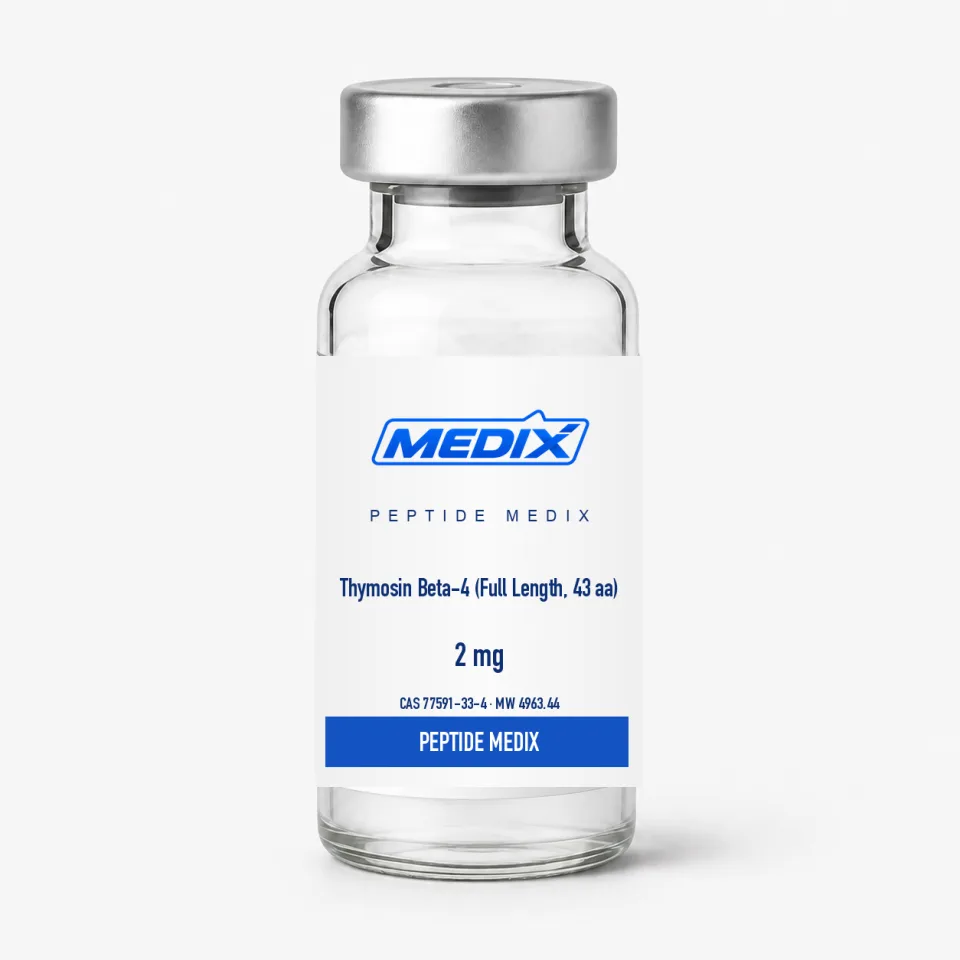
Thymosin Beta-4 (Full Length, 43 aa)
Full 43-residue acetylated thymosin beta-4, the intact actin-sequestering protein
- FormLyophilized powder, sealed glass vial with crimped stopper
- Mol. weight4963.44 g/mol
- Research areasActin dynamics, cell migration, wound closure, angiogenesis, cardiac and corneal repair
Overview
This is the complete 43-amino-acid thymosin beta-4 sequence with its native N-terminal acetylation — not the seven-residue actin-binding fragment sold as TB-500. Thymosin beta-4 is one of the most abundant intracellular proteins in mammalian cells and the principal G-actin sequestering protein, binding monomeric actin in a one-to-one complex and thereby holding a reserve pool that regulates how quickly filaments can polymerise.
The distinction from the fragment matters experimentally. TB-500 reproduces the central actin-binding motif LKKTETQ, but the full-length protein carries additional structure implicated in interactions beyond actin, including reported binding partners in cell migration, angiogenesis and inflammatory signalling. Studies that ask whether an observed effect depends on the whole protein or only on the binding motif need both molecules, which is why laboratories usually run them side by side.
Specifications
Identity
- CAS number
- 77591-33-4
- Molecular weight
- 4963.44 g/mol
- Amino acid sequence
- Ac-Ser-Asp-Lys-Pro-Asp-Met-Ala-Glu-Ile-Glu-Lys-Phe-Asp-Lys-Ser-Lys-Leu-Lys-Lys-Thr-Glu-Thr-Gln-Glu-Lys-Asn-Pro-Leu-Pro-Ser-Lys-Glu-Thr-Ile-Glu-Gln-Glu-Lys-Gln-Ala-Gly-Glu-Ser
- Chain length
- 43 amino acids, N-terminally acetylated
- Peptide class
- Beta-thymosin family; G-actin sequestering protein
Supply & purity
- Form
- Lyophilized powder, sealed glass vial with crimped stopper
- Purity
- ≥99% by HPLC; lot-matched COA available
- Available sizes
- 2 mg, 5 mg
- Solubility
- Readily soluble in sterile or bacteriostatic water; highly hydrophilic and acidic
Handling & storage
- Storage (lyophilized)
- −20 °C, sealed and protected from light and moisture
- Storage (reconstituted)
- 2–8 °C, protected from light; aliquot for longer holds
Additional detail
- Key motif
- LKKTETQ actin-binding motif at residues 17–23
- Relationship to TB-500
- TB-500 is the acetylated 17–23 fragment of this sequence
- Research areas
- Actin dynamics, cell migration, wound closure, angiogenesis, cardiac and corneal repair
Working out the concentration
Reconstitution is where the arithmetic lives. The same vial made up with 1 mL or with 3 mL of diluent gives three-fold different numbers, which is why a reconstitution volume calculator is more use here than a fixed table: enter the vial mass and your diluent volume and read the concentration back.
If the protocol asks for a molar concentration, the molar concentration calculator converts between 4963.44 g/mol, the mass you weigh out and the volume you dissolve it in.
Certificate of analysis
Every lot of Thymosin Beta-4 (Full Length, 43 aa) is released against a certificate of analysis: the batch-specific laboratory data for that lot, not a generic document for the compound. The lot number on the certificate matches the lot number printed on the label you receive — the vial label itself, where the product is vialled — so the record and the material it describes can always be reconciled.
Purity: ≥99% by HPLC — the specification for this listing. The figure for the lot you receive is the one reported on that lot’s certificate.
No lot certificate is on display on this page at the moment. That is a publishing state and not a testing one: lots are released and documented as described above whether or not the document is posted here, and we will send what exists for the lot in stock, or for a lot already on your bench, by its number.
Certificates are available on request before you order as well as after, with no account and no charge. Request the certificate for this listing, read the testing and documentation policy in full, or see how to read a peptide COA.
Questions about Thymosin Beta-4 (Full Length, 43 aa)
How is this different from TB-500?
TB-500 is the acetylated seven-residue fragment corresponding to residues 17 to 23 of this sequence. The material here is the complete 43-amino-acid protein, which carries that motif plus all the flanking structure. Laboratories use both to test whether the motif alone accounts for a given effect.
Why are the vial sizes smaller than TB-500 vials?
Synthesising a 43-residue peptide at high purity is considerably more demanding than a seven-residue fragment, so full-length thymosin beta-4 is supplied in 2 mg and 5 mg vials. On a molar basis the difference is larger still, since the full protein is about five and a half times heavier.
What purity and documentation are supplied?
Each lot is tested by HPLC to at least 99% purity with identity confirmed by mass spectrometry, and a lot-matched certificate of analysis is available. Mass spectrometry matters especially here, because the acidic disordered sequence behaves anomalously on gels and size-exclusion columns.
What does it do at the molecular level?
It binds monomeric G-actin in a one-to-one complex and holds it out of the polymerising pool, acting as the main intracellular actin buffer. That role places it at the centre of research on cytoskeletal dynamics, cell migration and processes that depend on rapid filament turnover.
How should it be stored?
Keep the sealed lyophilized vial at −20 °C, protected from light and moisture. Once reconstituted, store at 2–8 °C for short study windows or aliquot and freeze for longer holds. Avoid repeated freeze-thaw cycles and monitor the internal methionine for oxidation in long-running work.
Related