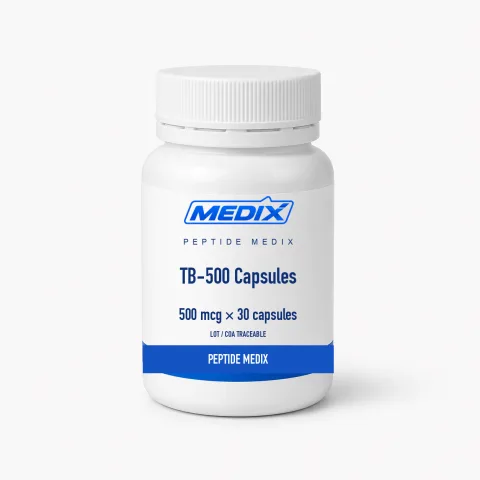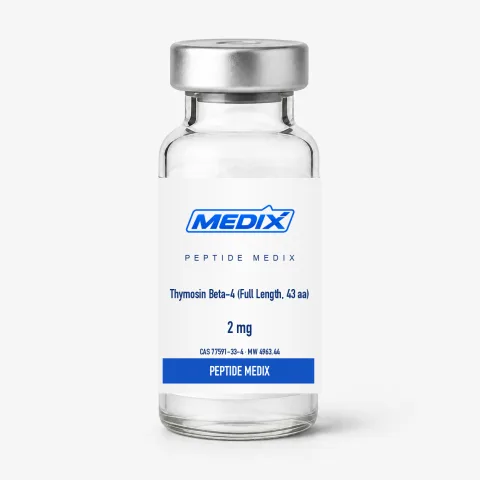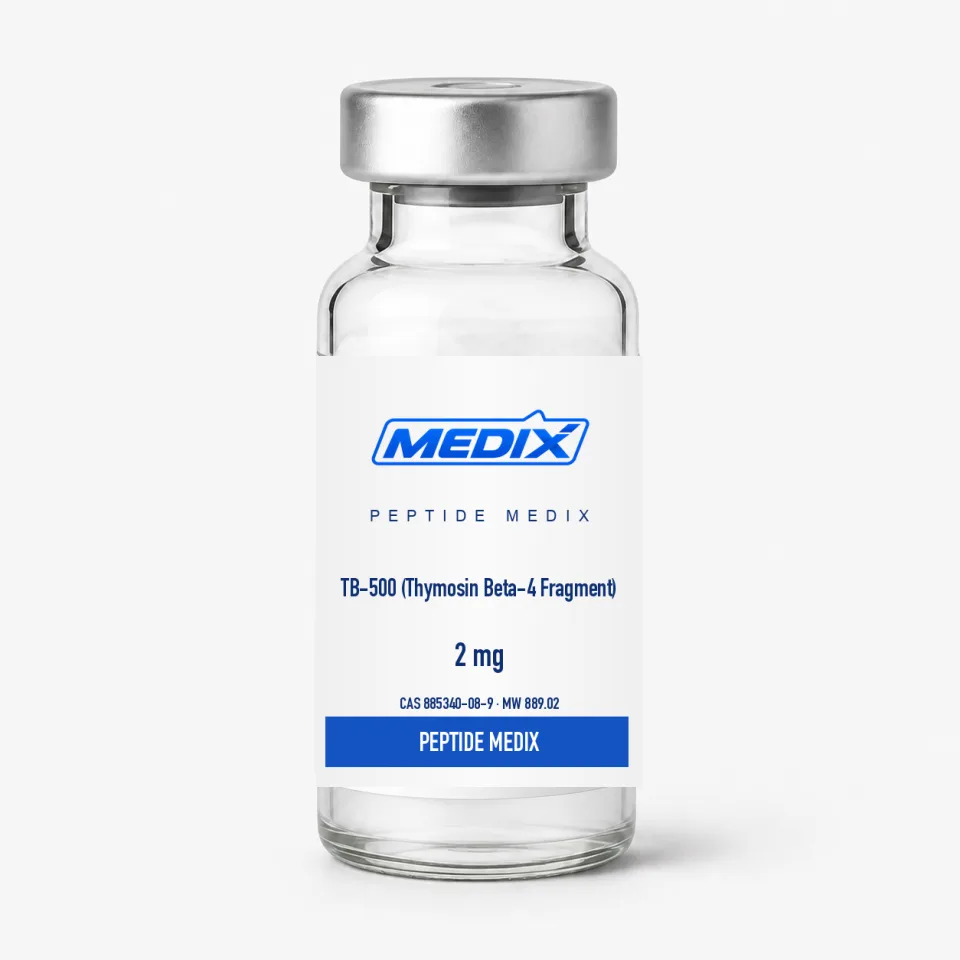
- ≥99% by HPLC
- Lot-matched certificate of analysis
- Ships next business day, tracked
Tissue Repair & Healing Peptides
TB-500 (Thymosin Beta-4 Fragment)
Acetylated LKKTETQ fragment, also known as ABP-7, in research vials
- FormLyophilized powder, sealed glass vial with crimped stopper
- Mol. weight889.02 g/mol
- Research areasCell migration, wound closure, angiogenesis, cardiac and corneal repair models
Overview
TB-500 is the acetylated seven-residue sequence Ac-Leu-Lys-Lys-Thr-Glu-Thr-Gln, corresponding to residues 17–23 of thymosin beta-4. The same defined molecule is also cataloged as ABP-7, a name derived from its actin-binding peptide length. ABP-7 is therefore an alias for this existing product—not a separate peptide or additional SKU.
The fragment isolates the LKKTETQ actin-binding motif of the full 43-residue protein. It is supplied as lyophilized powder in 2 mg, 5 mg, 10 mg and 20 mg sealed vials, plus a 10-vial research kit. Each lot is assayed to at least 99% purity by reversed-phase HPLC with mass-based identity confirmation, and a lot-matched certificate of analysis is available.
Specifications
Identity
- CAS number
- 885340-08-9
- Molecular formula
- C38H68N10O14
- Molecular weight
- 889.02 g/mol
- Amino acid sequence
- Ac-Leu-Lys-Lys-Thr-Glu-Thr-Gln (thymosin beta-4 residues 17–23)
- Chain length
- 7 amino acids, N-terminally acetylated
- Peptide class
- Thymosin beta-4 fragment; actin-binding domain peptide
Supply & purity
- Form
- Lyophilized powder, sealed glass vial with crimped stopper
- Purity
- ≥99% by HPLC; lot-matched COA available
- Available sizes
- 2 mg, 5 mg, 10 mg, 20 mg; 10-vial kit (10 × 5 mg)
Handling & storage
- Storage (lyophilized)
- −20 °C, sealed and protected from light and moisture
- Storage (reconstituted)
- 2–8 °C, protected from light, used within the study window
Additional detail
- Also known as
- ABP-7, Ac-LKKTETQ, thymosin beta-4 fragment 17–23
- Parent protein
- Thymosin beta-4, a 43-residue G-actin sequestering protein
- Research areas
- Cell migration, wound closure, angiogenesis, cardiac and corneal repair models
Working out the concentration
Because TB-500 (Thymosin Beta-4 Fragment) arrives dry, its concentration is a decision rather than a specification. Run the numbers through the reconstitution calculator — vial mass in, diluent volume in, mg/mL and mass per syringe unit out.
Certificate of analysis
Every lot of TB-500 (Thymosin Beta-4 Fragment) is released against a certificate of analysis: the batch-specific laboratory data for that lot, not a generic document for the compound. The lot number on the certificate matches the lot number printed on the label you receive — the vial label itself, where the product is vialled — so the record and the material it describes can always be reconciled.
Purity: ≥99% by HPLC — the specification for this listing. The figure for the lot you receive is the one reported on that lot’s certificate.
No lot certificate is on display on this page at the moment. That is a publishing state and not a testing one: lots are released and documented as described above whether or not the document is posted here, and we will send what exists for the lot in stock, or for a lot already on your bench, by its number.
Certificates are available on request before you order as well as after, with no account and no charge. Request the certificate for this listing, read the testing and documentation policy in full, or see how to read a peptide COA.
Questions about TB-500 (Thymosin Beta-4 Fragment)
What exactly is TB-500?
TB-500 is a synthetic seven-amino-acid peptide with an acetylated N-terminus that reproduces residues 17 to 23 of thymosin beta-4. The exact sequence is Ac-LKKTETQ and is also sold under the alias ABP-7.
Is ABP-7 a different product from TB-500?
No. In this catalog, both names identify the same acetylated seven-residue molecule: Ac-Leu-Lys-Lys-Thr-Glu-Thr-Gln. A second ABP-7 product page would duplicate the existing TB-500 SKU and split its search identity.
Is TB-500 the same thing as thymosin beta-4?
No. Thymosin beta-4 is the complete 43-residue protein; TB-500 is a seven-residue fragment of it. The fragment is much smaller, cheaper to synthesise and easier to handle, but it is not chemically identical and studies do not always report identical behaviour between the two.
How is purity verified and is a COA supplied?
Each lot is analysed by reversed-phase HPLC to at least 99% purity, and mass spectrometry confirms the expected molecular mass of 889.02 g/mol. A certificate of analysis matched to the lot number printed on your vial is available on request at any point before or after purchase.
Which vial size should a laboratory choose?
The 5 mg vial suits method development or a single plate-based experiment, 10 mg covers most short in-vivo pilots, and 20 mg is the practical choice for multi-arm or repeated studies where opening several small vials would introduce avoidable handling variability.
How should TB-500 be stored and reconstituted?
Keep the lyophilized powder at −20 °C in the sealed vial. Laboratories generally reconstitute with bacteriostatic or sterile water, swirling rather than shaking, then hold the solution at 2–8 °C protected from light. Aliquot before any freezing step so the material is not repeatedly thawed.
Related