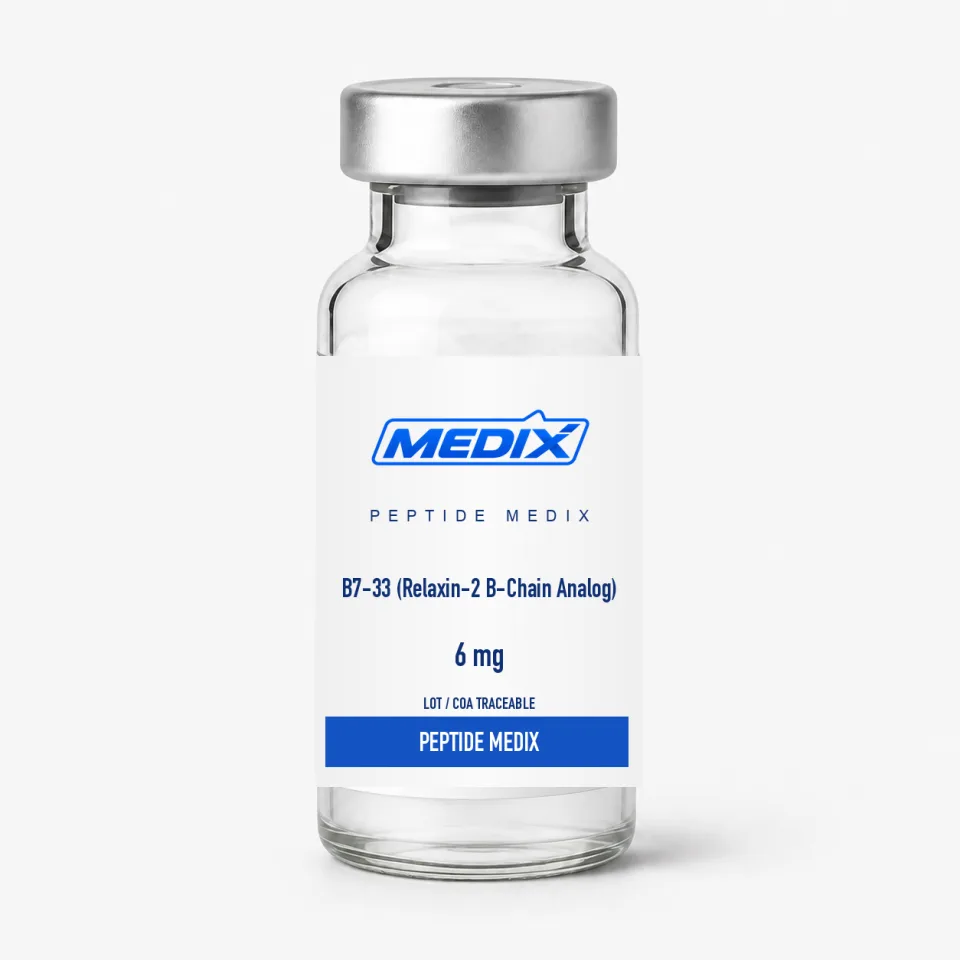
- ≥99% by HPLC; mass-based identity confirmation
- Lot-matched certificate of analysis
- Ships next business day, tracked
Tissue Repair & Healing Peptides
B7-33 (Relaxin-2 B-Chain Analog)
Linear 27-residue relaxin-2 B-chain analog studied as an RXFP1 agonist
- FormLyophilized powder, sealed glass research vial
- Research areasRXFP1 signaling bias, fibroblast biology, extracellular-matrix turnover, fibrosis and vascular-response models
Overview
B7-33 is a synthetic, single-chain peptide derived from the receptor-binding region of the human relaxin-2 B chain. Its 27-residue sequence retains the arginine-rich motif used by relaxin family peptide receptor 1 (RXFP1) while avoiding the two-chain, three-disulfide architecture of the native hormone. The name records that span, corresponding to positions 7 through 33 of the B chain, and because the sequence carries no cysteine it requires no oxidative folding step. The result is a linear research analog that is easier to synthesize and characterize than full relaxin-2.
The pharmacological interest is in what a single chain does to receptor signalling rather than in simply reproducing relaxin activity. Published work at RXFP1 describes the analogue as biased, favouring one branch of the receptor's output over the cyclic-AMP-dominated profile reported for the native two-chain hormone, and that difference is the reason it is run against relaxin-2 rather than in place of it. The assays follow from the fibrotic biology of the axis: fibroblast and myofibroblast culture, collagen and matrix metalloproteinase expression, and cardiac, renal and vascular remodelling models. A single 6 mg fill is stocked, held sealed at −20 °C, with working stocks refrigerated for a defined window and aliquoted rather than frozen repeatedly, and buffer compatibility validated per assay.
Specifications
Identity
- Amino acid sequence
- Val-Ile-Lys-Leu-Ser-Gly-Arg-Glu-Leu-Val-Arg-Ala-Gln-Ile-Ala-Ile-Ser-Gly-Met-Ser-Thr-Trp-Ser-Lys-Arg-Ser-Leu
- Chain length
- 27 amino acids
- Peptide class
- Linear human relaxin-2 B-chain analog
Supply & purity
- Form
- Lyophilized powder, sealed glass research vial
- Purity
- ≥99% by HPLC; mass-based identity confirmation; lot-matched COA available
- Solubility
- Water-soluble research peptide; buffer compatibility should be validated for the selected assay
Handling & storage
- Storage (lyophilized)
- −20 °C, sealed and protected from light and moisture
Additional detail
- Available size
- 6 mg
- Primary research target
- Relaxin family peptide receptor 1 (RXFP1)
- Research areas
- RXFP1 signaling bias, fibroblast biology, extracellular-matrix turnover, fibrosis and vascular-response models
- Distinction
- Not native relaxin-2 or serelaxin; contains one engineered linear chain and no disulfide-linked A chain
- Storage (in solution)
- 2–8 °C for a defined study window; aliquot for longer holds
Working out the concentration
B7-33 (Relaxin-2 B-Chain Analog) ships as a lyophilized powder, so nothing on this page can state a concentration: the figure you work with is the one you create when you add diluent. Put the vial mass and the volume you intend to use into the peptide reconstitution calculator and it returns mg/mL, mcg/mL and the mass sitting at each mark on a U-100 syringe.
Certificate of analysis
Every lot of B7-33 (Relaxin-2 B-Chain Analog) is released against a certificate of analysis: the batch-specific laboratory data for that lot, not a generic document for the compound. The lot number on the certificate matches the lot number printed on the label you receive — the vial label itself, where the product is vialled — so the record and the material it describes can always be reconciled.
Purity: ≥99% by HPLC; mass-based identity confirmation — the specification for this listing. The figure for the lot you receive is the one reported on that lot’s certificate.
No lot certificate is on display on this page at the moment. That is a publishing state and not a testing one: lots are released and documented as described above whether or not the document is posted here, and we will send what exists for the lot in stock, or for a lot already on your bench, by its number.
Certificates are available on request before you order as well as after, with no account and no charge. Request the certificate for this listing, read the testing and documentation policy in full, or see how to read a peptide COA.
Questions about B7-33 (Relaxin-2 B-Chain Analog)
What is B7-33?
B7-33 is a 27-amino-acid synthetic analog derived from the B chain of human relaxin-2. It retains the main RXFP1-binding motif in one linear chain, making it structurally simpler than native relaxin, which has separate A and B chains joined by disulfide bonds.
What does B7-33 target in research models?
Its primary reported target is RXFP1, the cognate receptor for relaxin-2. Studies examine receptor signaling, fibroblast matrix output, fibrotic remodeling and vascular endpoints, with results depending on cell type, receptor density and experimental design.
What purity documentation is available?
The peptide is released at ≥99% purity by reversed-phase HPLC with identity checked against the expected mass. A certificate of analysis matched to the vial's lot number is available for study records.
How should B7-33 be stored?
Keep the sealed lyophilized vial at −20 °C, dry and protected from light. After preparation, refrigerate short-term working stocks and use aliquots for longer study windows so the same solution is not repeatedly frozen and thawed.
Related