- Peptide purity: ≥99% by HPLC
- Lot-matched certificate of analysis
- Ships next business day, tracked
Tissue Repair & Healing Peptides
TB-500 Capsules
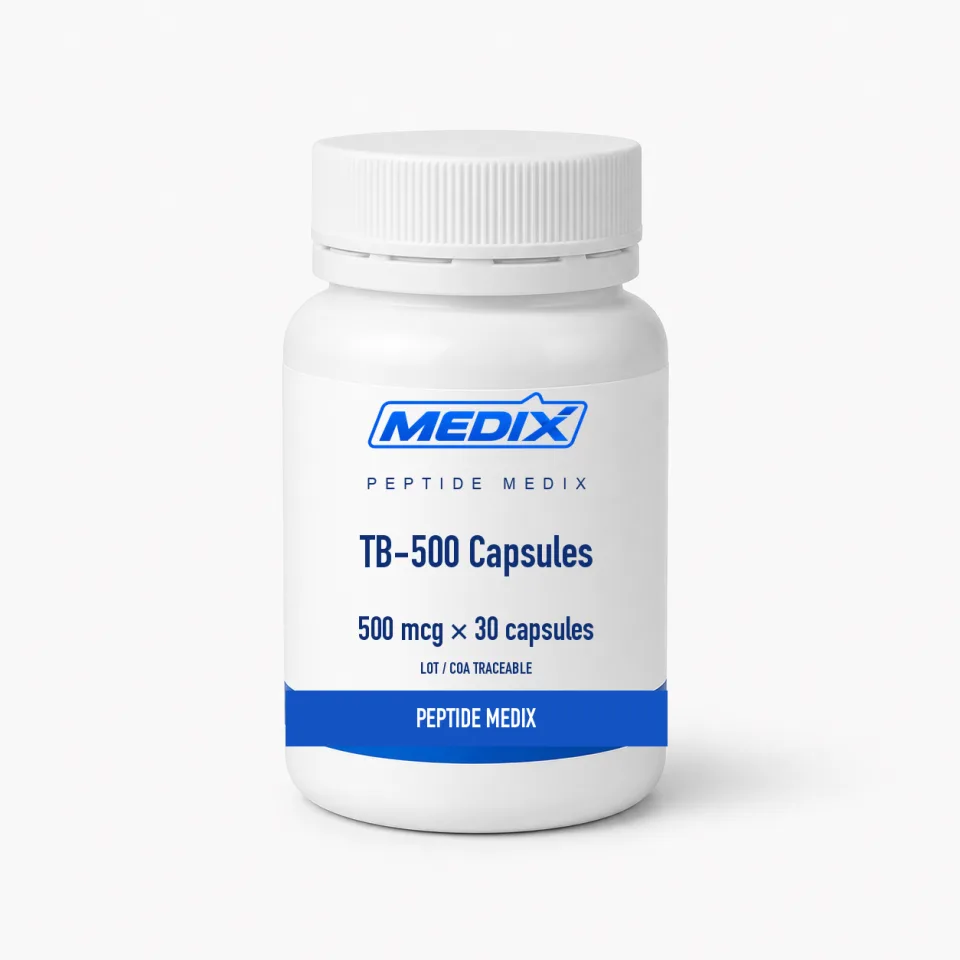
Oral TB-500 research capsules, 500 mcg per capsule, 30 count
- FormOral capsule, sealed bottle with tamper-evident closure and desiccant
- Mol. weight889.02 g/mol
- Research areasCell migration, wound closure, angiogenesis, oral versus parenteral route comparison
Overview
TB-500 itself is a heptapeptide, Ac-Leu-Lys-Lys-Thr-Glu-Thr-Gln, corresponding to the actin-binding region of the 43-residue thymosin beta-4 protein. Because the fragment is short and carries an acetylated N-terminus, it is a comparatively robust research peptide, though like all peptides it remains subject to gastric acid and pancreatic protease activity when an oral route is used — which is precisely what route-comparison studies are designed to quantify.
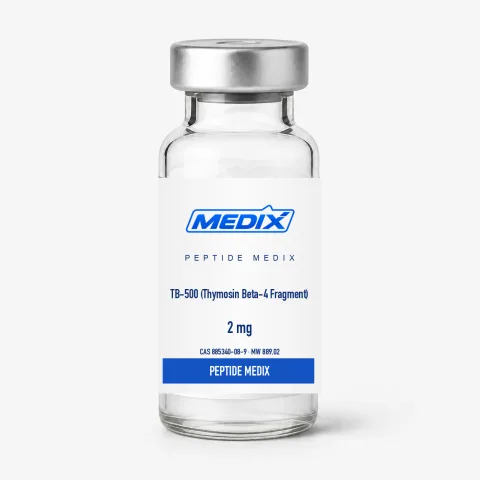
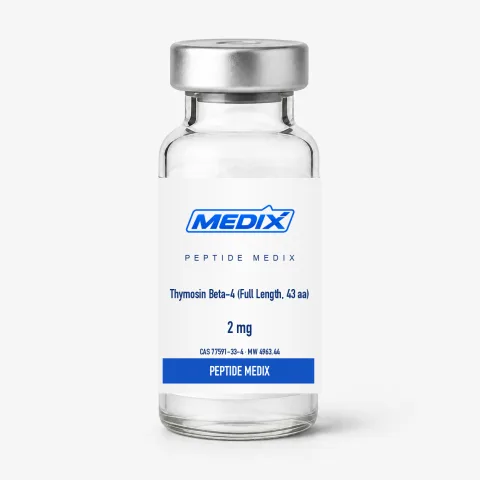
Thirty capsules at 500 micrograms each fill the bottle, made up from the same solid-phase synthesised, HPLC-purified material as the lyophilized vials, CAS 885340-08-9, C38H68N10O14, 889.02 g/mol, so a study can move between formats without changing lot chemistry. Two neighbouring listings frame what this one is for. The vialed heptapeptide lets the investigator set concentration and route; the full-length 43-residue thymosin beta-4 supplies the whole protein, of which Ac-Leu-Lys-Lys-Thr-Glu-Thr-Gln is only the actin-binding segment. The capsule exists for the third case, where the oral route is itself the variable under test and a fixed unit content at every time point removes preparation error from the comparison. Storage is cool, dry and dark, with the desiccant retained.
Specifications
Identity
- CAS number
- 885340-08-9
- Molecular formula
- C38H68N10O14
- Molecular weight
- 889.02 g/mol
- Amino acid sequence
- Ac-Leu-Lys-Lys-Thr-Glu-Thr-Gln
- Chain length
- 7 amino acids, N-terminally acetylated
Supply & purity
- Form
- Oral capsule, sealed bottle with tamper-evident closure and desiccant
Additional detail
- Peptide per capsule
- 500 mcg TB-500
- Available count
- 30 capsules
- Peptide purity
- ≥99% by HPLC; lot-matched COA available
- Active peptide
- TB-500, acetylated thymosin beta-4 fragment (residues 17–23)
- Parent protein
- Thymosin beta-4, a 43-residue G-actin sequestering protein
- Research areas
- Cell migration, wound closure, angiogenesis, oral versus parenteral route comparison
- Storage
- Cool, dry conditions away from direct light; refrigeration extends shelf stability
- Preparation required
- None — fixed unit content, no reconstitution step
Units and conversions
There is no reconstitution step for a solid oral format: the mass per unit of TB-500 Capsules is fixed on the label. Where a published method is written in micrograms and the label is in milligrams, the peptide unit converter does the conversion.
Certificate of analysis
Every lot of TB-500 Capsules is released against a certificate of analysis: the batch-specific laboratory data for that lot, not a generic document for the compound. The lot number on the certificate matches the lot number printed on the label you receive — the vial label itself, where the product is vialled — so the record and the material it describes can always be reconciled.
Peptide purity: ≥99% by HPLC — the specification for this listing. The figure for the lot you receive is the one reported on that lot’s certificate.
No lot certificate is on display on this page at the moment. That is a publishing state and not a testing one: lots are released and documented as described above whether or not the document is posted here, and we will send what exists for the lot in stock, or for a lot already on your bench, by its number.
Certificates are available on request before you order as well as after, with no account and no charge. Request the certificate for this listing, read the testing and documentation policy in full, or see how to read a peptide COA.
Questions about TB-500 Capsules
How much peptide is in each capsule?
Each capsule contains 500 micrograms of TB-500 blended with an inert carrier, and every capsule in the 30-count bottle is filled to the same target. The content and the peptide purity for the lot are stated on the certificate of analysis.
Is the peptide the same as in the TB-500 vials?
Yes. The capsules are filled with the same solid-phase synthesised, HPLC-purified TB-500 used for our lyophilized vials — Ac-Leu-Lys-Lys-Thr-Glu-Thr-Gln, CAS 885340-08-9, 889.02 g/mol. Only the presentation differs.
Why choose capsules over a vial?
A capsule removes the reconstitution step entirely, so the amount per unit is fixed and identical across the bottle. That suits studies with many time points or subjects where repeated preparation would add avoidable variability, and it makes oral-route comparison arms straightforward to set up.
Are peptides absorbed orally?
Only partially, as a class. Gastric acid and pancreatic proteases degrade most peptides and intestinal permeability limits uptake of molecules this size. Short acetylated sequences tend to fare better than long ones, and quantifying that difference is exactly what route-comparison research is for.
How is purity verified and is a COA supplied?
The peptide input is analysed by reversed-phase HPLC to at least 99% purity with mass-spectrometric identity confirmation. A certificate of analysis matched to the lot number printed on your bottle is available on request at any point before or after purchase.
How should the capsules be stored?
Keep the bottle sealed, cool and dry, out of direct light, with the desiccant in place. Refrigeration is optional but extends stability. Avoid humid environments and do not decant the capsules into other containers for long-term storage.
Can these be taken by people?
No. They are supplied for laboratory research only and are not a supplement, food or medicine.
Related