- ≥99% by HPLC
- Lot-matched certificate of analysis
- Ships next business day, tracked
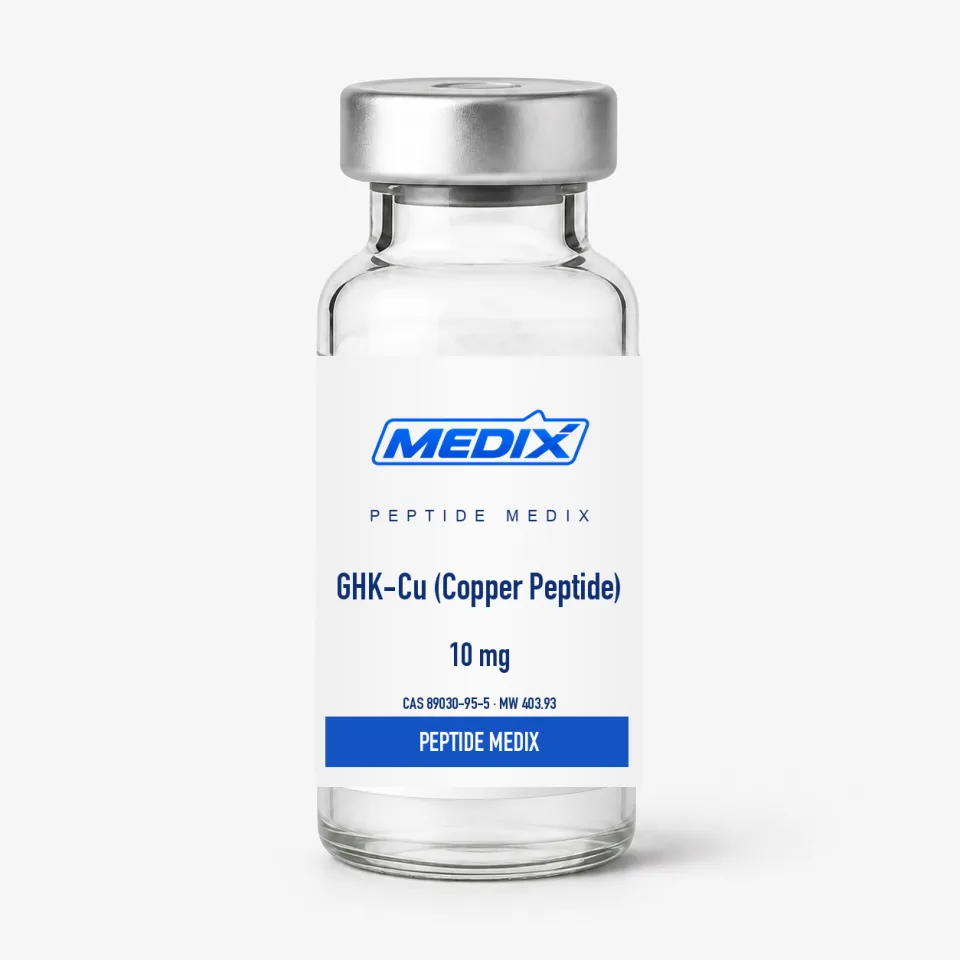
GHK-Cu (Copper Peptide)
Gly-His-Lys copper(II) complex, lyophilized blue research powder
- FormLyophilized blue powder, sealed glass vial with crimped stopper
- Mol. weight403.93 g/mol (copper(II) complex)
- Research areasCollagen and glycosaminoglycan synthesis, matrix remodelling, hair follicle and skin models
Overview
GHK-Cu is the copper(II) complex of the tripeptide glycyl-L-histidyl-L-lysine. The peptide was identified in human plasma in the 1970s during work on liver tissue culture, and its defining property is a very high affinity for copper ions: the histidine imidazole, the terminal amine and a backbone nitrogen together form a coordination site that captures Cu(II) tightly and, importantly, in a form that can be exchanged with cellular copper carriers.
That copper-carrying behaviour is why the complexed form rather than the bare tripeptide dominates the literature. The material is a distinctly blue lyophilized powder, the colour coming directly from the coordinated copper, and any vial that is white rather than blue is not a copper complex. Ours is supplied in 50 mg, 100 mg and 200 mg sizes — larger than typical peptide vials because formulation and topical-model work consumes material quickly.
Research interest concentrates on extracellular matrix remodelling, collagen and glycosaminoglycan synthesis in fibroblast culture, hair follicle biology and wound-repair models, alongside a body of gene-expression work. Reported plasma concentrations decline substantially with age, which underpins much of the ageing-related investigation. Supplied for laboratory research only.
Specifications
Identity
- CAS number
- 89030-95-5
- Molecular formula
- C14H24N6O4·Cu
- Molecular weight
- 403.93 g/mol (copper(II) complex)
- Amino acid sequence
- Gly-His-Lys, complexed with copper(II)
- Chain length
- 3 amino acids (tripeptide) plus one coordinated copper ion
- Peptide class
- Copper-binding matrix tripeptide
Supply & purity
- Form
- Lyophilized blue powder, sealed glass vial with crimped stopper
- Purity
- ≥99% by HPLC; lot-matched COA available
- Available sizes
- 10 mg, 50 mg, 100 mg, 200 mg, 500 mg
Handling & storage
- Storage (lyophilized)
- −20 °C, sealed and protected from light and moisture
- Storage (reconstituted)
- 2–8 °C, protected from light, used within the study window
Additional detail
- Colour
- Blue in both powder and solution — an indicator of copper coordination
- Research areas
- Collagen and glycosaminoglycan synthesis, matrix remodelling, hair follicle and skin models
Working out the concentration
The vial sizes above — 10 mg, 50 mg, 100 mg, 200 mg, 500 mg — describe a mass of material, not a strength. Choose a diluent volume, work it out with the reconstitution calculator, and you have the concentration for your own vial of GHK-Cu (Copper Peptide) plus the volume that carries any mass you want to withdraw.
Certificate of analysis
Every lot of GHK-Cu (Copper Peptide) is released against a certificate of analysis: the batch-specific laboratory data for that lot, not a generic document for the compound. The lot number on the certificate matches the lot number printed on the label you receive — the vial label itself, where the product is vialled — so the record and the material it describes can always be reconciled.
Purity: ≥99% by HPLC — the specification for this listing. The figure for the lot you receive is the one reported on that lot’s certificate.
No lot certificate is on display on this page at the moment. That is a publishing state and not a testing one: lots are released and documented as described above whether or not the document is posted here, and we will send what exists for the lot in stock, or for a lot already on your bench, by its number.
Certificates are available on request before you order as well as after, with no account and no charge. Request the certificate for this listing, read the testing and documentation policy in full, or see how to read a peptide COA.
Questions about GHK-Cu (Copper Peptide)
What is GHK-Cu?
GHK-Cu is the copper(II) complex of the tripeptide glycyl-histidyl-lysine, a sequence identified in human plasma in the 1970s. It is supplied as a lyophilized blue research powder and is studied in extracellular matrix, wound-repair and hair follicle models.
Why is the powder blue?
The colour comes from the coordinated copper ion. A genuine GHK-Cu preparation is blue in both powder and solution; material that appears white is the uncomplexed peptide rather than the copper complex. Loss of colour in a stored solution suggests the complex has been disrupted.
How is GHK-Cu different from plain GHK?
GHK is the bare tripeptide; GHK-Cu is that tripeptide with a copper(II) ion bound at its coordination site. Most of the published literature uses the copper complex, since the copper-carrying behaviour is central to the proposed mechanisms being studied.
Why are the vial sizes so large?
GHK-Cu is used at higher masses than most research peptides, particularly in topical formulation studies and in matrix or follicle work, where a single experiment can consume tens of milligrams. Vials of 50 mg, 100 mg and 200 mg keep the cost per experiment reasonable.
Is purity documented?
Yes. Each lot is analysed by reversed-phase HPLC to at least 99% purity, and a certificate of analysis matched to the lot number printed on your vial is available on request before or after ordering, alongside confirmation of the expected molecular mass.
Are there handling conditions specific to copper peptides?
Yes. The complex is light-sensitive and pH-dependent, and strongly chelating buffers can pull copper away from the peptide. Laboratories keep solutions cold, shield them from light in amber or foil-wrapped containers, and use the blue colour as a quick integrity check.
Related