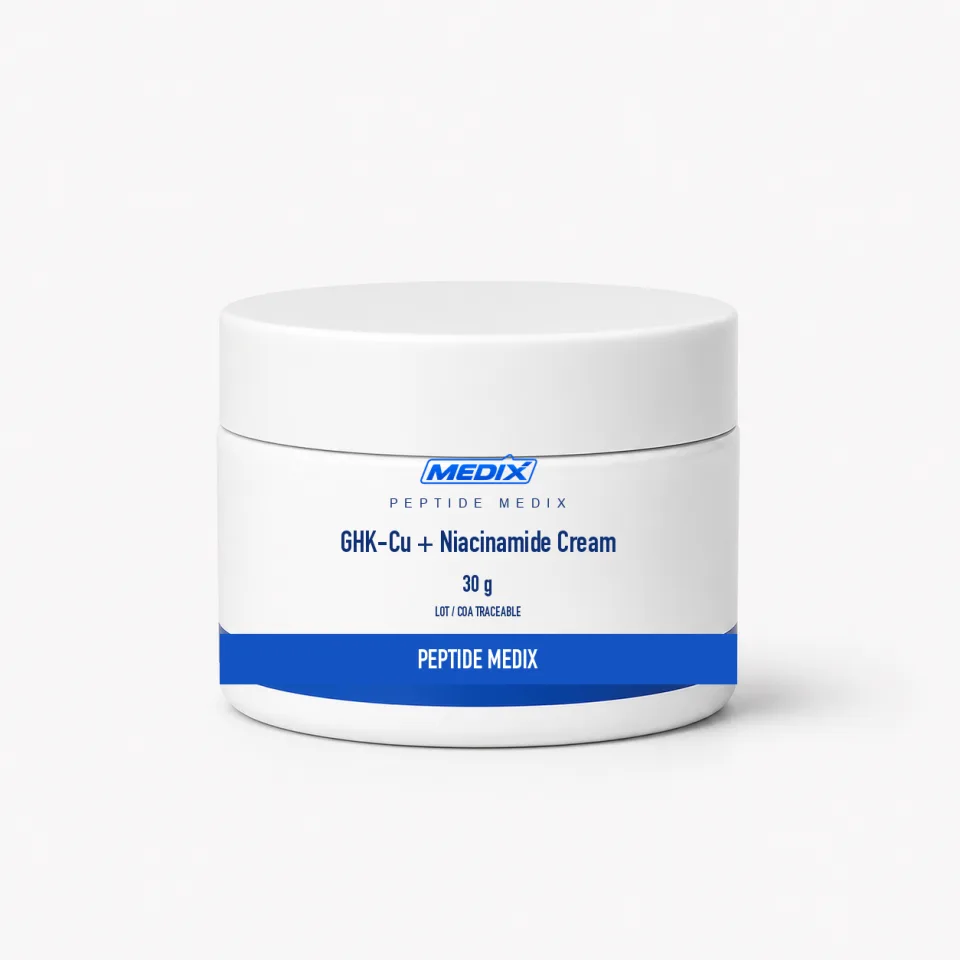
- Peptide purity input: ≥99% by HPLC
- Lot-matched certificate of analysis
- Ships next business day, tracked
GHK-Cu + Niacinamide Cream
Copper tripeptide-1 with niacinamide in an emollient cream — 30 g and 50 g
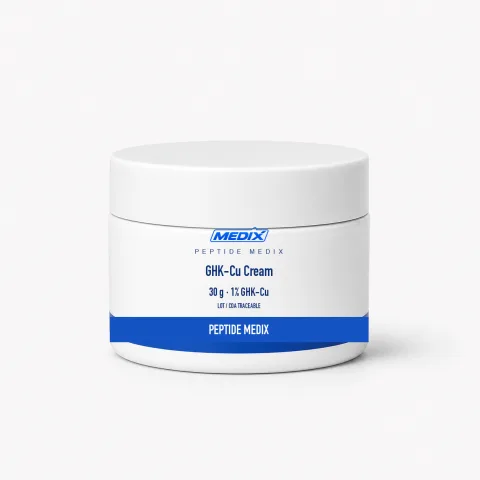
- FormBlue-tinted emollient cream in a screw-top jar
- Research areasBarrier-lipid and keratinocyte models, ECM endpoints, combination-formulation stability
Overview
This cream pairs GHK-Cu — the copper(II) complex of glycyl-L-histidyl-L-lysine — with niacinamide, the amide form of vitamin B3, in an emollient base supplied in 30 g and 50 g jars. The two ingredients come from different research traditions. GHK-Cu is a matrix-side active studied for fibroblast behaviour, collagen and glycosaminoglycan output and copper-dependent chemistry. Niacinamide is a small, highly water-soluble vitamin studied for barrier-lipid synthesis, keratinocyte differentiation, pigment-transfer endpoints and its role as a precursor in NAD biosynthesis.
Putting them together makes the formulation itself worth studying. Niacinamide is used at relatively high percentages compared with peptide actives, it can hydrolyse to nicotinic acid at unfavourable pH, and the pH window that keeps it stable is not automatically the window that best preserves a copper complex. Combination creams of this kind are therefore examined for stability of each active, interaction with the emulsion phases and any effect on delivery of the other component.
Peptide input is third-party tested to ≥99% by HPLC with a lot-matched certificate of analysis. Jars are lot-numbered, filled and shipped from the United States for laboratory research only.
Specifications
Supply & purity
- Form
- Blue-tinted emollient cream in a screw-top jar
- Available sizes
- 30 g, 50 g
Additional detail
- Active 1
- GHK-Cu — copper(II) complex of glycyl-L-histidyl-L-lysine (INCI copper tripeptide-1)
- Active 1 identifiers
- CAS 89030-95-5 · C14H24N6O4·Cu · 403.93 g/mol
- Active 2
- Niacinamide (nicotinamide, vitamin B3)
- Active 2 identifiers
- CAS 98-92-0 · C6H6N2O · 122.12 g/mol
- Concentrations
- Printed on the lot label for each active
- Peptide purity input
- ≥99% by HPLC; lot-matched COA available
- Vehicle
- Emollient oil-in-water cream base, no added fragrance
- Research areas
- Barrier-lipid and keratinocyte models, ECM endpoints, combination-formulation stability
- Storage
- Cool and dark, ideally 2–8 °C; keep the jar closed
- Compatibility note
- Niacinamide can hydrolyse to nicotinic acid at unfavourable pH; reducing agents disturb copper coordination
Units and conversions
This is a pre-mixed presentation: the strength is fixed at fill, and the only arithmetic between the label and the bench is a change of units. The peptide unit converter moves between mg, mcg, mL and µL without the decimal-point slip that costs a whole run.
Certificate of analysis
Every lot of GHK-Cu + Niacinamide Cream is released against a certificate of analysis: the batch-specific laboratory data for that lot, not a generic document for the compound. The lot number on the certificate matches the lot number printed on the label you receive — the vial label itself, where the product is vialled — so the record and the material it describes can always be reconciled.
Peptide purity input: ≥99% by HPLC — the specification for this listing. The figure for the lot you receive is the one reported on that lot’s certificate.
No lot certificate is on display on this page at the moment. That is a publishing state and not a testing one: lots are released and documented as described above whether or not the document is posted here, and we will send what exists for the lot in stock, or for a lot already on your bench, by its number.
Certificates are available on request before you order as well as after, with no account and no charge. Request the certificate for this listing, read the testing and documentation policy in full, or see how to read a peptide COA.
Questions about GHK-Cu + Niacinamide Cream
What does this cream contain?
Two actives in an emollient base: GHK-Cu, the copper(II) complex of glycyl-histidyl-lysine, and niacinamide, the amide form of vitamin B3. Concentrations for each are printed on the lot label. It is offered in 30 g and 50 g jars that differ only in fill weight.
Why pair a copper peptide with niacinamide?
They address different layers of the published literature. GHK-Cu is studied for dermal matrix endpoints, niacinamide for keratinocyte and barrier-lipid endpoints. Combination formulations let a study ask whether both move together and whether either affects delivery of the other.
Is the peptide in this formulation tested, and is a COA available?
Yes. The peptide input is released against a ≥99% HPLC purity specification with mass-spectrometric identity confirmation, and the lot-matched certificate of analysis is available on request. Each finished container is labelled with its own lot number so bench records can be tied back to the raw-material certificate.
Are the two actives stable together?
That is one of the questions this format is used to study. Niacinamide hydrolyses to nicotinic acid at unfavourable pH or under heat, and copper coordination is sensitive to competing ligands and pH. Stability work should assay each active separately rather than assume the pair behaves like either alone.
What is the right control for a combination experiment?
A single-active preparation in a comparable base. Our GHK-Cu cream uses the same peptide specification in a similar emollient vehicle, so running it alongside this jar isolates the contribution of the niacinamide component rather than confounding it with vehicle differences.
How should the jars be stored?
Closed, cool and dark, ideally at 2–8 °C, and away from heat sources. Sample with clean tools, log the lot number and opening date, and stop using a jar for quantitative work if the blue colour fades or shifts, which indicates the copper complex has been disturbed.
Related