- Peptide purity: ≥99% by HPLC before encapsulation
- Lot-matched certificate of analysis
- Ships next business day, tracked
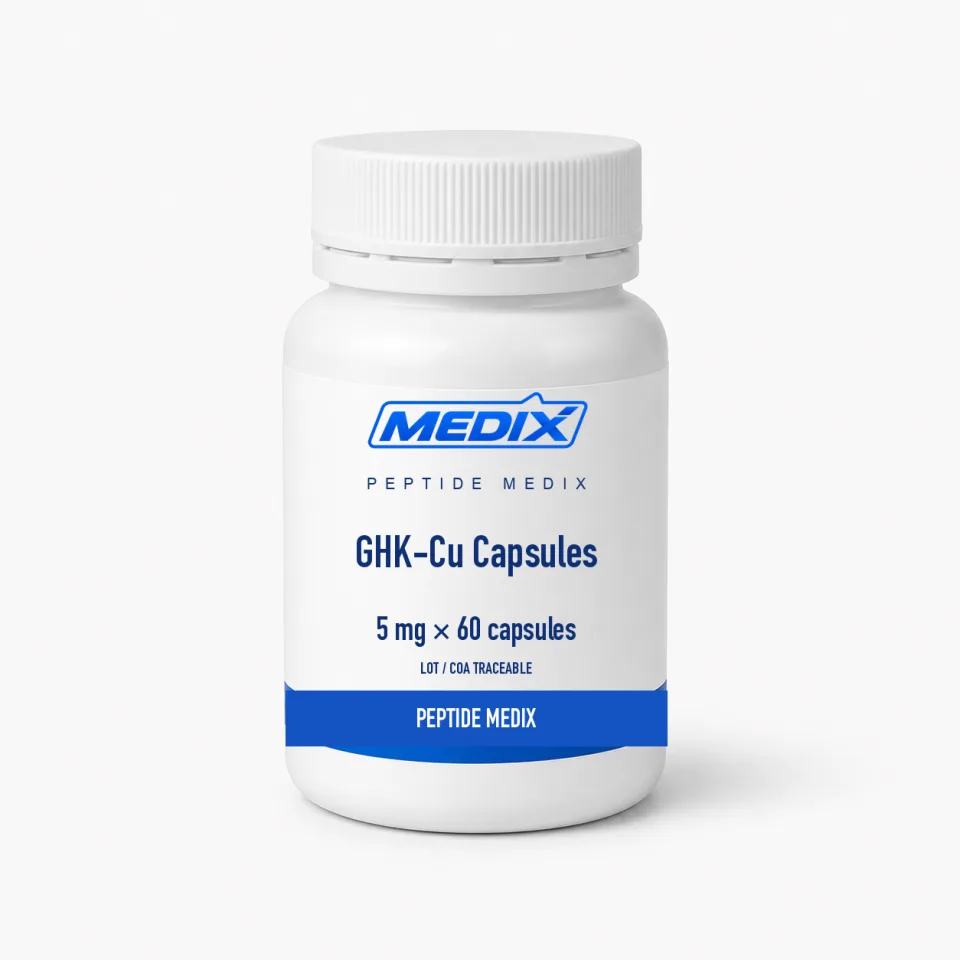
GHK-Cu Capsules
Oral copper tripeptide capsules, 5 mg GHK-Cu per capsule, 60 count
- FormOral capsule in a sealed bottle with tamper-evident closure
- Research areasOral peptide bioavailability, copper transport and homeostasis, matrix remodelling, skin and hair-follicle models
Overview
These capsules supply GHK-Cu, the copper(II) complex of glycyl-L-histidyl-L-lysine, as a fixed 5 mg oral unit with sixty capsules per bottle. The peptide is the same blue-tinted material used for our vials and serums: the histidine imidazole, terminal amine and a backbone nitrogen together form a coordination site that binds Cu(II) tightly while still allowing exchange with cellular copper carriers.
An oral format changes the research question rather than the molecule. A vial is reconstituted to any concentration a study requires and is used for cell culture, matrix work or parenteral administration in animal models. A capsule is a fixed unit that enters the gastrointestinal tract, where a small tripeptide-metal complex faces peptidases, an acidic gastric environment and competition for its copper from dietary ligands and transport proteins. Whether the complex survives that transit intact, dissociates into free peptide and copper, or is absorbed as fragments is an open and actively studied question.
Specifications
Supply & purity
- Form
- Oral capsule in a sealed bottle with tamper-evident closure
Additional detail
- Peptide per capsule
- 5 mg GHK-Cu
- Available count
- 60 capsules
- Active component
- GHK-Cu, copper(II) complex of glycyl-L-histidyl-L-lysine
- INCI name of active
- Copper Tripeptide-1
- Amino acid sequence (active)
- Gly-His-Lys, coordinated to Cu(II)
- CAS number (active)
- 89030-95-5
- Molecular formula (active)
- C14H24N6O4·Cu
- Molecular weight (active)
- 403.93 g/mol (copper(II) complex)
- Peptide purity
- ≥99% by HPLC before encapsulation; lot-matched COA available
- Colour
- Blue powder fill — the colour indicates intact copper coordination
- Research areas
- Oral peptide bioavailability, copper transport and homeostasis, matrix remodelling, skin and hair-follicle models
- Storage
- Cool, dry and dark in the closed bottle; refrigeration extends shelf stability
Units and conversions
There is no reconstitution step for a solid oral format: the mass per unit of GHK-Cu Capsules is fixed on the label. Where a published method is written in micrograms and the label is in milligrams, the peptide unit converter does the conversion.
Certificate of analysis
Every lot of GHK-Cu Capsules is released against a certificate of analysis: the batch-specific laboratory data for that lot, not a generic document for the compound. The lot number on the certificate matches the lot number printed on the label you receive — the vial label itself, where the product is vialled — so the record and the material it describes can always be reconciled.
Peptide purity: ≥99% by HPLC before encapsulation — the specification for this listing. The figure for the lot you receive is the one reported on that lot’s certificate.
No lot certificate is on display on this page at the moment. That is a publishing state and not a testing one: lots are released and documented as described above whether or not the document is posted here, and we will send what exists for the lot in stock, or for a lot already on your bench, by its number.
Certificates are available on request before you order as well as after, with no account and no charge. Request the certificate for this listing, read the testing and documentation policy in full, or see how to read a peptide COA.
Questions about GHK-Cu Capsules
How do capsules differ from the GHK-Cu vial?
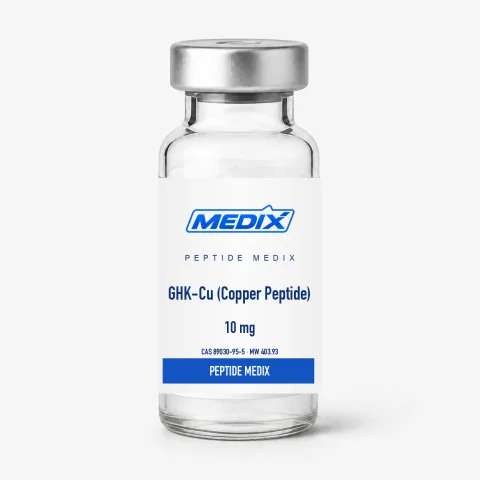
The peptide is identical. The vial is lyophilized powder that a laboratory reconstitutes to any concentration for cell culture or parenteral work, while each capsule is a fixed 5 mg oral unit intended for research on gastrointestinal transit and oral bioavailability.
Does the copper survive digestion?
That is precisely the open question. Gastric acid, brush-border peptidases and competing copper-binding proteins can all disturb the complex. Well-designed studies measure the peptide and the copper independently rather than assuming the intact complex reaches the circulation.
Why is the capsule fill blue?
The blue colour comes from the coordinated copper(II) ion and is characteristic of the intact complex. It serves as a rough qualitative indicator: colour loss suggests dissociation or degradation, though quantitative confirmation still requires chromatographic and elemental analysis.
What purity documentation is available?
The peptide used in manufacture is released at ≥99% purity by reversed-phase HPLC and a lot-matched certificate of analysis is available. Retaining it with your records preserves traceability between the encapsulated material and the peptide lot it came from.
Should copper content be accounted for separately?
Yes. Copper homeostasis is tightly regulated and total copper exposure is a variable in its own right. Research designs in this area usually include copper-only and peptide-only control arms so effects can be attributed to the complex rather than to the metal alone.
Related