- Peptide purity input: ≥99% by HPLC
- Lot-matched certificate of analysis
- Ships next business day, tracked
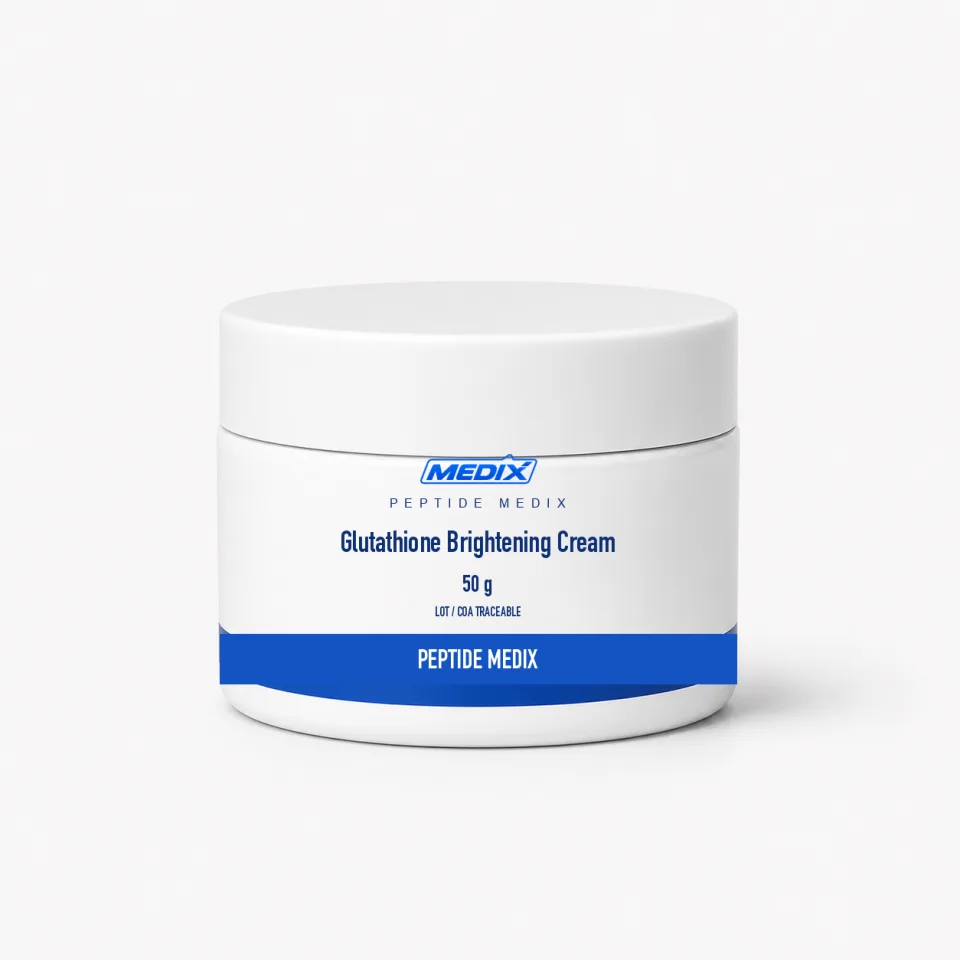
Glutathione Brightening Cream
Reduced L-glutathione in a 50 g emollient cream base for topical research
- FormOpaque emollient cream in a screw-top jar
- Research areasTopical antioxidant delivery, melanogenesis and tyrosinase models, vehicle and occlusion effects, thiol stability in formulation
Overview
This preparation places reduced L-glutathione — the gamma-linked tripeptide gamma-L-glutamyl-L-cysteinyl-glycine, CAS 70-18-8 — into an emollient cream base supplied in a 50 g jar. The peptide input is the same ≥99% HPLC-purity material used in our lyophilized vials; what changes is the vehicle, and in topical research the vehicle is rarely a neutral detail.
Glutathione is the dominant intracellular thiol antioxidant, and its free cysteinyl sulfhydryl group is the reactive feature behind almost everything studied about it. In pigmentation research specifically, glutathione appears as an agent reported to interfere with melanogenesis through several proposed routes: direct interaction with tyrosinase, quenching of reactive intermediates in the melanin pathway, and a shift in the eumelanin-to-pheomelanin balance. That combination is why topical and systemic glutathione preparations recur in the depigmentation literature.
Specifications
Identity
- Peptide class
- Non-ribosomal gamma-linked tripeptide
Supply & purity
- Form
- Opaque emollient cream in a screw-top jar
- Available sizes
- 50 g
Additional detail
- Active
- Reduced L-glutathione (GSH), gamma-L-glutamyl-L-cysteinyl-glycine
- Peptide purity input
- ≥99% by HPLC; lot-matched COA available
- Active loading
- Stated on the jar label for your lot
- CAS number (active)
- 70-18-8
- Molecular formula (active)
- C10H17N3O6S
- Molecular weight (active)
- 307.32 g/mol
- Reactive group
- Free cysteinyl thiol (−SH), oxidises to the GSSG disulfide dimer
- Vehicle
- Oil-in-water emollient cream base, no added fragrance
- Research areas
- Topical antioxidant delivery, melanogenesis and tyrosinase models, vehicle and occlusion effects, thiol stability in formulation
- Compatibility note
- Avoid contact with oxidising agents and metal ions such as copper or iron, which accelerate thiol oxidation
- Storage
- Cool and dark, ideally 2–8 °C; keep the jar tightly closed
Units and conversions
This is a pre-mixed presentation: the strength is fixed at fill, and the only arithmetic between the label and the bench is a change of units. The peptide unit converter moves between mg, mcg, mL and µL without the decimal-point slip that costs a whole run.
Certificate of analysis
Every lot of Glutathione Brightening Cream is released against a certificate of analysis: the batch-specific laboratory data for that lot, not a generic document for the compound. The lot number on the certificate matches the lot number printed on the label you receive — the vial label itself, where the product is vialled — so the record and the material it describes can always be reconciled.
Peptide purity input: ≥99% by HPLC — the specification for this listing. The figure for the lot you receive is the one reported on that lot’s certificate.
No lot certificate is on display on this page at the moment. That is a publishing state and not a testing one: lots are released and documented as described above whether or not the document is posted here, and we will send what exists for the lot in stock, or for a lot already on your bench, by its number.
Certificates are available on request before you order as well as after, with no account and no charge. Request the certificate for this listing, read the testing and documentation policy in full, or see how to read a peptide COA.
Questions about Glutathione Brightening Cream
Is the glutathione the same as in your vials?
Yes. The same reduced L-glutathione is used, with the same CAS number, formula and molecular mass, built from ≥99% HPLC-purity input. The difference is presentation — here it is dispersed in an emollient cream base rather than supplied as a lyophilized powder you dissolve yourself.
Why is a cream format used for research rather than a solution?
Because the vehicle is often the research question. A cream leaves an occlusive residual film, changing stratum corneum hydration, contact time and partitioning for a hydrophilic molecule. Permeation, occlusion and vehicle-comparison studies need a formulated article, not a beaker solution.
How stable is glutathione in a cream base?
The free thiol oxidises to the GSSG disulfide dimer on air exposure, and metal ions such as copper and iron catalyse that strongly. Cold, dark, tightly closed storage slows it, but studies should measure the reduced fraction at the time of use rather than assuming the labelled content persists.
What documentation comes with it?
A lot-matched certificate of analysis for the glutathione input, covering HPLC purity of at least 99% and identity confirmation. The active loading of the finished cream is stated on the jar label. Quote the lot number when requesting the COA.
Should it be combined with GHK-Cu preparations?
Only with care in experimental design. GHK-Cu is a copper complex and glutathione is a strong thiol reducing agent, so the two chemistries can interact — copper accelerates thiol oxidation and thiols can disturb copper coordination. If that interaction is not your variable, run them separately.
Related