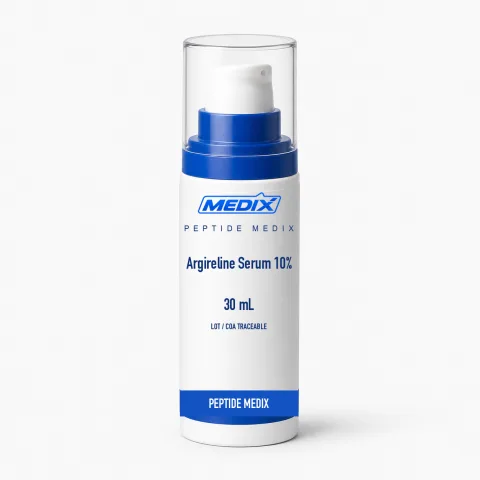
- Peptide purity input: High-purity HPLC-tested peptides with lot-matched COA
- Lot-matched certificate of analysis
- Ships next business day, tracked
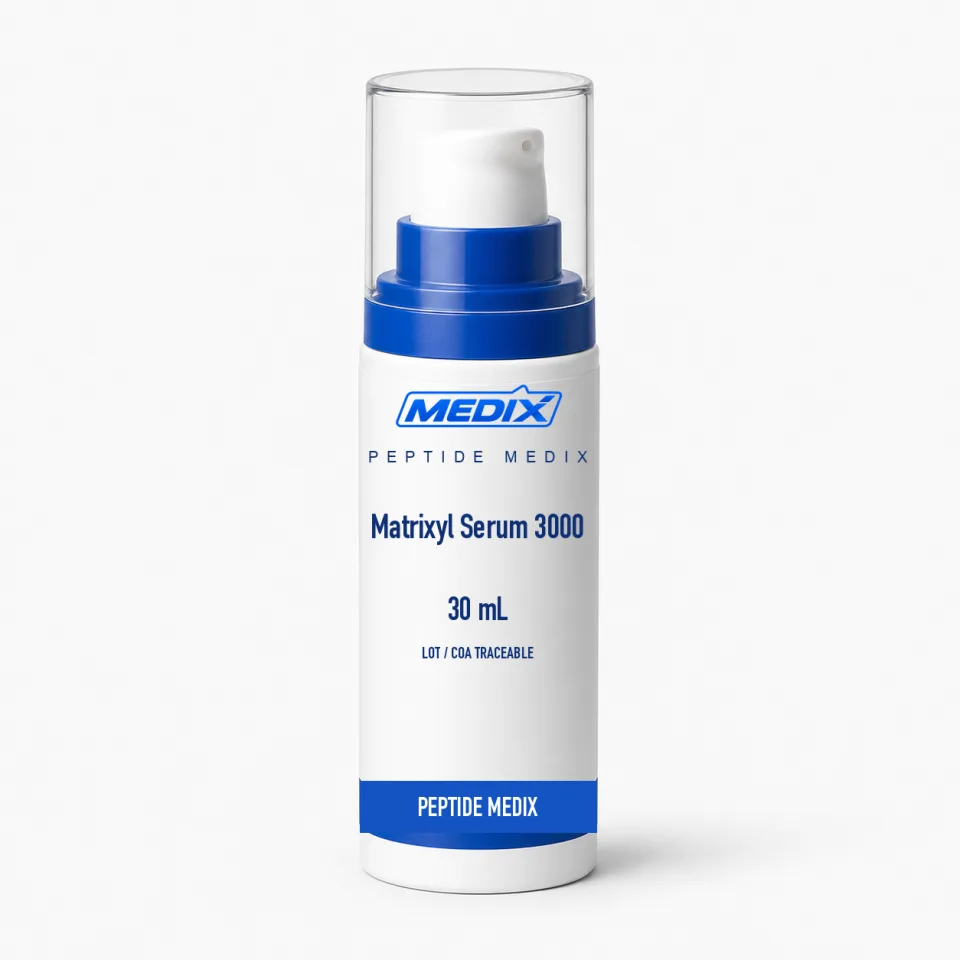
Matrixyl Serum 3000
Aqueous matrikine serum with palmitoyl tripeptide-1 and tetrapeptide-7, 30 mL
- FormClear low-viscosity aqueous serum in a 30 mL bottle
- Research areasProcollagen and glycosaminoglycan synthesis, ECM remodelling, cytokine markers in dermal models, skin permeation
Overview
Matrixyl Serum 3000 is a ready-to-use aqueous serum built around the 3000-type matrikine pairing: palmitoyl tripeptide-1 (Pal-Gly-His-Lys) and palmitoyl tetrapeptide-7 (Pal-Gly-Gln-Pro-Arg). Both are lipidated signal peptides, meaning a palmitic acid chain is attached to the peptide N-terminus to raise lipophilicity and improve partitioning into a lipid-rich barrier that bare hydrophilic peptides cross poorly.
The two peptides carry different parent sequences and are studied for different reasons. GHK is the tripeptide identified in human plasma in the 1970s and studied extensively in matrix and copper-binding research; GQPR derives from immunoglobulin G and appears in work on cytokine signalling in dermal models. Combining a matrix-signalling matrikine with an inflammation-associated fragment is the rationale behind the 3000-type complex, and it is why comparative studies usually test each peptide separately as well as together.
This differs from our Matrixyl vial, which supplies palmitoyl pentapeptide-4 (Pal-KTTKS) as lyophilized powder for a laboratory to formulate itself. The serum removes that step: it is a low-viscosity aqueous vehicle in a 30 mL bottle, prepared with peptide inputs released at high HPLC purity with lot-matched documentation. It is supplied for laboratory and formulation research and is not a licensed cosmetic or drug product.
Specifications
Identity
- Peptide class
- Lipidated matrikines / collagen- and immunoglobulin-derived signal peptides
Supply & purity
- Form
- Clear low-viscosity aqueous serum in a 30 mL bottle
Additional detail
- Available size
- 30 mL
- Active peptides
- Palmitoyl tripeptide-1 and palmitoyl tetrapeptide-7
- INCI names
- Palmitoyl Tripeptide-1; Palmitoyl Tetrapeptide-7
- Palmitoyl tripeptide-1 sequence
- Palmitoyl-Gly-His-Lys (Pal-GHK)
- Palmitoyl tripeptide-1 CAS
- 147732-56-7
- Palmitoyl tetrapeptide-7 sequence
- Palmitoyl-Gly-Gln-Pro-Arg (Pal-GQPR)
- Palmitoyl tetrapeptide-7 CAS
- 221227-05-0
- Vehicle
- Aqueous base with humectant and solubiliser; no added fragrance or colourant
- Peptide purity input
- High-purity HPLC-tested peptides with lot-matched COA
- Research areas
- Procollagen and glycosaminoglycan synthesis, ECM remodelling, cytokine markers in dermal models, skin permeation
- Storage
- 2–8 °C preferred, protected from light; keep the closure tight
Units and conversions
Because this is supplied at a stated strength, the question is rarely how much diluent to add — it is what that strength looks like in the units your method is written in. Convert mcg to mg, mL to µL and back with the unit converter.
Certificate of analysis
Every lot of Matrixyl Serum 3000 is released against a certificate of analysis: the batch-specific laboratory data for that lot, not a generic document for the compound. The lot number on the certificate matches the lot number printed on the label you receive — the vial label itself, where the product is vialled — so the record and the material it describes can always be reconciled.
Peptide purity input: High-purity HPLC-tested peptides with lot-matched COA — the specification for this listing. The figure for the lot you receive is the one reported on that lot’s certificate.
No lot certificate is on display on this page at the moment. That is a publishing state and not a testing one: lots are released and documented as described above whether or not the document is posted here, and we will send what exists for the lot in stock, or for a lot already on your bench, by its number.
Certificates are available on request before you order as well as after, with no account and no charge. Request the certificate for this listing, read the testing and documentation policy in full, or see how to read a peptide COA.
Questions about Matrixyl Serum 3000
How does this differ from our Matrixyl vial?
The vial supplies palmitoyl pentapeptide-4 (Pal-KTTKS) as lyophilized powder for a laboratory to formulate. This serum is a ready-made aqueous preparation built on a different pairing — palmitoyl tripeptide-1 and palmitoyl tetrapeptide-7 — so the peptides and the workflow both differ.
Is palmitoyl tripeptide-1 the same as GHK-Cu?
No. Both are built on the Gly-His-Lys sequence, but palmitoyl tripeptide-1 is lipidated and supplied without a coordinated copper ion, whereas GHK-Cu is the copper(II) complex of the bare tripeptide. The copper is central to GHK-Cu's chemistry and is absent here.
Why are the peptides palmitoylated?
Short hydrophilic peptides partition poorly into the lipid lamellae of the stratum corneum. A sixteen-carbon palmitoyl chain raises lipophilicity and improves that partitioning, which is a formulation strategy for delivery rather than a change to the underlying signalling sequence.
Related