- Lot-matched certificate of analysis
- Ships next business day, tracked
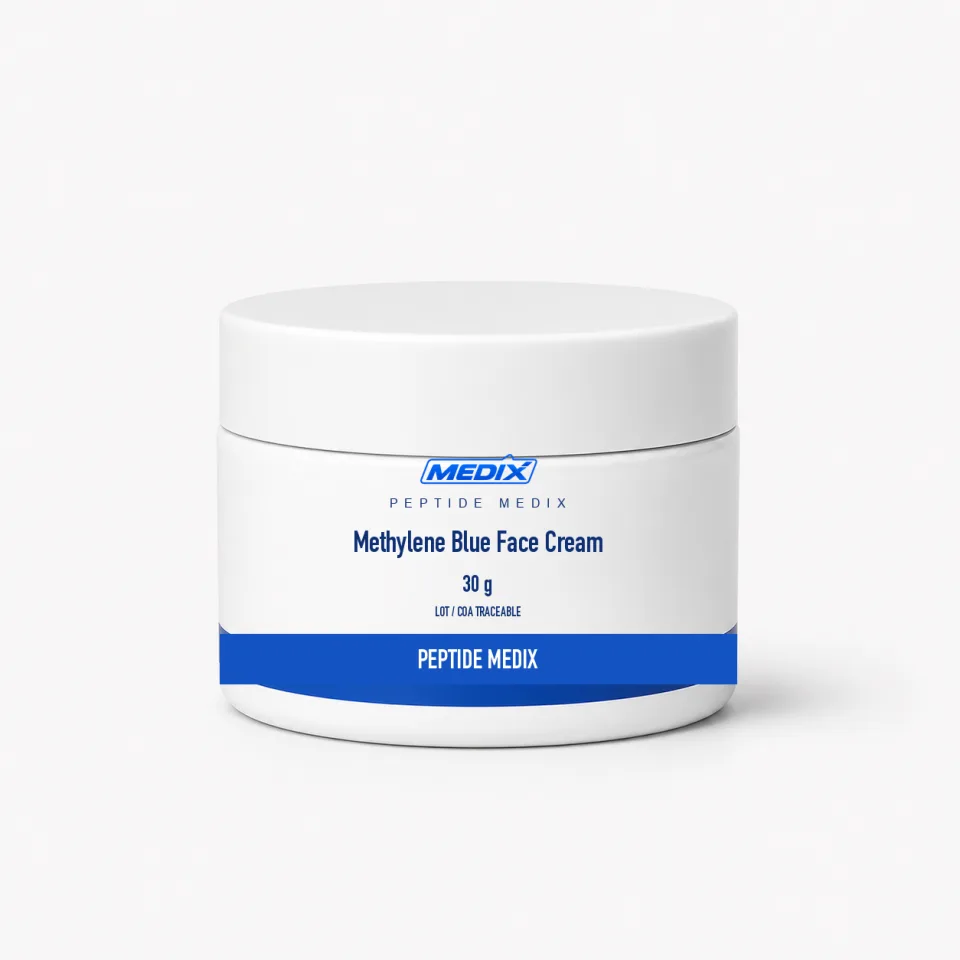
Methylene Blue Face Cream
Tint-free methylene blue cream, 30 g, for mitochondrial skin-model research
- FormEmollient cream in a 30 g screw-top jar
- Research areasFibroblast oxidative stress, cellular senescence models, mitochondrial function in skin
Overview
Methylene blue is a phenothiazine dye with an unusually long scientific history — it was the first fully synthetic compound used as a medicine, and it remains a workhorse redox indicator. Its interest in cell biology comes from its behaviour at low concentrations as an alternative electron carrier: it can accept electrons from NADH and deliver them further down the mitochondrial electron transport chain, bypassing complexes whose activity is impaired, which in cell models has been associated with reduced reactive oxygen species and extended fibroblast lifespan in culture.
This 30 g cream places methylene blue in an emollient base at a low, tint-free concentration — deliberately far below the roughly 0.05% level at which the dye leaves visible blue staining on skin. Keeping the concentration in the sub-staining range is what makes the material practical for skin models, since visible colour otherwise interferes with photographic and colorimetric endpoints.
Methylene blue is a small molecule rather than a peptide, so it sits in this catalogue as a companion compound to the copper-peptide and cosmetic-peptide formats rather than as a peptide product. It is supplied lot-numbered and shipped from the United States for laboratory research only.
Specifications
Supply & purity
- Form
- Emollient cream in a 30 g screw-top jar
Additional detail
- Available size
- 30 g
- Active
- Methylene blue (methylthioninium chloride)
- Active concentration
- Sub-staining, tint-free level; exact figure printed on the lot label
- CAS number (active)
- 61-73-4
- Molecular formula (active)
- C16H18ClN3S
- Molecular weight (active)
- 319.85 g/mol
- Compound class
- Phenothiazine dye; redox-active small molecule
- Mechanism studied
- Alternative electron carrier in the mitochondrial electron transport chain
- Research areas
- Fibroblast oxidative stress, cellular senescence models, mitochondrial function in skin
- Vehicle
- Emollient cream base, no added fragrance
- Storage
- Cool and dark, ideally 2–8 °C; keep the jar closed
- Handling note
- Methylene blue stains textiles and porous surfaces even at low concentrations
Units and conversions
Methylene Blue Face Cream arrives already made up, so there is no diluent volume to choose and no reconstitution step. What is left is unit work — percent to mg/mL, milligrams to micrograms, millilitres to microlitres — and the mcg to mg converter does all three.
Certificate of analysis
Every lot of Methylene Blue Face Cream is released against its own lot documentation, and where the manufacturer issues a certificate of analysis for it, that certificate is the record for the lot rather than a generic document for the compound. The lot number on the certificate matches the lot number printed on the label you receive — the vial label itself, where the product is vialled — so the record and the material it describes can always be reconciled.
This listing carries no purity percentage, so none is claimed for it here. Where the manufacturer issues analytical documentation for a lot of this item, it is passed on unaltered — ask and we will send whatever exists.
No lot certificate is on display on this page at the moment. That is a publishing state and not a testing one: lots are released and documented as described above whether or not the document is posted here, and we will send what exists for the lot in stock, or for a lot already on your bench, by its number.
Certificates are available on request before you order as well as after, with no account and no charge. Request the certificate for this listing, read the testing and documentation policy in full, or see how to read a peptide COA.
Questions about Methylene Blue Face Cream
What is in this cream?
The active is methylene blue, a redox-active phenothiazine small molecule, formulated in an emollient cream base at a low tint-free concentration. The exact figure for your jar is printed on the lot label. The 30 g jar is the only size offered.
Will it stain skin or surfaces blue?
The formulation is kept below the concentration at which visible staining appears on skin, roughly 0.05%. Methylene blue nonetheless stains textiles, paper and porous surfaces on contact, so gloves, a protected work surface and prompt cleanup of spills are sensible precautions.
Why is methylene blue studied in skin models?
At low concentrations it acts as an alternative electron carrier in the mitochondrial electron transport chain. Cell-culture work has reported reduced reactive oxygen species and delayed senescence markers in human fibroblasts under those conditions. These are in vitro observations in specific models.
Is this a peptide product?
No. Methylene blue is a small synthetic molecule with CAS 61-73-4, not a peptide. It appears in this catalogue as a companion compound to the copper-peptide and cosmetic-peptide topical formats, and documentation for the active is available on request.
How should the jar be stored and sampled?
Keep it closed, cool and out of light, ideally refrigerated. Take aliquots with a clean spatula instead of dipping used tools, weigh quantities for quantitative work, and log the lot number with the opening date so measurements stay traceable to a specific fill.
Related