- Lot-matched certificate of analysis
- Ships next business day, tracked
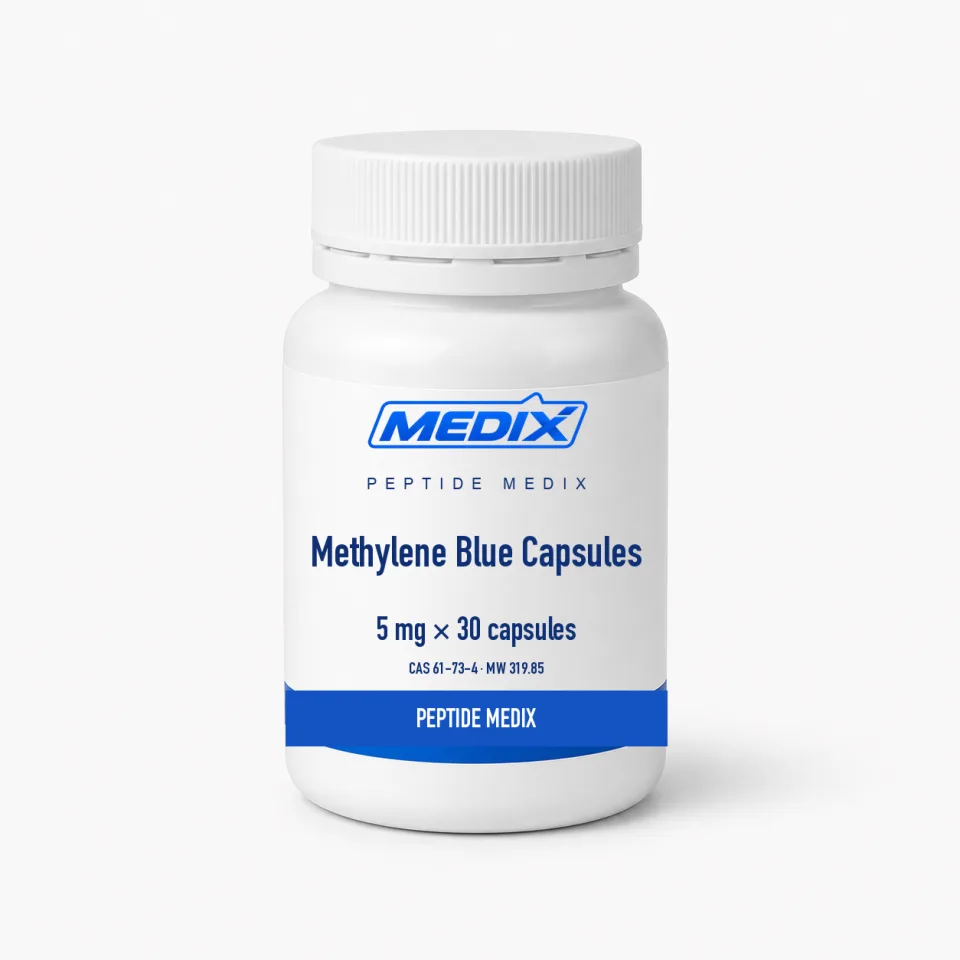
Methylene Blue Capsules
Methylthioninium chloride capsules in 5 mg, 10 mg and 25 mg strengths
- FormPre-filled oral-style capsules in a sealed bottle
- Mol. weight319.85 g/mol
- Research areasMitochondrial electron transport, redox cycling, MAO-A inhibition, protein aggregation assays, histological staining
Overview
Methylene blue, chemically methylthioninium chloride, is a phenothiazinium dye first synthesized in 1876 and one of the oldest synthetic compounds still in continuous scientific use. It was the starting point for the phenothiazine drug class, the first synthetic compound used against malaria, and it remains a staple histological stain. Its defining property is reversible redox cycling: the blue oxidized form accepts electrons to become the colorless leucomethylene blue and gives them up again, a cycle that underlies most of its research applications.
Supplied as pre-filled capsules in three strengths, 30 capsules per bottle, with a lot-matched Certificate of Analysis.
Specifications
Identity
- CAS number
- 61-73-4
- Molecular formula
- C16H18ClN3S
- Molecular weight
- 319.85 g/mol
Supply & purity
- Form
- Pre-filled oral-style capsules in a sealed bottle
- Solubility
- Soluble in water and ethanol
Additional detail
- Available strengths
- 5 mg, 10 mg and 25 mg per capsule
- Count
- 30 capsules per bottle
- Compound
- Methylene blue (methylthioninium chloride)
- Chemical class
- Phenothiazinium redox dye, small molecule
- Appearance
- Dark green to blue crystalline powder; deep blue in aqueous solution
- Research areas
- Mitochondrial electron transport, redox cycling, MAO-A inhibition, protein aggregation assays, histological staining
- Storage
- Cool, dry place in the sealed bottle, protected from light
- Handling note
- Stains skin, fabric and lab surfaces; wear gloves and work over a protected bench
Units and conversions
The arithmetic on an oral format is unit arithmetic rather than dilution arithmetic. Use the milligram to microgram converter to line a per-unit figure up against a method written in different units.
Certificate of analysis
Every lot of Methylene Blue Capsules is released against its own lot documentation, and where the manufacturer issues a certificate of analysis for it, that certificate is the record for the lot rather than a generic document for the compound. The lot number on the certificate matches the lot number printed on the label you receive — the vial label itself, where the product is vialled — so the record and the material it describes can always be reconciled.
This listing carries no purity percentage, so none is claimed for it here. Where the manufacturer issues analytical documentation for a lot of this item, it is passed on unaltered — ask and we will send whatever exists.
No lot certificate is on display on this page at the moment. That is a publishing state and not a testing one: lots are released and documented as described above whether or not the document is posted here, and we will send what exists for the lot in stock, or for a lot already on your bench, by its number.
Certificates are available on request before you order as well as after, with no account and no charge. Request the certificate for this listing, read the testing and documentation policy in full, or see how to read a peptide COA.
Questions about Methylene Blue Capsules
What is methylene blue?
Methylene blue, or methylthioninium chloride, is a phenothiazinium dye that cycles reversibly between an oxidized blue and a reduced colorless form. It is used in redox chemistry, mitochondrial research, protein aggregation assays and as a classic histological stain.
What strengths are available?
Capsules are offered at 5 mg, 10 mg and 25 mg, with 30 capsules per bottle. The capsule format supplies a pre-measured quantity, which is convenient when a protocol calls for repeated identical amounts without weighing a staining dye.
Is this a peptide?
No. Methylene blue is a small-molecule dye with a molecular weight of 319.85 g/mol, unrelated to peptides. It appears in this catalog because laboratories studying mitochondrial function frequently work with both classes of compound.
Is the material tested?
Yes. Each lot is supplied with a lot-matched Certificate of Analysis documenting identity and purity. Purity matters particularly for this compound, since dye preparations vary widely in grade and contaminating metals can confound redox experiments.
How should staining and spills be managed?
Wear gloves and work over a protected surface. The dye stains skin, clothing and glassware, and residue on labware can carry into later preparations and distort spectrophotometric readings. Clean spills promptly and dedicate glassware to dye work where possible.
Related