- Lot-matched certificate of analysis
- Ships next business day, tracked
Methylcobalamin (Vitamin B12)
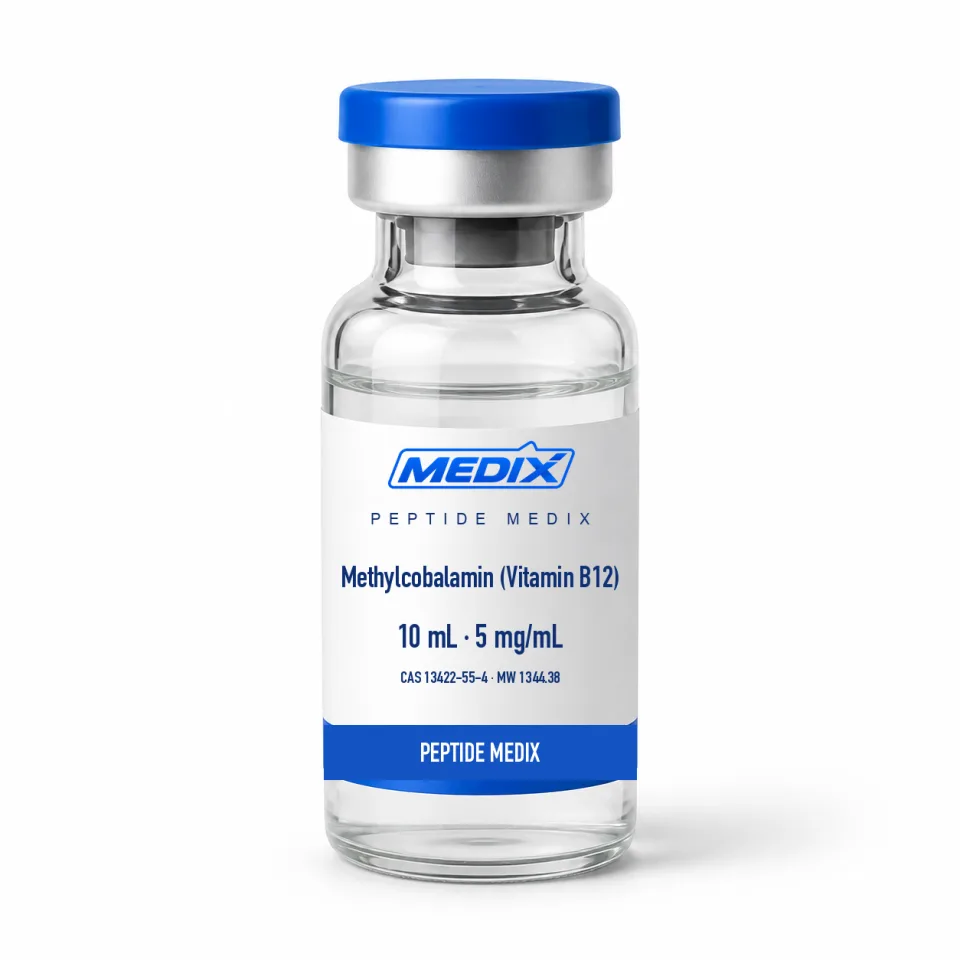
Methylcobalamin solution, 5 mg/mL in 10 mL and 30 mL amber vials
- FormClear deep-red aqueous solution in an amber vial
- Mol. weight1344.38 g/mol
- Research areasOne-carbon and folate metabolism, homocysteine studies, methylation research, neurological models
Overview
Methylcobalamin is one of the two coenzyme-active forms of vitamin B12, the cobalt-containing corrinoid family. Its structure centers on a cobalt ion held in a corrin ring, with a methyl group as the upper axial ligand — the feature that distinguishes it from cyanocobalamin, where that position holds a cyanide group, and from adenosylcobalamin, the mitochondrial coenzyme form.
Biochemically, methylcobalamin is the cofactor for methionine synthase, the cytosolic enzyme that transfers a methyl group from 5-methyltetrahydrofolate to homocysteine to regenerate methionine. That single reaction links B12 status to folate metabolism, to homocysteine concentration and to the supply of S-adenosylmethionine used across cellular methylation. Researchers study these connections in one-carbon metabolism, methylation and neurological model systems.
Supplied as a ready-to-use aqueous solution at 5 mg/mL in amber vials of 10 mL or 30 mL. The characteristic deep red color comes from the corrin-cobalt chromophore, and it is also a warning: cobalamins are markedly photosensitive, so light protection is the central handling requirement for this material. Lot-matched Certificate of Analysis available.
Specifications
Identity
- CAS number
- 13422-55-4
- Molecular formula
- C63H91CoN13O14P
- Molecular weight
- 1344.38 g/mol
Supply & purity
- Form
- Clear deep-red aqueous solution in an amber vial
- Available sizes
- 10 mL and 30 mL vials
Additional detail
- Concentration
- 5 mg/mL methylcobalamin
- Chemical class
- Cobalamin (corrinoid) coenzyme, vitamin B12 family
- Axial ligand
- Methyl group at the upper (beta) cobalt position
- Enzyme role
- Cofactor for methionine synthase (MTR)
- Research areas
- One-carbon and folate metabolism, homocysteine studies, methylation research, neurological models
- Photosensitivity
- High — degrades under ambient and UV light; keep in amber glass and shielded
- Storage
- Refrigerated 2–8 °C, protected from light; do not freeze
Units and conversions
Methylcobalamin (Vitamin B12) arrives already made up, so there is no diluent volume to choose and no reconstitution step. What is left is unit work — percent to mg/mL, milligrams to micrograms, millilitres to microlitres — and the mcg to mg converter does all three.
Certificate of analysis
Every lot of Methylcobalamin (Vitamin B12) is released against its own lot documentation, and where the manufacturer issues a certificate of analysis for it, that certificate is the record for the lot rather than a generic document for the compound. The lot number on the certificate matches the lot number printed on the label you receive — the vial label itself, where the product is vialled — so the record and the material it describes can always be reconciled.
This listing carries no purity percentage, so none is claimed for it here. Where the manufacturer issues analytical documentation for a lot of this item, it is passed on unaltered — ask and we will send whatever exists.
No lot certificate is on display on this page at the moment. That is a publishing state and not a testing one: lots are released and documented as described above whether or not the document is posted here, and we will send what exists for the lot in stock, or for a lot already on your bench, by its number.
Certificates are available on request before you order as well as after, with no account and no charge. Request the certificate for this listing, read the testing and documentation policy in full, or see how to read a peptide COA.
Questions about Methylcobalamin (Vitamin B12)
What is methylcobalamin?
Methylcobalamin is a coenzyme-active form of vitamin B12 in which a methyl group occupies the upper axial position on the central cobalt ion. It serves as the cofactor for methionine synthase in the one-carbon metabolism pathway.
How does it differ from cyanocobalamin?
Cyanocobalamin carries a cyanide ligand at the same position and must be converted intracellularly before it can act as a coenzyme. Methylcobalamin is already in a coenzyme form. Cyanocobalamin is more photostable, which is why it dominates as an analytical standard.
What concentration and sizes are supplied?
The solution is supplied at 5 mg/mL in either a 10 mL or a 30 mL amber vial. It arrives ready to use, so no reconstitution or weighing of the compound is needed before dilution into your experimental system.
Why is light protection so important?
The cobalt-carbon bond in methylcobalamin photolyses under visible light, converting the compound to hydroxocobalamin and other products. A vial left in ambient light can lose significant content within hours, so amber glass and low-light handling are essential.
Is the material tested?
Yes. Each lot ships with a lot-matched Certificate of Analysis documenting identity, concentration and purity. Because photodegradation is the main risk, confirming the deep red color and spectrophotometric profile on receipt is a useful additional check.
Related