- Lot-matched certificate of analysis
- Ships next business day, tracked
B-Complex Injection
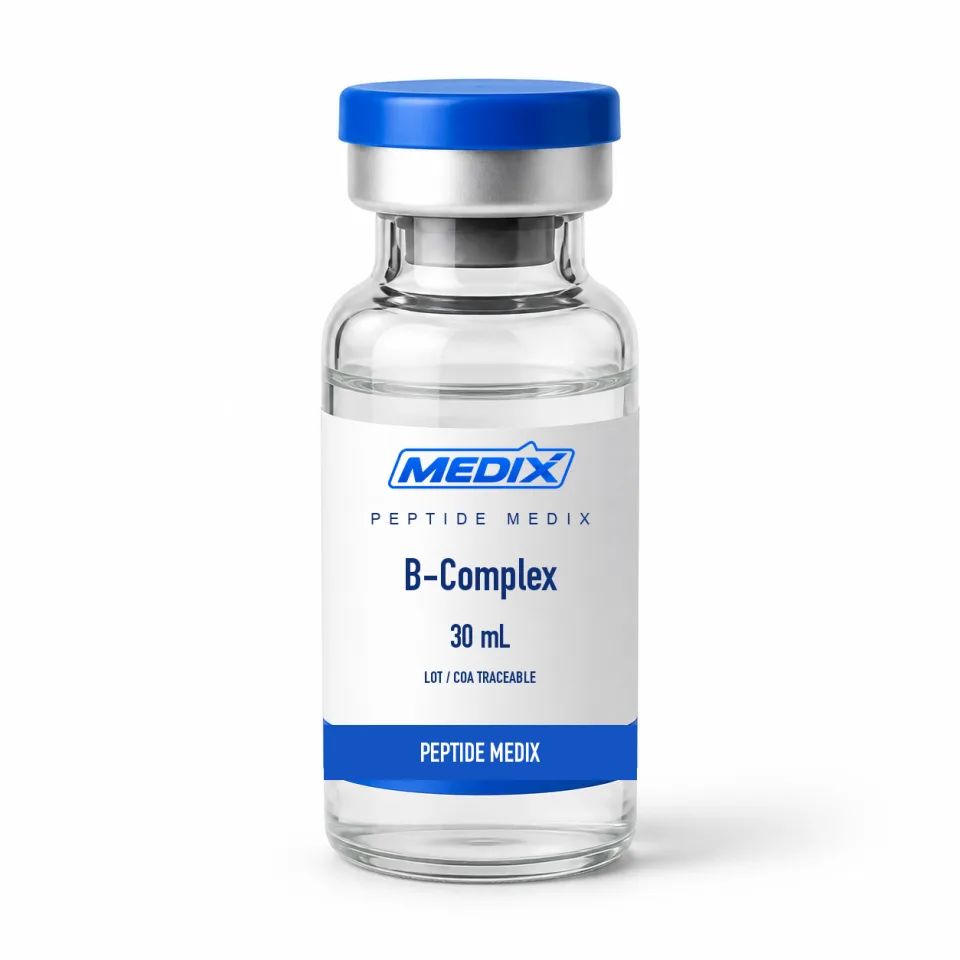
Multi-vitamin B solution in a 30 mL vial with thiamine, niacinamide, B2 and B6
- Research areasCarbohydrate catabolism, NAD salvage pathway, flavin-dependent enzymes, amino acid metabolism
Overview
This B-complex solution combines four water-soluble B vitamins in a single 30 mL vial: thiamine (B1) at 100 mg/mL, niacinamide (B3) at 100 mg/mL, riboflavin-5-phosphate (the active phosphorylated form of B2) at 2 mg/mL, and pyridoxine (B6) at 2 mg/mL. Grouping them reflects how the vitamins actually work — as interlocking cofactors in the same catabolic pathways rather than as isolated compounds.
Each contributes a distinct coenzyme. Thiamine becomes thiamine pyrophosphate, the cofactor for pyruvate dehydrogenase, alpha-ketoglutarate dehydrogenase and transketolase. Niacinamide is the precursor for NAD+ and NADP+ through the salvage pathway, linking this formulation directly to sirtuin and PARP research. Riboflavin-5-phosphate is FMN itself and the precursor of FAD, the flavin cofactors of complexes I and II. Pyridoxine converts to pyridoxal-5-phosphate, the cofactor for well over a hundred enzymes in amino acid metabolism.
The solution ships ready to use with a lot-matched Certificate of Analysis. Riboflavin in particular is strongly photosensitive, so the vial should be kept shielded from light throughout its working life.
Specifications
Supply & purity
- Solubility
- All components are water-soluble vitamins already in solution
Additional detail
- Vial size
- 30 mL
- Thiamine (B1)
- 100 mg/mL
- Niacinamide (B3)
- 100 mg/mL
- Riboflavin-5-phosphate (B2)
- 2 mg/mL
- Pyridoxine (B6)
- 2 mg/mL
- Coenzyme forms studied
- Thiamine pyrophosphate, NAD+/NADP+, FMN and FAD, pyridoxal-5-phosphate
- Research areas
- Carbohydrate catabolism, NAD salvage pathway, flavin-dependent enzymes, amino acid metabolism
- Appearance note
- The yellow color comes from the riboflavin component
- Photosensitivity
- High — riboflavin degrades rapidly under light; keep shielded
- Storage
- 2–8 °C, protected from light; do not freeze
- Documentation
- Lot-matched Certificate of Analysis available
Units and conversions
B-Complex arrives already made up, so there is no diluent volume to choose and no reconstitution step. What is left is unit work — percent to mg/mL, milligrams to micrograms, millilitres to microlitres — and the mcg to mg converter does all three.
Certificate of analysis
Every lot of B-Complex is released against its own lot documentation, and where the manufacturer issues a certificate of analysis for it, that certificate is the record for the lot rather than a generic document for the compound. The lot number on the certificate matches the lot number printed on the label you receive — the vial label itself, where the product is vialled — so the record and the material it describes can always be reconciled.
This listing carries no purity percentage, so none is claimed for it here. Where the manufacturer issues analytical documentation for a lot of this item, it is passed on unaltered — ask and we will send whatever exists.
No lot certificate is on display on this page at the moment. That is a publishing state and not a testing one: lots are released and documented as described above whether or not the document is posted here, and we will send what exists for the lot in stock, or for a lot already on your bench, by its number.
Certificates are available on request before you order as well as after, with no account and no charge. Request the certificate for this listing, read the testing and documentation policy in full, or see how to read a peptide COA.
Questions about B-Complex
What is in this B-complex vial?
Each 30 mL vial supplies thiamine at 100 mg/mL, niacinamide at 100 mg/mL, riboflavin-5-phosphate at 2 mg/mL and pyridoxine at 2 mg/mL. The four are combined because their coenzyme products act at interlocking steps of the same metabolic pathways.
Why riboflavin-5-phosphate rather than riboflavin?
Riboflavin-5-phosphate is FMN, the already-phosphorylated active form, and it is far more water-soluble than free riboflavin. That solubility is the practical reason it is used in combined liquid preparations where plain riboflavin would not stay in solution.
How does this relate to NAD+ research?
Niacinamide is the direct precursor for NAD+ through the salvage pathway, in which NAMPT and NMNAT rebuild the coenzyme. Laboratories studying sirtuins, PARPs or NAD+ pool dynamics often examine niacinamide supply as one of the input variables.
Why is the solution yellow?
The color comes from the riboflavin-5-phosphate component; flavins are intensely yellow chromophores. Fading of that color is a useful visual indicator that the vial has had light exposure and may have lost riboflavin content.
How should the vial be stored?
Keep it refrigerated at 2–8 °C, inside its carton, protected from light, and do not freeze. Riboflavin is one of the most photosensitive vitamins known, so light exposure is the main threat to the integrity of this preparation.
Related