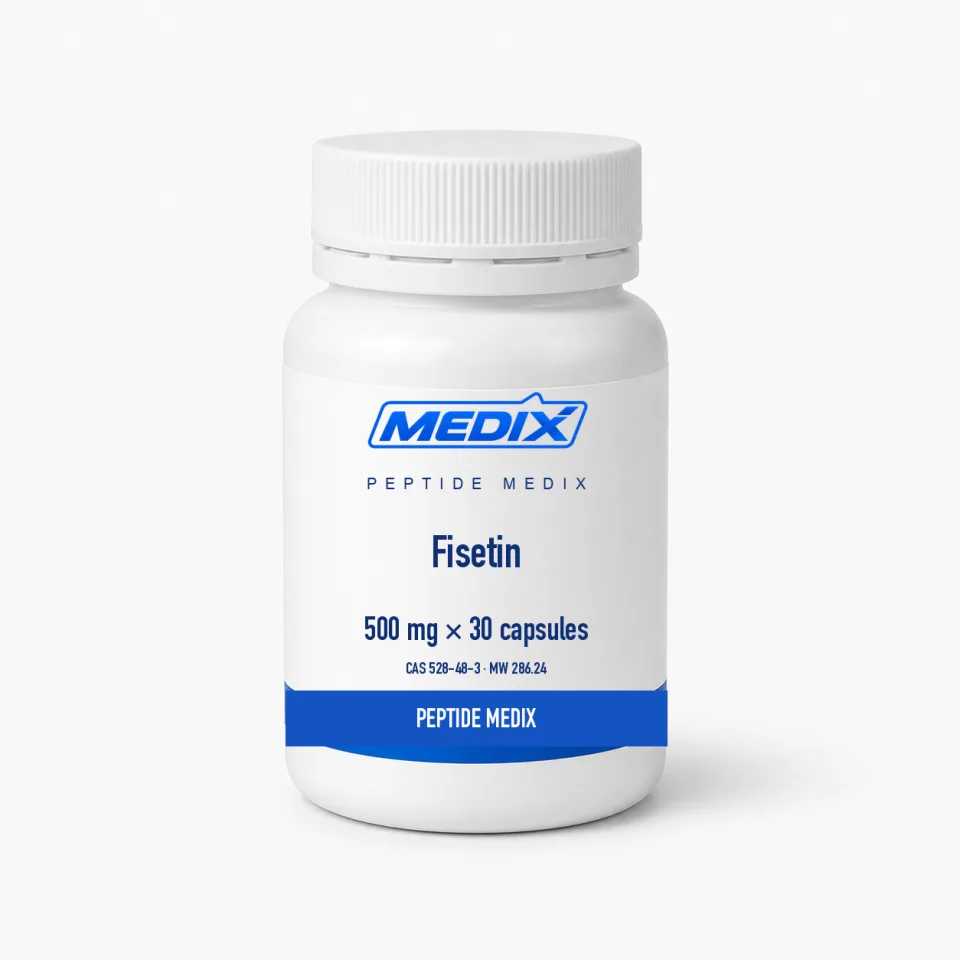
- ≥98% by HPLC
- Lot-matched certificate of analysis
- Ships next business day, tracked
Fisetin
Plant flavonol studied as a senolytic in cellular ageing models
- FormYellow crystalline powder in oral research capsules, sealed bottle with desiccant
- Mol. weight286.24 g/mol
- Research areasCellular senescence and senolytics, Nrf2 and antioxidant response, sirtuin signalling, neuroprotection models
Overview
Fisetin is a naturally occurring flavonol — 3,3',4',7-tetrahydroxyflavone — found in strawberries, apples, persimmons, grapes and onions, usually at very low concentrations. The material supplied here is a purified yellow crystalline powder encapsulated at 500 mg per unit, well above dietary levels, which is why it appears so often in cell and rodent studies rather than in nutrition work.
Like most flavonoids, fisetin is poorly water-soluble and extensively conjugated after absorption, so bioavailability is a central theme in the literature and a practical consideration at the bench: stocks are typically prepared in DMSO, and formulation studies often use lipid or cyclodextrin vehicles. Each lot we supply is assayed chromatographically to a ≥98% specification with a lot-matched certificate of analysis available.
Specifications
Identity
- CAS number
- 528-48-3
- Molecular formula
- C15H10O6
- Molecular weight
- 286.24 g/mol
Supply & purity
- Form
- Yellow crystalline powder in oral research capsules, sealed bottle with desiccant
- Purity
- ≥98% by HPLC; lot-matched COA available
- Solubility
- Practically insoluble in water; soluble in DMSO, ethanol and alkaline aqueous buffers
Additional detail
- Content per capsule
- 500 mg fisetin
- Available counts
- 30 capsules
- Chemical name
- 3,3',4',7-tetrahydroxyflavone
- Chemical class
- Flavonol (flavonoid polyphenol)
- Natural sources
- Strawberry, apple, persimmon, grape, onion — typically at milligram-per-kilogram levels
- Research areas
- Cellular senescence and senolytics, Nrf2 and antioxidant response, sirtuin signalling, neuroprotection models
- Storage
- Room temperature or cooler, dry, sealed and protected from light
Units and conversions
Capsule and troche strengths are stated per unit, so the figure a method needs is usually a conversion rather than a dilution. The mcg to mg converter handles the milligram-to-microgram step, and the millilitre arithmetic if you are working from a solution format instead.
Certificate of analysis
Every lot of Fisetin is released against a certificate of analysis: the batch-specific laboratory data for that lot, not a generic document for the compound. The lot number on the certificate matches the lot number printed on the label you receive — the vial label itself, where the product is vialled — so the record and the material it describes can always be reconciled.
Purity: ≥98% by HPLC — the specification for this listing. The figure for the lot you receive is the one reported on that lot’s certificate.
No lot certificate is on display on this page at the moment. That is a publishing state and not a testing one: lots are released and documented as described above whether or not the document is posted here, and we will send what exists for the lot in stock, or for a lot already on your bench, by its number.
Certificates are available on request before you order as well as after, with no account and no charge. Request the certificate for this listing, read the testing and documentation policy in full, or see how to read a peptide COA.
Questions about Fisetin
What is fisetin?
Fisetin is a flavonol — 3,3',4',7-tetrahydroxyflavone — found naturally in strawberries, apples and other plants. In research it is best known as a senolytic candidate: a compound studied for its reported ability to preferentially eliminate senescent cells in culture and in aged animal models.
How pure is the material and is a COA available?
Fisetin is supplied at ≥98% purity determined by HPLC, and a lot-matched certificate of analysis documenting identity, method and measured purity is available on request. Botanical-origin flavonoids vary widely between suppliers, so we recommend checking the COA before designing a study around a specific lot.
Why is bioavailability discussed so often in fisetin papers?
Fisetin is poorly water-soluble and is rapidly conjugated by glucuronidation and sulfation after absorption, so free-aglycone exposure is brief in pharmacokinetic studies. Much of the recent literature therefore focuses on formulation chemistry — liposomal, cyclodextrin and nanoparticle systems designed to raise measured exposure.
How is it prepared for in vitro work?
Because it is practically insoluble in water, laboratories usually prepare a concentrated DMSO stock, store light-protected aliquots at −20 °C and dilute into medium immediately before use. Vehicle controls matter, as does watching for precipitation and for polyphenol autoxidation artefacts in culture media.
How should the capsules be stored?
Store the closed bottle at room temperature or cooler, dry, away from heat and direct light, with the desiccant left inside. Fisetin powder is stable under those conditions; visible darkening suggests oxidation and the lot should be checked against its COA before further use.
Related