- Assayed by HPLC
- Lot-matched certificate of analysis
- Ships next business day, tracked
Spermidine
Natural polyamine studied for autophagy and cellular ageing endpoints
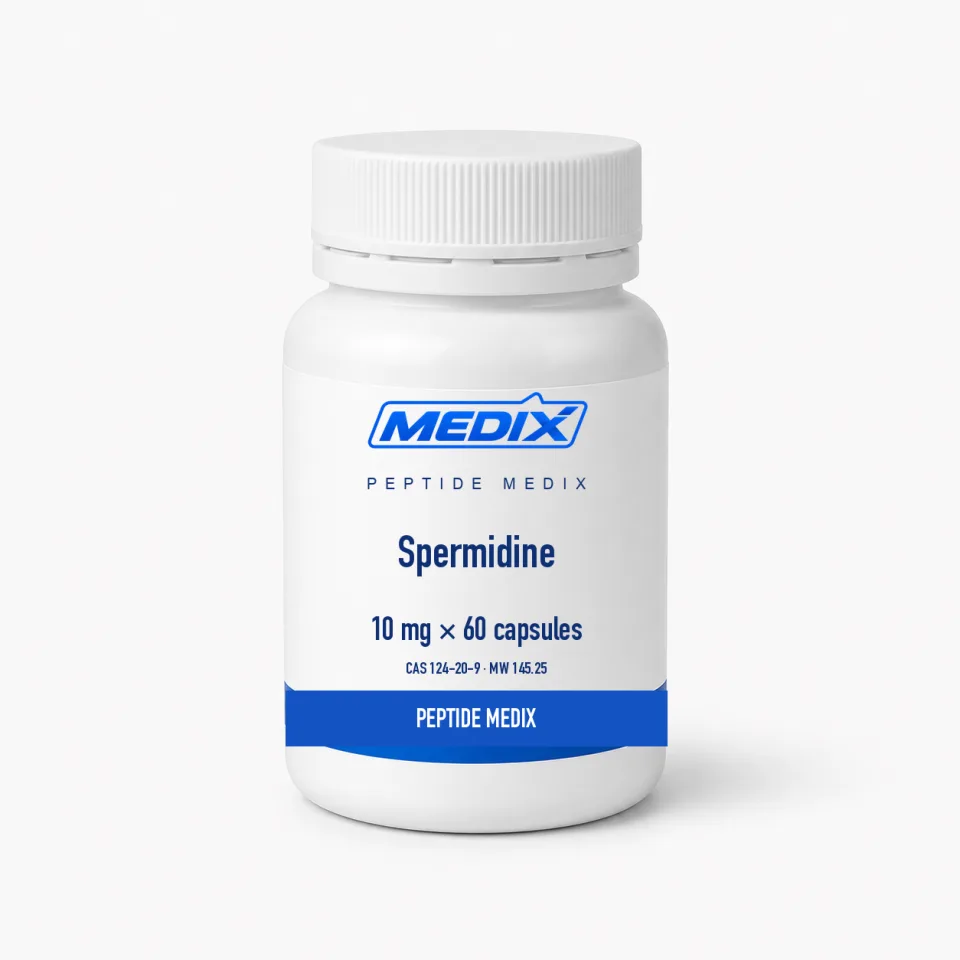
- FormOral capsule, sealed bottle with tamper-evident closure and desiccant
- Mol. weight145.25 g/mol
- Research areasAutophagy induction, cellular senescence, cardiac and neuronal ageing models, translation control
Overview
Spermidine is a naturally occurring polyamine — a small, flexible triamine of formula C7H19N3 and mass 145.25 g/mol, CAS 124-20-9. It is present in every living cell, produced from putrescine by spermidine synthase using decarboxylated S-adenosylmethionine as the aminopropyl donor, and is also supplied by the diet through wheat germ, soybeans and natto, aged cheese, mushrooms and legumes. Tissue polyamine content is reported to decline with age in several species, which is much of the reason the molecule attracts longevity researchers.
Its best-characterised molecular role is not a receptor interaction at all. Spermidine is the exclusive substrate for hypusination, the unusual post-translational modification that activates eukaryotic translation initiation factor 5A. No other molecule can supply the aminobutyl group involved, so eIF5A function is directly tied to spermidine availability. Alongside that, spermidine has been reported to inhibit acetyltransferase activity and to induce autophagy across yeast, flies, worms and mammalian cells.
Specifications
Identity
- CAS number
- 124-20-9
- Molecular formula
- C7H19N3
- Molecular weight
- 145.25 g/mol
Supply & purity
- Form
- Oral capsule, sealed bottle with tamper-evident closure and desiccant
- Purity
- Assayed by HPLC; lot-matched COA available
- Solubility
- Freely soluble in water; free base is hygroscopic and air-sensitive
Additional detail
- Content per capsule
- 10 mg spermidine
- Available count
- 60 capsules
- Chemical class
- Biogenic polyamine (triamine)
- IUPAC name
- N-(3-aminopropyl)butane-1,4-diamine
- Biosynthesis
- Formed from putrescine by spermidine synthase; precursor to spermine
- Molecular role
- Exclusive substrate for hypusination of eIF5A; reported acetyltransferase inhibition
- Research areas
- Autophagy induction, cellular senescence, cardiac and neuronal ageing models, translation control
- Storage
- Room temperature or cooler, sealed and dry, protected from light
- Preparation required
- None — fixed unit content, no reconstitution step
Units and conversions
There is no reconstitution step for a solid oral format: the mass per unit of Spermidine is fixed on the label. Where a published method is written in micrograms and the label is in milligrams, the peptide unit converter does the conversion.
Certificate of analysis
Every lot of Spermidine is released against a certificate of analysis: the batch-specific laboratory data for that lot, not a generic document for the compound. The lot number on the certificate matches the lot number printed on the label you receive — the vial label itself, where the product is vialled — so the record and the material it describes can always be reconciled.
Purity: Assayed by HPLC — the specification for this listing. The figure for the lot you receive is the one reported on that lot’s certificate.
No lot certificate is on display on this page at the moment. That is a publishing state and not a testing one: lots are released and documented as described above whether or not the document is posted here, and we will send what exists for the lot in stock, or for a lot already on your bench, by its number.
Certificates are available on request before you order as well as after, with no account and no charge. Request the certificate for this listing, read the testing and documentation policy in full, or see how to read a peptide COA.
Questions about Spermidine
What is spermidine?
It is a naturally occurring polyamine found in all living cells and in many foods, notably wheat germ, natto, aged cheese and legumes. Chemically it is a small triamine, C7H19N3, produced from putrescine and serving as the precursor to spermine in the polyamine pathway.
Why is it studied in longevity research?
Supplementation has been reported to induce autophagy and extend lifespan in yeast, worms and flies, with effects that disappear when autophagy genes are removed. Tissue polyamine levels also decline with age in several species, which makes it a natural candidate in ageing research.
What is hypusination?
It is a rare post-translational modification in which spermidine's aminobutyl group is transferred onto a lysine of eIF5A, then hydroxylated to form hypusine. eIF5A is the only protein known to carry it, and spermidine is the only possible donor, which ties translation of certain motifs directly to polyamine supply.
Is a certificate of analysis provided?
Yes. Each lot is assayed for identity and content and a certificate of analysis matched to the lot number on your bottle is available on request. Because polyamines are hygroscopic, content assay rather than appearance is the meaningful check on a capsule product.
How should the capsules be stored?
Keep them at room temperature or cooler in the sealed original bottle with the desiccant in place, away from light and humidity. Do not transfer capsules to unsealed containers, and discard any that have softened, discoloured or fused.
How does it compare with NMN or fisetin?
They act on different pathways. NMN feeds NAD-plus salvage, fisetin is studied as a senolytic flavonoid, and spermidine is studied mainly as an autophagy inducer and eIF5A substrate. Longevity researchers often run them as separate arms to distinguish those mechanisms.
Related