- Lot-matched certificate of analysis
- Ships next business day, tracked
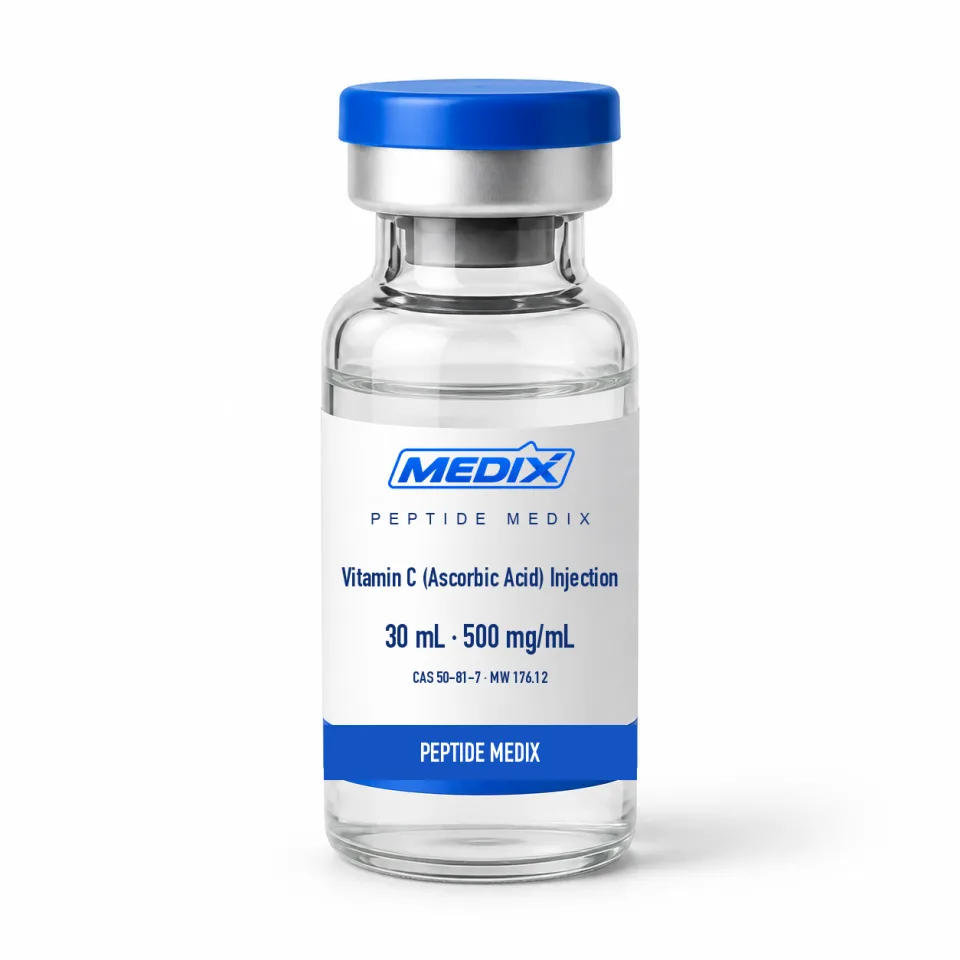
Vitamin C (Ascorbic Acid) Injection
Ascorbic acid solution, 500 mg/mL in a 30 mL multi-dose vial
- FormClear, colourless to pale straw aqueous solution in a sealed glass vial
- Mol. weight176.12 g/mol
- Research areasCollagen maturation, redox buffering in culture, pharmacologic-ascorbate pro-oxidant models, DNA demethylation and stem-cell studies, iron chemistry
Overview
Biochemically it is a reducing agent and a cofactor. It donates electrons to a family of iron- and copper-dependent enzymes, keeping their metal centres in the reduced state — prolyl and lysyl hydroxylases in collagen maturation, dopamine beta-hydroxylase in catecholamine synthesis, and the 2-oxoglutarate-dependent dioxygenases that include the TET enzymes and the HIF prolyl hydroxylases. That last group is why ascorbate turns up so often in epigenetics and hypoxia-signalling papers.
Filled at 500 mg/mL, the 30 mL vial holds 15 g of ascorbic acid, a far higher concentration than nutritional work calls for. That is deliberate. One of the main research uses of concentrated ascorbate is the pharmacologic pro-oxidant model, in which millimolar extracellular concentrations, together with catalytically available transition metals, generate hydrogen peroxide instead of acting as an antioxidant, which is the opposite of the behaviour seen at physiological levels. Ascorbic acid is a weak acid, so the solution is pH-adjusted and a substantial part of the content is present as the ascorbate anion. Oxidation is the handling problem throughout: air, light, warmth and trace metal contamination all accelerate it, and marked darkening or cloudiness is the visible endpoint.
Specifications
Identity
- CAS number
- 50-81-7
- Molecular formula
- C6H8O6
- Molecular weight
- 176.12 g/mol
Supply & purity
- Form
- Clear, colourless to pale straw aqueous solution in a sealed glass vial
Additional detail
- Concentration
- 500 mg/mL L-ascorbic acid
- Chemical class
- Water-soluble vitamin; six-carbon lactone of a hexonic acid, redox-active
- Chemistry note
- Weak acid; solutions are pH-adjusted, which means part of the content is present as the ascorbate anion
- Enzyme roles
- Prolyl and lysyl hydroxylases, dopamine beta-hydroxylase, 2-oxoglutarate-dependent dioxygenases including TET and HIF-PHD
- Research areas
- Collagen maturation, redox buffering in culture, pharmacologic-ascorbate pro-oxidant models, DNA demethylation and stem-cell studies, iron chemistry
- Oxidation sensitivity
- High — degrades on exposure to air, light, heat and trace transition metals
- Storage
- 2–8 °C, protected from light, tightly stoppered; do not freeze
- Appearance check
- Discard if markedly darkened, cloudy or containing particulates
Units and conversions
This is a pre-mixed presentation: the strength is fixed at fill, and the only arithmetic between the label and the bench is a change of units. The peptide unit converter moves between mg, mcg, mL and µL without the decimal-point slip that costs a whole run.
Certificate of analysis
Every lot of Vitamin C (Ascorbic Acid) Injection is released against its own lot documentation, and where the manufacturer issues a certificate of analysis for it, that certificate is the record for the lot rather than a generic document for the compound. The lot number on the certificate matches the lot number printed on the label you receive — the vial label itself, where the product is vialled — so the record and the material it describes can always be reconciled.
This listing carries no purity percentage, so none is claimed for it here. Where the manufacturer issues analytical documentation for a lot of this item, it is passed on unaltered — ask and we will send whatever exists.
No lot certificate is on display on this page at the moment. That is a publishing state and not a testing one: lots are released and documented as described above whether or not the document is posted here, and we will send what exists for the lot in stock, or for a lot already on your bench, by its number.
Certificates are available on request before you order as well as after, with no account and no charge. Request the certificate for this listing, read the testing and documentation policy in full, or see how to read a peptide COA.
Questions about Vitamin C (Ascorbic Acid) Injection
How much ascorbic acid is in the vial?
The 30 mL vial is filled at 500 mg/mL, so it contains 15 g of L-ascorbic acid in total. The lot-matched certificate of analysis states the measured assay value alongside identity and pH for that specific batch.
Why does the solution darken over time?
Ascorbate oxidises to dehydroascorbate and then to diketogulonic acid, and the coloured degradation products accumulate. Light, warmth, air and trace transition metals all accelerate it. Marked darkening, cloudiness or particulates mean the vial should be discarded rather than assayed.
Is a certificate of analysis provided?
Yes. Every lot is released with a certificate stating identity, assay concentration, pH and appearance, available on request against the lot number printed on the vial. Assay documentation matters particularly for an easily oxidised compound.
Related