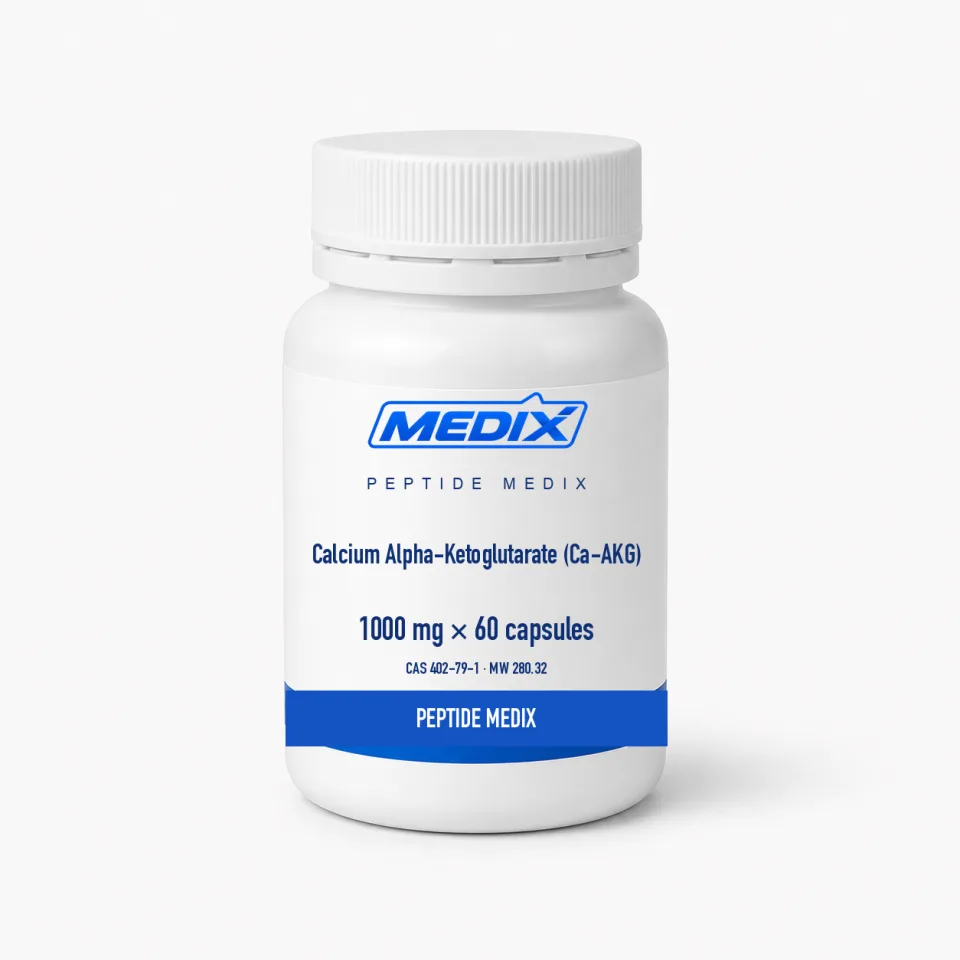
- Third-party tested
- Lot-matched certificate of analysis
- Ships next business day, tracked
Calcium Alpha-Ketoglutarate (Ca-AKG)
Calcium salt of the TCA-cycle intermediate 2-oxoglutarate, 1000 mg capsules
- FormWhite to off-white crystalline powder, encapsulated
- Research areasMitochondrial metabolism, epigenetic regulation, HIF signalling, nitrogen balance, aging biology
Overview
Calcium alpha-ketoglutarate, usually shortened to Ca-AKG, is the calcium salt of alpha-ketoglutaric acid — better known to biochemists as 2-oxoglutarate, one of the central intermediates of the tricarboxylic acid cycle. Salting the acid with calcium turns a hygroscopic, strongly acidic solid into a stable, free-flowing powder that is far easier to weigh, encapsulate and store, which is why nearly all research material is supplied in this form rather than as the free acid.
2-Oxoglutarate sits at a genuinely busy metabolic junction. It is the product of isocitrate dehydrogenase and the substrate of the alpha-ketoglutarate dehydrogenase complex, it accepts amino groups in transamination reactions that link carbon and nitrogen metabolism, and it is the obligate co-substrate for the large family of 2-oxoglutarate-dependent dioxygenases — enzymes that include the TET DNA demethylases, the JmjC histone demethylases and the prolyl hydroxylases that regulate HIF-1α. That last role is why a simple TCA intermediate turns up so often in epigenetics and aging papers.
Specifications
Identity
- CAS number
- 402-79-1
Supply & purity
- Form
- White to off-white crystalline powder, encapsulated
- Purity
- Third-party tested; lot-matched COA available
- Available sizes
- 1000 mg × 60 capsules
- Solubility
- Sparingly soluble in water; solubility of the calcium salt is lower than that of the free acid
Additional detail
- Chemical class
- Calcium salt of alpha-ketoglutaric acid (2-oxoglutaric acid)
- Free acid
- Alpha-ketoglutaric acid, C5H6O5, 146.11 g/mol, CAS 328-50-7
- Also known as
- Ca-AKG, calcium 2-oxoglutarate, calcium alpha-ketoglutarate
- Metabolic role
- TCA-cycle intermediate between isocitrate and succinyl-CoA
- Key enzymes
- Isocitrate dehydrogenase (produces it), alpha-ketoglutarate dehydrogenase complex (consumes it), transaminases
- Cofactor role
- Co-substrate for 2-oxoglutarate-dependent dioxygenases including TET enzymes, JmjC histone demethylases and prolyl hydroxylases
- Research areas
- Mitochondrial metabolism, epigenetic regulation, HIF signalling, nitrogen balance, aging biology
- Storage
- Cool, dry, sealed container protected from light and moisture
Units and conversions
The arithmetic on an oral format is unit arithmetic rather than dilution arithmetic. Use the milligram to microgram converter to line a per-unit figure up against a method written in different units.
Certificate of analysis
Every lot of Calcium Alpha-Ketoglutarate (Ca-AKG) is released against a certificate of analysis: the batch-specific laboratory data for that lot, not a generic document for the compound. The lot number on the certificate matches the lot number printed on the label you receive — the vial label itself, where the product is vialled — so the record and the material it describes can always be reconciled.
Purity: Third-party tested — the specification for this listing. The figure for the lot you receive is the one reported on that lot’s certificate.
No lot certificate is on display on this page at the moment. That is a publishing state and not a testing one: lots are released and documented as described above whether or not the document is posted here, and we will send what exists for the lot in stock, or for a lot already on your bench, by its number.
Certificates are available on request before you order as well as after, with no account and no charge. Request the certificate for this listing, read the testing and documentation policy in full, or see how to read a peptide COA.
Questions about Calcium Alpha-Ketoglutarate (Ca-AKG)
What is the difference between AKG and Ca-AKG?
AKG refers to the alpha-ketoglutarate anion, sold either as the free acid or as a salt. Ca-AKG is the calcium salt. The salt is far less hygroscopic and less acidic than the free acid, which makes it stable enough to weigh and encapsulate — the same anion, in a more practical solid form.
Why does a TCA-cycle intermediate appear in aging research?
Because 2-oxoglutarate is the obligate co-substrate for a large family of dioxygenases that includes the TET DNA demethylases, JmjC histone demethylases and HIF prolyl hydroxylases. That gives a simple metabolite direct leverage over epigenetic and hypoxia signalling, which is why it recurs in aging papers.
Is purity documentation available?
Yes. Material is third-party tested and a lot-matched certificate of analysis is available on request. Because this is a small molecule rather than a peptide, testing follows small-molecule identity and purity methods rather than the HPLC peptide-purity assays used elsewhere in the catalogue.
How should Ca-AKG be stored?
Cool, dry and sealed, protected from light and moisture. The calcium salt is considerably more stable than the free acid, but bulk powder will still absorb atmospheric moisture and cake if the container is left open, so reseal after each use.
Does Ca-AKG dissolve readily in water?
Only sparingly. The calcium salt is markedly less water-soluble than the free acid. Solution protocols commonly use gentle warming with agitation, or start from alpha-ketoglutaric acid and adjust pH with a separate base, keeping the calcium contribution controlled.
How is it related to NMN and spermidine?
Only by research theme. All three appear frequently in the metabolic and aging-biology literature, but they act through different mechanisms — NAD+ precursor supply, autophagy and polyamine signalling, and dioxygenase co-substrate availability respectively. Co-listing reflects shared subject matter, not a combination protocol.
Related