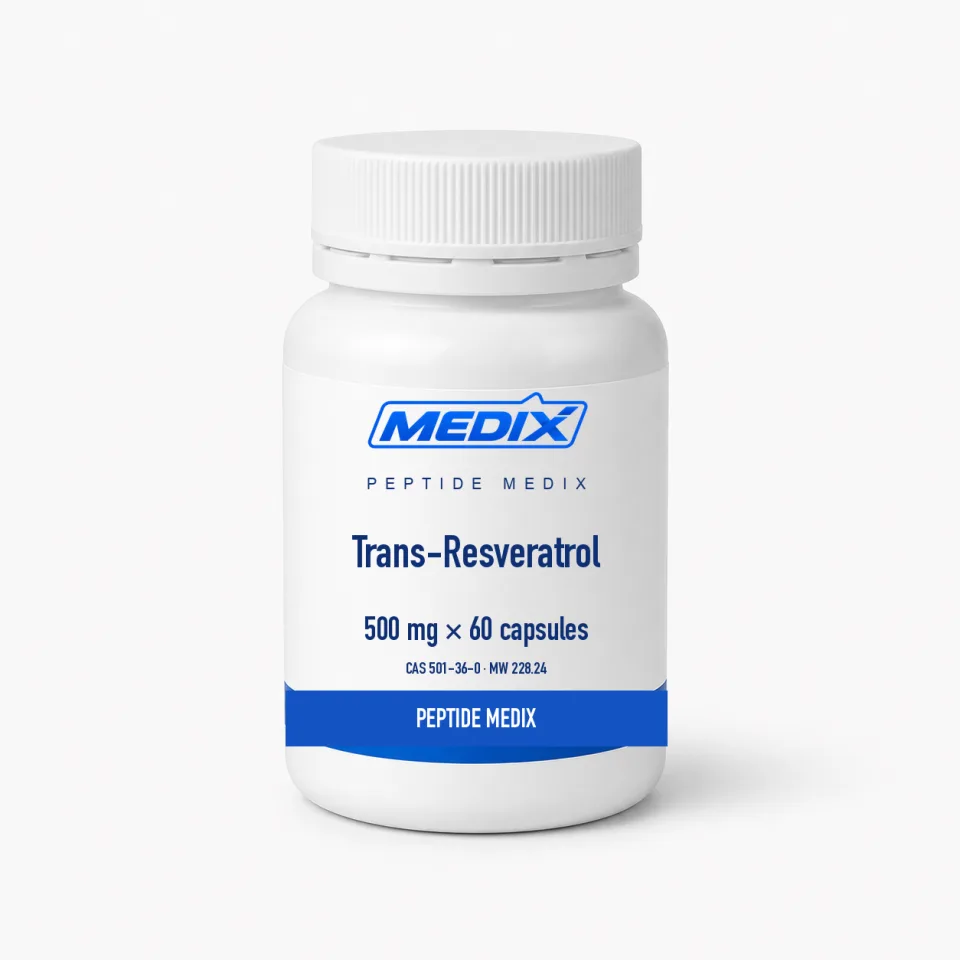
- ≥98% trans-resveratrol by HPLC
- Lot-matched certificate of analysis
- Ships next business day, tracked
Trans-Resveratrol
Trans-resveratrol stilbenoid polyphenol for sirtuin and longevity research
- FormOff-white to light tan powder in vegetarian capsules, sealed bottle
- Mol. weight228.24 g/mol
- Research areasSIRT1 and sirtuin biology, AMPK signalling, oxidative stress, cellular senescence, xenohormesis
Overview
Trans-resveratrol is a stilbenoid polyphenol — 3,5,4'-trihydroxy-trans-stilbene — produced by grapevine, Japanese knotweed and several other plants as a phytoalexin, a defensive compound made in response to fungal attack and stress. Commercial material is usually extracted from Polygonum cuspidatum root or produced synthetically, and the trans isomer is the one of interest: the cis form is less studied and forms readily when the molecule is exposed to UV light, which is why resveratrol preparations are kept dark.
The compound became a fixture of longevity research after reports that it activated the NAD-dependent deacetylase SIRT1 and extended lifespan in yeast and invertebrate models. That interpretation has been argued over ever since — a substantial body of work suggests the original assay depended on a fluorophore-tagged substrate, and alternative or additional mechanisms including AMPK activation, phosphodiesterase inhibition and direct antioxidant chemistry have all been proposed. The debate itself is part of why resveratrol remains a heavily used research standard.
Specifications
Identity
- CAS number
- 501-36-0
- Molecular formula
- C14H12O3
- Molecular weight
- 228.24 g/mol
Supply & purity
- Form
- Off-white to light tan powder in vegetarian capsules, sealed bottle
- Purity
- ≥98% trans-resveratrol by HPLC; lot-matched COA available
- Solubility
- Poorly water soluble; soluble in ethanol and DMSO for stock preparation
Additional detail
- Available size
- 500 mg × 60 capsules
- Chemical name
- 3,5,4'-trihydroxy-trans-stilbene
- Chemical class
- Stilbenoid polyphenol (phytoalexin)
- Isomerism
- Trans form; converts to the cis isomer on UV exposure
- Research areas
- SIRT1 and sirtuin biology, AMPK signalling, oxidative stress, cellular senescence, xenohormesis
- Storage
- Cool, dry place, sealed and protected from light; refrigeration extends shelf life
- Stability note
- Sensitive to light, oxygen and alkaline pH
Units and conversions
Capsule and troche strengths are stated per unit, so the figure a method needs is usually a conversion rather than a dilution. The mcg to mg converter handles the milligram-to-microgram step, and the millilitre arithmetic if you are working from a solution format instead.
Certificate of analysis
Every lot of Trans-Resveratrol is released against a certificate of analysis: the batch-specific laboratory data for that lot, not a generic document for the compound. The lot number on the certificate matches the lot number printed on the label you receive — the vial label itself, where the product is vialled — so the record and the material it describes can always be reconciled.
Purity: ≥98% trans-resveratrol by HPLC — the specification for this listing. The figure for the lot you receive is the one reported on that lot’s certificate.
No lot certificate is on display on this page at the moment. That is a publishing state and not a testing one: lots are released and documented as described above whether or not the document is posted here, and we will send what exists for the lot in stock, or for a lot already on your bench, by its number.
Certificates are available on request before you order as well as after, with no account and no charge. Request the certificate for this listing, read the testing and documentation policy in full, or see how to read a peptide COA.
Questions about Trans-Resveratrol
Why trans-resveratrol specifically?
Almost all published research uses the trans isomer, which is the naturally predominant and more extensively characterised form. The cis isomer forms on UV exposure and behaves differently in several assays, so material is specified, stored and shipped to preserve the trans configuration.
Is a certificate of analysis available?
Yes. Each lot is tested by HPLC and supplied with a matching COA reporting trans-resveratrol content and identity. Request it by lot number and keep it with your records, since polyphenol purity varies widely between sources and affects comparability of results.
How is resveratrol prepared for cell-culture work?
Aqueous solubility is poor, so laboratories typically dissolve weighed material in DMSO or ethanol to make a concentrated stock, then dilute into medium immediately before use. Keep the final solvent fraction consistent across every arm of the experiment, vehicle controls included.
How does it compare with NMN or fisetin?
All three appear in longevity research but act on different chemistry: NMN is an NAD precursor feeding the NAD pool directly, fisetin is a flavonoid studied largely in senolytic screens, and resveratrol is a stilbenoid studied around sirtuin and AMPK signalling. Laboratories often run them as a comparative panel.
Why do published results disagree so much?
Reported outcomes depend heavily on concentration, model organism, strain and formulation, and much in vitro work uses concentrations far above what whole-organism studies achieve because resveratrol is rapidly conjugated after absorption. Stating the model and concentration explicitly is essential when reporting.
Related