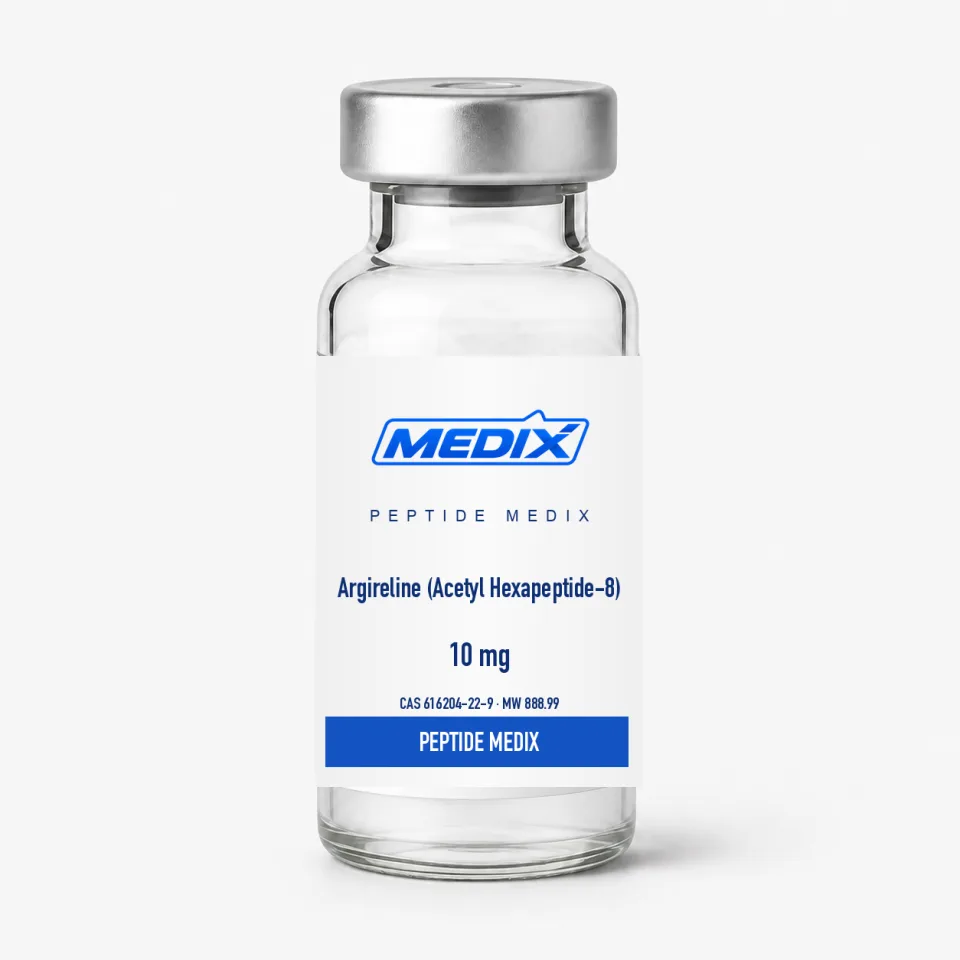
- ≥99% by HPLC with mass-spectrometric identity check
- Lot-matched certificate of analysis
- Ships next business day, tracked
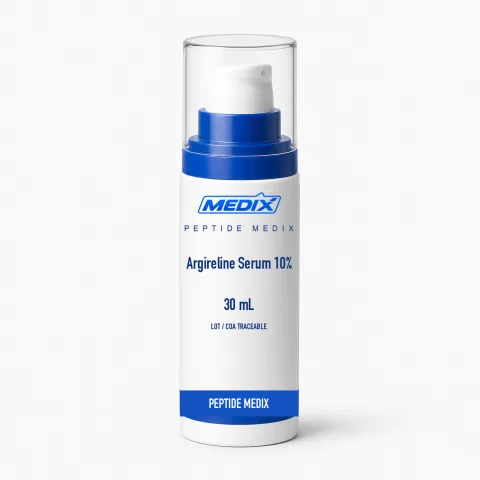
Argireline (Acetyl Hexapeptide-8)
Acetyl hexapeptide-8 — the EEMQRR cosmetic signal peptide, 10 mg and 50 mg
- FormWhite lyophilized powder in a sealed glass vial
- Mol. weight888.99 g/mol
- Research areasSNARE assembly, exocytosis interference, expression-line formulation studies
Overview
Argireline is the trade name for acetyl hexapeptide-8, a six-residue peptide with the sequence Glu-Glu-Met-Gln-Arg-Arg, acetylated at the N-terminus and amidated at the C-terminus. It was originally described as acetyl hexapeptide-3 and remains one of the most extensively studied cosmetic signal peptides, in large part because it is small, water-soluble and cheap to characterise. The sequence is taken from the N-terminal region of SNAP-25, a component of the SNARE complex responsible for vesicle docking and fusion at the synapse.
In research settings the peptide is used to probe interference with SNARE assembly from outside the cell, and as a benchmark ingredient in topical formulation studies that measure the appearance of dynamic lines by profilometry or image analysis. It is the reference point against which newer analogs such as SNAP-8 are compared, so bench programmes commonly run the two together in the same vehicle and at matched molar concentrations.
Peptide Medix stocks Argireline as a lyophilized powder in 10 mg and 50 mg vials, third-party tested to ≥99% by HPLC with a lot-matched certificate of analysis, dispatched from the United States.
Specifications
Identity
- CAS number
- 616204-22-9
- Molecular formula
- C34H60N14O12S
- Molecular weight
- 888.99 g/mol
- Amino acid sequence
- Ac-Glu-Glu-Met-Gln-Arg-Arg-NH2
- Peptide class
- Cosmetic signal peptide; SNAP-25 N-terminal fragment analog
Supply & purity
- Form
- White lyophilized powder in a sealed glass vial
- Purity
- ≥99% by HPLC with mass-spectrometric identity check; COA per lot
- Available sizes
- 10 mg, 50 mg
- Solubility
- Freely soluble in water and bacteriostatic water
Handling & storage
- Storage (lyophilized)
- −20 °C, sealed, away from light and moisture
Additional detail
- INCI name
- Acetyl Hexapeptide-8 (formerly acetyl hexapeptide-3)
- Research areas
- SNARE assembly, exocytosis interference, expression-line formulation studies
- Storage (in solution)
- 2–8 °C, short-term; methionine is oxidation-sensitive
Working out the concentration
Argireline (Acetyl Hexapeptide-8) ships as a lyophilized powder, so nothing on this page can state a concentration: the figure you work with is the one you create when you add diluent. Put the vial mass and the volume you intend to use into the peptide reconstitution calculator and it returns mg/mL, mcg/mL and the mass sitting at each mark on a U-100 syringe.
If the protocol asks for a molar concentration, the molar concentration calculator converts between 888.99 g/mol, the mass you weigh out and the volume you dissolve it in.
Certificate of analysis
Every lot of Argireline (Acetyl Hexapeptide-8) is released against a certificate of analysis: the batch-specific laboratory data for that lot, not a generic document for the compound. The lot number on the certificate matches the lot number printed on the label you receive — the vial label itself, where the product is vialled — so the record and the material it describes can always be reconciled.
Purity: ≥99% by HPLC with mass-spectrometric identity check — the specification for this listing. The figure for the lot you receive is the one reported on that lot’s certificate.
No lot certificate is on display on this page at the moment. That is a publishing state and not a testing one: lots are released and documented as described above whether or not the document is posted here, and we will send what exists for the lot in stock, or for a lot already on your bench, by its number.
Certificates are available on request before you order as well as after, with no account and no charge. Request the certificate for this listing, read the testing and documentation policy in full, or see how to read a peptide COA.
Questions about Argireline (Acetyl Hexapeptide-8)
What is Argireline?
Argireline is the commercial name for acetyl hexapeptide-8, a six-amino-acid peptide with the sequence Ac-Glu-Glu-Met-Gln-Arg-Arg-NH2 copied from the N-terminal region of SNAP-25. It is one of the most-studied cosmetic signal peptides and is widely used as a reference material in formulation and SNARE-assembly research.
Is acetyl hexapeptide-8 the same as acetyl hexapeptide-3?
Yes. The ingredient was originally listed as acetyl hexapeptide-3 and later renamed acetyl hexapeptide-8 in INCI nomenclature. Older papers and datasheets use the earlier name for the identical sequence, which is worth knowing when reconciling literature values with a current certificate of analysis.
Is this lot third-party tested, and can I see the COA?
Yes. Every production lot is analysed by an independent laboratory for identity and purity — HPLC with mass-spectrometric confirmation — and the lot-matched certificate of analysis is available on request before purchase. The COA states the lot number, assay result and test date so it can be filed with your experimental records.
How does it compare with SNAP-8?
SNAP-8 is the same core sequence with two extra residues at the C-terminus, giving an octapeptide. Comparative bench work looks at affinity for the SNARE interface, aqueous stability and behaviour in identical vehicles. Neither peptide substitutes for the other in a study design; they are usually run in parallel.
What sizes and vial contents are offered?
Argireline is supplied in 10 mg and 50 mg lyophilized vials containing peptide only, with no diluent, carrier or preservative. The 10 mg size suits receptor and assay work; the 50 mg size is aimed at repeated formulation trials where larger volumes of stock solution are needed.
How should it be stored and dissolved?
Store the sealed lyophilate at −20 °C, protected from light and moisture. It dissolves freely in water or bacteriostatic water. Because of the oxidation-prone methionine, prepare solutions close to the time of use, keep them at 2–8 °C and avoid repeated freeze–thaw cycles.
Related