- Lot-matched certificate of analysis
- Ships next business day, tracked
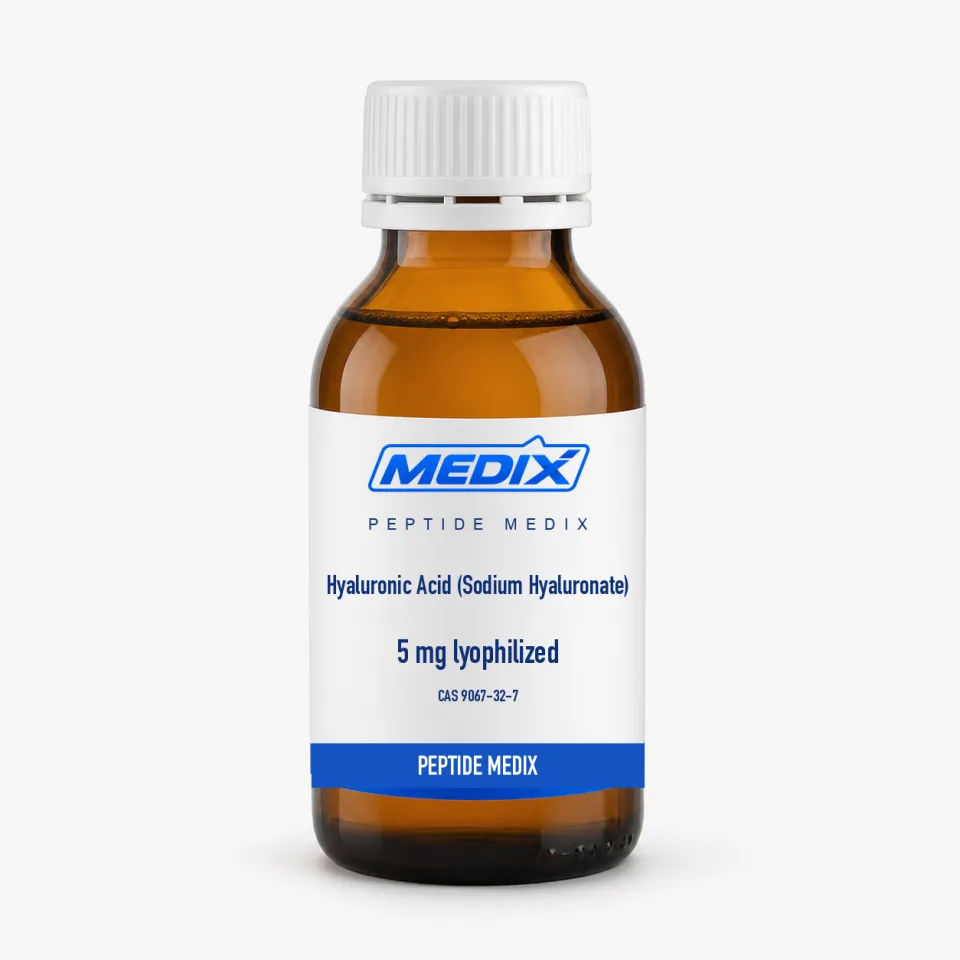
Hyaluronic Acid (Sodium Hyaluronate)
Sodium hyaluronate glycosaminoglycan for skin, matrix and viscosity research
- FormLyophilized sodium hyaluronate powder, or pre-mixed 1% aqueous solution
- Mol. weightPolydisperse — a chain-length distribution rather than a single mass; see the lot COA
- Research areasSkin hydration and dermal matrix models, hydrogel scaffolds, synovial viscosity, wound-model studies
Overview
Hyaluronic acid is not a peptide at all — it is a linear glycosaminoglycan built from a repeating disaccharide of D-glucuronic acid and N-acetyl-D-glucosamine joined by alternating beta-1,3 and beta-1,4 linkages. That simple, unsulfated backbone is the same in every tissue that makes it, from skin dermis and synovial fluid to the vitreous humour of the eye; what changes between sources is chain length, and chain length is what drives most of its physical and biological behaviour. Material supplied for laboratory work is normally the sodium salt, sodium hyaluronate, which is far easier to dry, weigh and redissolve than the free acid.
Because the polymer carries one carboxylate per disaccharide, it binds a very large volume of water relative to its mass and forms viscoelastic solutions at low concentration. Researchers use those properties directly — as a viscosity modifier, a hydrogel component or a matrix mimic — and also study the polymer as a signalling molecule, since fragments of different molecular weight interact differently with the CD44, RHAMM and LYVE-1 receptors and with hyaluronidase enzymes.
Specifications
Identity
- CAS number
- 9067-32-7 (sodium hyaluronate)
- Molecular weight
- Polydisperse — a chain-length distribution rather than a single mass; see the lot COA
Supply & purity
- Form
- Lyophilized sodium hyaluronate powder, or pre-mixed 1% aqueous solution
- Available sizes
- 5 mg lyophilized; 2 mL of 1% solution
- Solubility
- Water and aqueous buffers; dissolves slowly, hydrate without vigorous shear
Additional detail
- Chemical class
- Non-sulfated linear glycosaminoglycan (polysaccharide)
- Repeating unit
- D-glucuronic acid + N-acetyl-D-glucosamine, beta-1,3 and beta-1,4 linked
- Solution behaviour
- Highly hydrophilic; forms viscoelastic, shear-thinning solutions at low concentration
- Known receptors
- CD44, RHAMM (HMMR), LYVE-1
- Degrading enzymes
- Hyaluronidases (HYAL1, HYAL2, PH-20) and reactive oxygen species
- Research areas
- Skin hydration and dermal matrix models, hydrogel scaffolds, synovial viscosity, wound-model studies
- Storage (powder)
- 2–8 °C or cooler, sealed and protected from moisture
- Storage (solution)
- 2–8 °C, protected from light; do not freeze-thaw repeatedly
Working out the concentration
Because Hyaluronic Acid (Sodium Hyaluronate) arrives dry, its concentration is a decision rather than a specification. Run the numbers through the reconstitution calculator — vial mass in, diluent volume in, mg/mL and mass per syringe unit out.
Certificate of analysis
Every lot of Hyaluronic Acid (Sodium Hyaluronate) is released against its own lot documentation, and where the manufacturer issues a certificate of analysis for it, that certificate is the record for the lot rather than a generic document for the compound. The lot number on the certificate matches the lot number printed on the label you receive — the vial label itself, where the product is vialled — so the record and the material it describes can always be reconciled.
This listing carries no purity percentage, so none is claimed for it here. Where the manufacturer issues analytical documentation for a lot of this item, it is passed on unaltered — ask and we will send whatever exists.
No lot certificate is on display on this page at the moment. That is a publishing state and not a testing one: lots are released and documented as described above whether or not the document is posted here, and we will send what exists for the lot in stock, or for a lot already on your bench, by its number.
Certificates are available on request before you order as well as after, with no account and no charge. Request the certificate for this listing, read the testing and documentation policy in full, or see how to read a peptide COA.
Questions about Hyaluronic Acid (Sodium Hyaluronate)
Is this hyaluronic acid or sodium hyaluronate?
The material supplied is sodium hyaluronate, the sodium salt of hyaluronic acid. It is the standard laboratory form because it dries to a stable powder and redissolves more readily than the free acid. In solution the two are chemically equivalent at physiological pH.
What molecular weight is the material?
Hyaluronan is polydisperse, so it is described by a chain-length distribution rather than one number. The lot-matched certificate of analysis is the authoritative record for the batch you receive, and it is worth quoting that range in any write-up because reported effects often depend on chain size.
Is a certificate of analysis available?
Yes. Every lot is tested and supplied with a matching COA covering identity and purity. Request it with your order or afterwards by lot number, and keep it with your experimental records so the material grade can be reported alongside your results.
Which format should a laboratory choose?
The 5 mg lyophilized powder suits work where you need to control buffer, ionic strength and final concentration yourself. The 2 mL 1% solution suits formulation, viscosity and topical-model work where a consistent, ready-made stock removes a preparation variable.
How is it dissolved without lumps?
Scatter the powder across the surface of the aqueous phase and leave it to swell before mixing, rather than adding it to an already-stirring vessel. Gentle agitation over a longer period gives a clear solution; aggressive shear or sonication dissolves it faster but cleaves the polymer chains.
Related