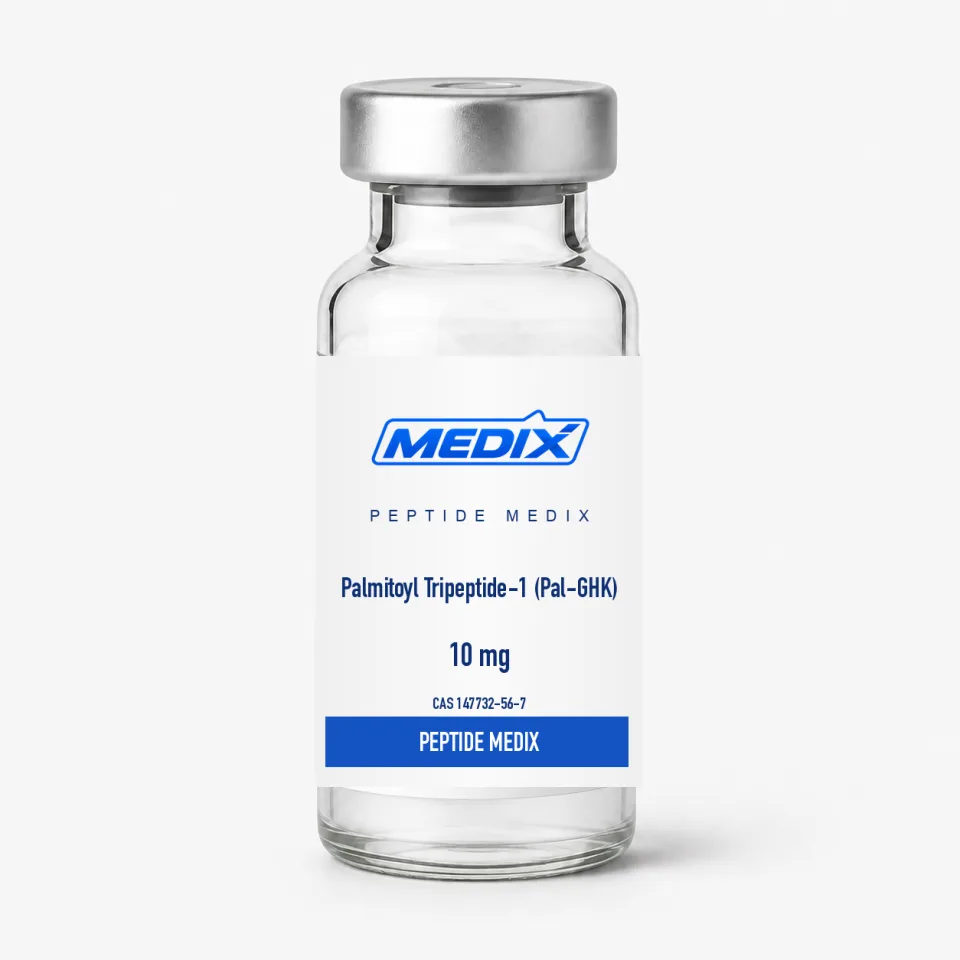
- ≥98% by HPLC
- Lot-matched certificate of analysis
- Ships next business day, tracked
Palmitoyl Tripeptide-1 (Pal-GHK)
Palmitoylated Gly-His-Lys matrikine studied in collagen and ECM models
- FormLyophilized powder, sealed glass vial
- Mol. weight578.8 g/mol
- Research areasCollagen and glycosaminoglycan synthesis, ECM remodelling, fibroblast signalling, transdermal penetration of lipidated peptides
Overview
Palmitoyl tripeptide-1 is the tripeptide Gly-His-Lys with a sixteen-carbon palmitic acid chain attached to its N-terminal glycine. The peptide core is GHK, the same matrikine fragment that appears in the catalogue as GHK-Cu, released naturally when extracellular matrix proteins such as collagen I are degraded and recognised by fibroblasts as a signal that repair is needed.
The palmitoyl chain is not decoration. Free GHK is a small, highly polar molecule that partitions poorly into lipid membranes and the stratum corneum, so its usefulness in topical formulation work is limited by penetration. Acylating the N-terminus with palmitic acid roughly triples the molecular weight, drops water solubility sharply and gives the molecule an amphiphilic, surfactant-like character — it will orient at interfaces, associate with lipid bilayers and traverse lipid-rich barriers that the free tripeptide cannot. This lipidation strategy is the same one behind palmitoyl pentapeptide-4 and the wider family of cosmetic matrikine derivatives.
Specifications
Identity
- CAS number
- 147732-56-7
- Molecular formula
- C30H54N6O5
- Molecular weight
- 578.8 g/mol
- Amino acid sequence
- Palmitoyl-Gly-His-Lys (Pal-GHK)
- Peptide class
- Lipidated matrikine tripeptide (cosmetic peptide)
Supply & purity
- Form
- Lyophilized powder, sealed glass vial
- Purity
- ≥98% by HPLC; lot-matched COA available
- Available sizes
- 10 mg, 50 mg
- Solubility
- Poorly soluble in water; commonly dissolved in ethanol, propylene glycol, DMSO or a warmed surfactant-containing vehicle
Handling & storage
- Storage (lyophilized)
- −20 °C, sealed and protected from light and moisture
Additional detail
- Also known as
- Pal-GHK, palmitoyl oligopeptide, N-palmitoyl-Gly-His-Lys
- Peptide core
- GHK — Gly-His-Lys, a matrix fragment released during collagen I degradation
- Key modification
- C16 palmitoyl chain amide-linked to the N-terminal glycine
- Research areas
- Collagen and glycosaminoglycan synthesis, ECM remodelling, fibroblast signalling, transdermal penetration of lipidated peptides
- Storage (in solution)
- 2–8 °C, protected from light, used within the study window
Working out the concentration
A lyophilized vial carries a mass on the label and no concentration anywhere, so the first calculation of any protocol is the reconstitution one. The peptide concentration calculator converts vial mass plus diluent volume into mg/mL, and back into the draw volume for a given mass.
Where a method is written in molar terms instead, the molecular weight above — 578.8 g/mol — is the input the molarity calculator needs.
Certificate of analysis
Every lot of Palmitoyl Tripeptide-1 (Pal-GHK) is released against a certificate of analysis: the batch-specific laboratory data for that lot, not a generic document for the compound. The lot number on the certificate matches the lot number printed on the label you receive — the vial label itself, where the product is vialled — so the record and the material it describes can always be reconciled.
Purity: ≥98% by HPLC — the specification for this listing. The figure for the lot you receive is the one reported on that lot’s certificate.
No lot certificate is on display on this page at the moment. That is a publishing state and not a testing one: lots are released and documented as described above whether or not the document is posted here, and we will send what exists for the lot in stock, or for a lot already on your bench, by its number.
Certificates are available on request before you order as well as after, with no account and no charge. Request the certificate for this listing, read the testing and documentation policy in full, or see how to read a peptide COA.
Questions about Palmitoyl Tripeptide-1 (Pal-GHK)
How does Pal-GHK differ from GHK-Cu?
Both share the Gly-His-Lys core. GHK-Cu is the copper(II) complex of the free tripeptide, water-soluble and blue, studied largely for copper-dependent effects. Palmitoyl tripeptide-1 has no copper; instead a C16 fatty acid is amide-linked to the N-terminus, making it lipophilic rather than water-soluble.
Why is it so hard to dissolve in water?
The palmitoyl chain dominates the molecule's behaviour. A sixteen-carbon lipid tail on a small tripeptide creates an amphiphile that prefers interfaces and lipid phases. Stocks are usually made in ethanol, propylene glycol or DMSO, then diluted into the aqueous working system rather than dissolved directly.
What purity is the material and is a COA available?
It is supplied at ≥98% by HPLC with a lot-matched certificate of analysis available on request. Lipidated peptides typically carry slightly lower assayed purity than unmodified sequences because the acylation step and the resulting hydrophobicity complicate purification.
Is this the same as Matrixyl?
No. Matrixyl is the trade name most associated with palmitoyl pentapeptide-4 (Pal-KTTKS). Palmitoyl tripeptide-1 is a different, shorter lipidated matrikine. The two appear together in some multi-peptide cosmetic literature, which is why they are cross-listed here.
How should it be stored?
Keep the sealed powder at −20 °C, protected from light and moisture, and let the vial warm to room temperature before opening. Solutions and stocks are stored at 2–8 °C and protected from light. Because the peptide adsorbs to plastic, glass or low-binding containers are preferred.
Can it be used to make a skincare product?
No. Material supplied here is research grade and is not a cosmetic ingredient release — it carries no cosmetic-grade specification, no preservative system and no suitability assessment for consumer formulation. It is for laboratory formulation and cell-culture research only.
Related