- ≥99% by HPLC with mass-spectrometric identity check
- Lot-matched certificate of analysis
- Ships next business day, tracked
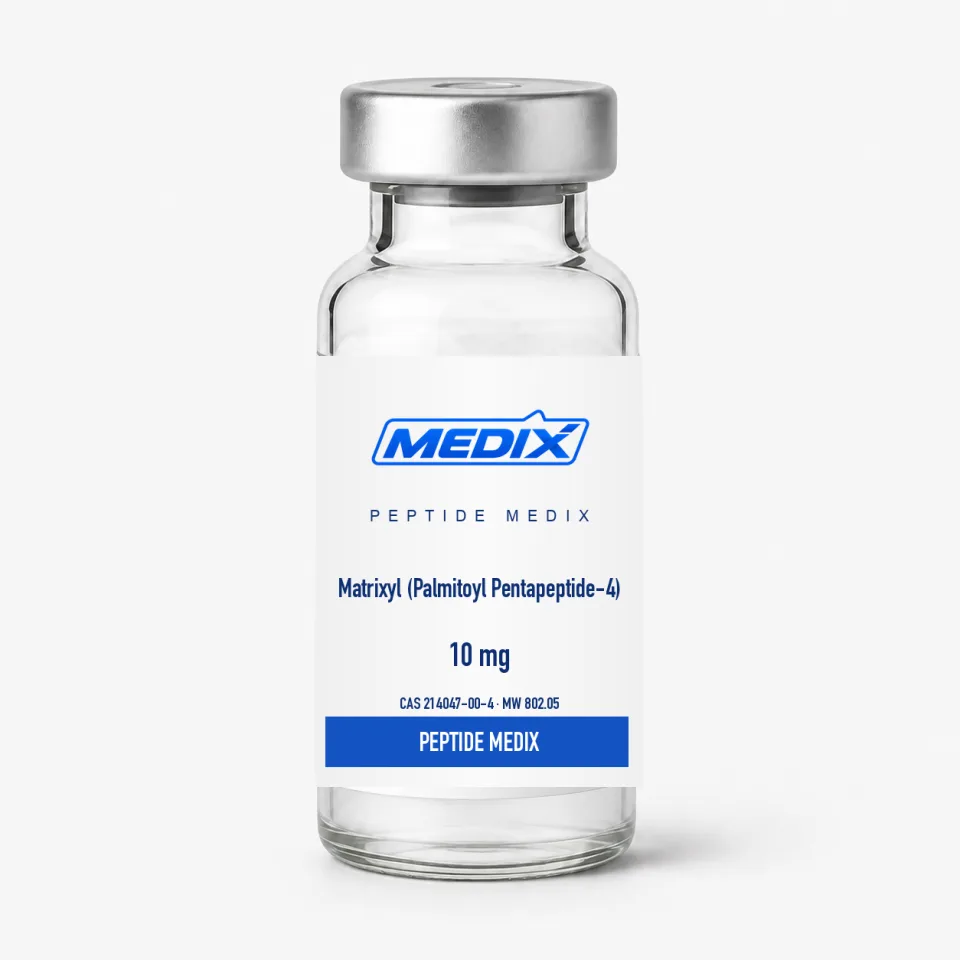
Matrixyl (Palmitoyl Pentapeptide-4)
Palmitoyl pentapeptide-4 (Pal-KTTKS) — lipidated collagen-fragment matrikine
- FormWhite to off-white lyophilized powder in a sealed glass vial
- Mol. weight802.05 g/mol
- Research areasProcollagen I and III synthesis, fibronectin, ECM remodelling, skin permeation
Overview
Matrixyl is the trade name for palmitoyl pentapeptide-4, a lipidated matrikine built from the pentapeptide Lys-Thr-Thr-Lys-Ser (KTTKS) with a palmitic acid chain attached to the N-terminal lysine. The KTTKS sequence occurs in the C-terminal propeptide of type I collagen, where it is released during matrix turnover; the observation that such fragments feed back onto fibroblasts is the reason the peptide became a staple of extracellular-matrix research. The palmitoyl tail was added to raise lipophilicity and improve behaviour in topical vehicles compared with the bare peptide.
Laboratory work with Pal-KTTKS mostly examines fibroblast responses — procollagen I and III output, fibronectin, glycosaminoglycan production — and formulation questions such as partitioning, micelle formation and skin permeation. It is also the reference compound for the wider matrikine family, including palmitoyl tripeptide-1 and palmitoyl tetrapeptide-7, which are often assayed against it.
Peptide Medix supplies palmitoyl pentapeptide-4 as a lyophilized powder in 10 mg and 50 mg vials, third-party tested to ≥99% by HPLC with a lot-matched certificate of analysis, shipped from the United States.
Specifications
Identity
- CAS number
- 214047-00-4
- Molecular formula
- C39H75N7O10
- Molecular weight
- 802.05 g/mol
- Peptide class
- Lipidated matrikine / collagen-fragment signal peptide
Supply & purity
- Form
- White to off-white lyophilized powder in a sealed glass vial
- Purity
- ≥99% by HPLC with mass-spectrometric identity check; COA per lot
- Available sizes
- 10 mg, 50 mg
- Solubility
- Limited in plain water; usually prepared with a co-solvent such as propylene glycol, ethanol or DMSO before dilution
Handling & storage
- Storage (lyophilized)
- −20 °C, sealed, protected from light and moisture
Additional detail
- Peptide sequence
- Palmitoyl-Lys-Thr-Thr-Lys-Ser (Pal-KTTKS)
- INCI name
- Palmitoyl Pentapeptide-4 (formerly palmitoyl pentapeptide-3)
- Research areas
- Procollagen I and III synthesis, fibronectin, ECM remodelling, skin permeation
- Storage (in solution)
- 2–8 °C, short-term; check for cloudiness before use
Working out the concentration
The vial sizes above — 10 mg, 50 mg — describe a mass of material, not a strength. Choose a diluent volume, work it out with the reconstitution calculator, and you have the concentration for your own vial of Matrixyl (Palmitoyl Pentapeptide-4) plus the volume that carries any mass you want to withdraw.
If the protocol asks for a molar concentration, the molar concentration calculator converts between 802.05 g/mol, the mass you weigh out and the volume you dissolve it in.
Certificate of analysis
Every lot of Matrixyl (Palmitoyl Pentapeptide-4) is released against a certificate of analysis: the batch-specific laboratory data for that lot, not a generic document for the compound. The lot number on the certificate matches the lot number printed on the label you receive — the vial label itself, where the product is vialled — so the record and the material it describes can always be reconciled.
Purity: ≥99% by HPLC with mass-spectrometric identity check — the specification for this listing. The figure for the lot you receive is the one reported on that lot’s certificate.
No lot certificate is on display on this page at the moment. That is a publishing state and not a testing one: lots are released and documented as described above whether or not the document is posted here, and we will send what exists for the lot in stock, or for a lot already on your bench, by its number.
Certificates are available on request before you order as well as after, with no account and no charge. Request the certificate for this listing, read the testing and documentation policy in full, or see how to read a peptide COA.
Questions about Matrixyl (Palmitoyl Pentapeptide-4)
What is Matrixyl?
Matrixyl is the trade name for palmitoyl pentapeptide-4, the pentapeptide KTTKS with a palmitic acid chain on the N-terminus. KTTKS is a fragment of the type I collagen propeptide, and the lipidated version is one of the most widely studied matrikines in extracellular-matrix and cosmetic-ingredient research.
How does it differ from plain KTTKS?
The sequence is identical; the difference is the C16 lipid tail. Palmitoylation makes the molecule amphiphilic, so it partitions into lipid phases, forms micelles above a threshold concentration and behaves quite differently in permeation studies. Comparative work almost always reports both forms separately.
Is this lot third-party tested, and can I see the COA?
Yes. Every production lot is analysed by an independent laboratory for identity and purity — HPLC with mass-spectrometric confirmation — and the lot-matched certificate of analysis is available on request before purchase. The COA states the lot number, assay result and test date so it can be filed with your experimental records.
How is it dissolved for laboratory work?
Solubility in plain water is limited. Researchers normally make a concentrated stock in propylene glycol, ethanol or DMSO and then dilute into the aqueous phase with stirring. Record the co-solvent and its final percentage, and inspect diluted solutions for haze that would indicate the peptide has come out of solution.
What research endpoints is it used for?
Typical readouts are procollagen I and III, fibronectin and glycosaminoglycan output in dermal fibroblast culture, plus formulation endpoints such as permeation through model membranes and stability in emulsions. All findings are laboratory measurements described in hedged, model-specific terms.
Is Matrixyl the same as palmitoyl pentapeptide-3?
It is the same molecule under an older INCI name. The ingredient was renamed palmitoyl pentapeptide-4, so older publications and datasheets may use pentapeptide-3. Check CAS 214047-00-4 when matching literature values against the certificate of analysis for a given lot.
Related