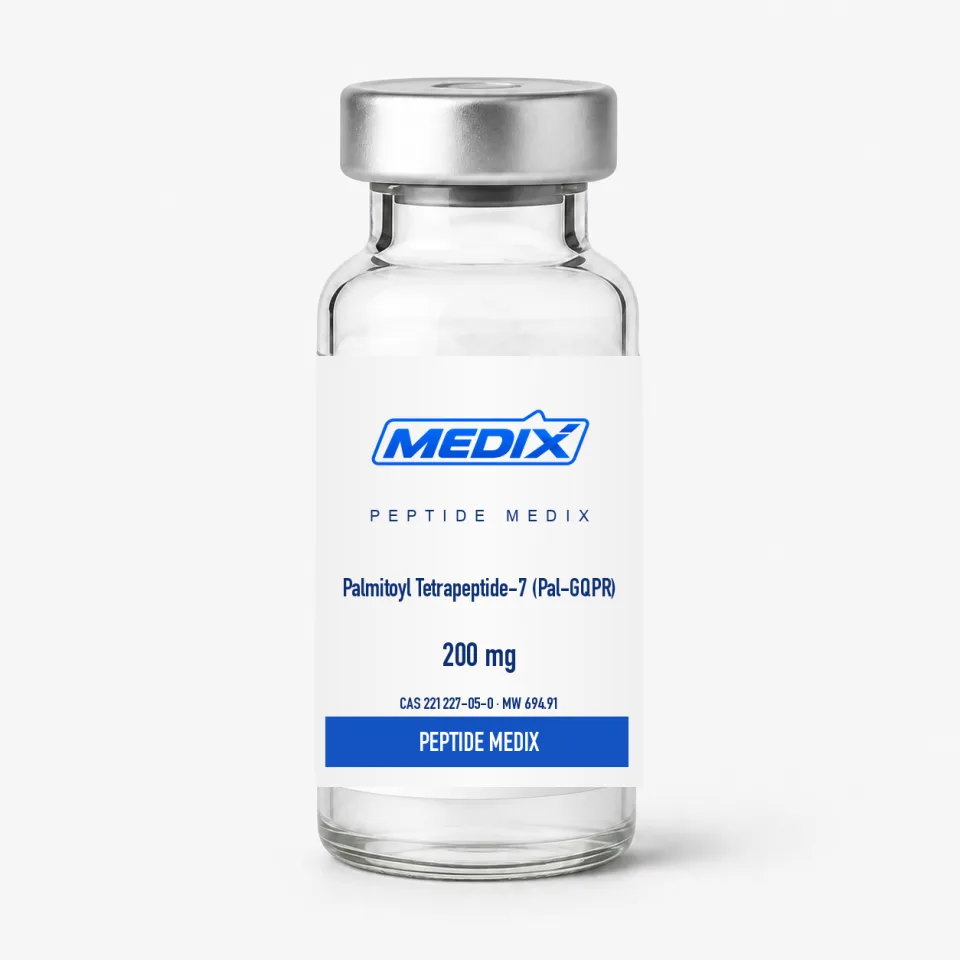
- ≥99% by HPLC
- Lot-matched certificate of analysis
- Ships next business day, tracked
Palmitoyl Tetrapeptide-7 (Pal-GQPR)
Lipidated GQPR matrikine used in matrix, cytokine and permeation models
- FormLyophilized amphiphilic peptide powder, sealed glass vial
- Mol. weight694.91 g/mol
- Research areasFibroblast extracellular-matrix output, cytokine markers, UV-stress models, peptide permeation and formulation stability
Overview
Palmitoyl Tetrapeptide-7 is the N-palmitoylated form of Gly-Gln-Pro-Arg, abbreviated Pal-GQPR. The GQPR sequence is associated with an immunoglobulin G fragment, while the attached sixteen-carbon chain raises lipophilicity and changes how the peptide partitions into membranes, emulsions and other lipid-rich systems. Free GQPR is also catalogued as rigin, and it shares its C-terminal Pro-Arg motif with tuftsin (Thr-Lys-Pro-Arg), another short immunoglobulin-derived sequence — a relationship worth noting because it places the peptide outside the true matrikines, which are fragments of extracellular-matrix proteins rather than of an antibody.
This ingredient is often encountered as one half of Matrixyl 3000-type formulations alongside Palmitoyl Tripeptide-1. A standalone vial lets laboratories study Pal-GQPR independently, quantify it separately and run single-agent controls before interpreting a two-peptide blend. Published work is weighted toward formulation, fibroblast, extracellular-matrix and cytokine-marker models, with independent evidence more limited than branded mixture claims may suggest. Acylation adds roughly 238 Da of purely hydrophobic mass to the tetrapeptide, so equal-weight comparisons against the unmodified sequence deliver unequal numbers of molecules and matched-molarity designs are the meaningful ones.
The 200 mg vial contains lyophilized Pal-GQPR, CAS 221227-05-0, formula C34H62N8O7 and molecular weight 694.91 g/mol. It is HPLC tested with a lot-matched COA available and is supplied strictly as a laboratory research material, not as a finished cosmetic or drug.
Specifications
Identity
- CAS number
- 221227-05-0
- Molecular formula
- C34H62N8O7
- Molecular weight
- 694.91 g/mol
- Peptide class
- Lipidated tetrapeptide / matrikine-associated cosmetic peptide
Supply & purity
- Form
- Lyophilized amphiphilic peptide powder, sealed glass vial
- Purity
- ≥99% by HPLC; lot-matched COA available
- Solubility
- Low water solubility; use a validated co-solvent or surfactant vehicle
Additional detail
- Available size
- 200 mg
- Sequence
- Palmitoyl-Gly-Gln-Pro-Arg-OH (Pal-GQPR)
- Also known as
- Pal-GQPR, Palmitoyl-GQPR, N-Palmitoyl Rigin, Rigin
- Research areas
- Fibroblast extracellular-matrix output, cytokine markers, UV-stress models, peptide permeation and formulation stability
- Storage
- −20 °C lyophilized; protect from light and moisture
Working out the concentration
Palmitoyl Tetrapeptide-7 (Pal-GQPR) ships as a lyophilized powder, so nothing on this page can state a concentration: the figure you work with is the one you create when you add diluent. Put the vial mass and the volume you intend to use into the peptide reconstitution calculator and it returns mg/mL, mcg/mL and the mass sitting at each mark on a U-100 syringe.
If the protocol asks for a molar concentration, the molar concentration calculator converts between 694.91 g/mol, the mass you weigh out and the volume you dissolve it in.
Certificate of analysis
Every lot of Palmitoyl Tetrapeptide-7 (Pal-GQPR) is released against a certificate of analysis: the batch-specific laboratory data for that lot, not a generic document for the compound. The lot number on the certificate matches the lot number printed on the label you receive — the vial label itself, where the product is vialled — so the record and the material it describes can always be reconciled.
Purity: ≥99% by HPLC — the specification for this listing. The figure for the lot you receive is the one reported on that lot’s certificate.
No lot certificate is on display on this page at the moment. That is a publishing state and not a testing one: lots are released and documented as described above whether or not the document is posted here, and we will send what exists for the lot in stock, or for a lot already on your bench, by its number.
Certificates are available on request before you order as well as after, with no account and no charge. Request the certificate for this listing, read the testing and documentation policy in full, or see how to read a peptide COA.
Questions about Palmitoyl Tetrapeptide-7 (Pal-GQPR)
Is Palmitoyl Tetrapeptide-7 the same as Matrixyl 3000?
No. Palmitoyl Tetrapeptide-7 is one defined peptide, Pal-GQPR. Matrixyl 3000-type systems combine it with Palmitoyl Tripeptide-1 in a formulated mixture. This standalone vial supports single-agent controls and independent quantification.
What is the amino acid sequence?
The peptide core is Gly-Gln-Pro-Arg with an N-terminal C16 palmitoyl group, written Pal-GQPR. Its registered identity is CAS 221227-05-0 with molecular weight 694.91 g/mol.
Why is the peptide poorly soluble in water?
The C16 palmitoyl chain contributes a large hydrophobic surface. It improves lipid-phase partitioning but also encourages aggregation and adsorption, so the vehicle and labware must be selected and documented.
How does it differ from Palmitoyl Tripeptide-1?
Palmitoyl Tripeptide-1 uses the Gly-His-Lys core; Palmitoyl Tetrapeptide-7 uses Gly-Gln-Pro-Arg. Both carry the same type of lipid tail but represent different sequences and research questions.
Related