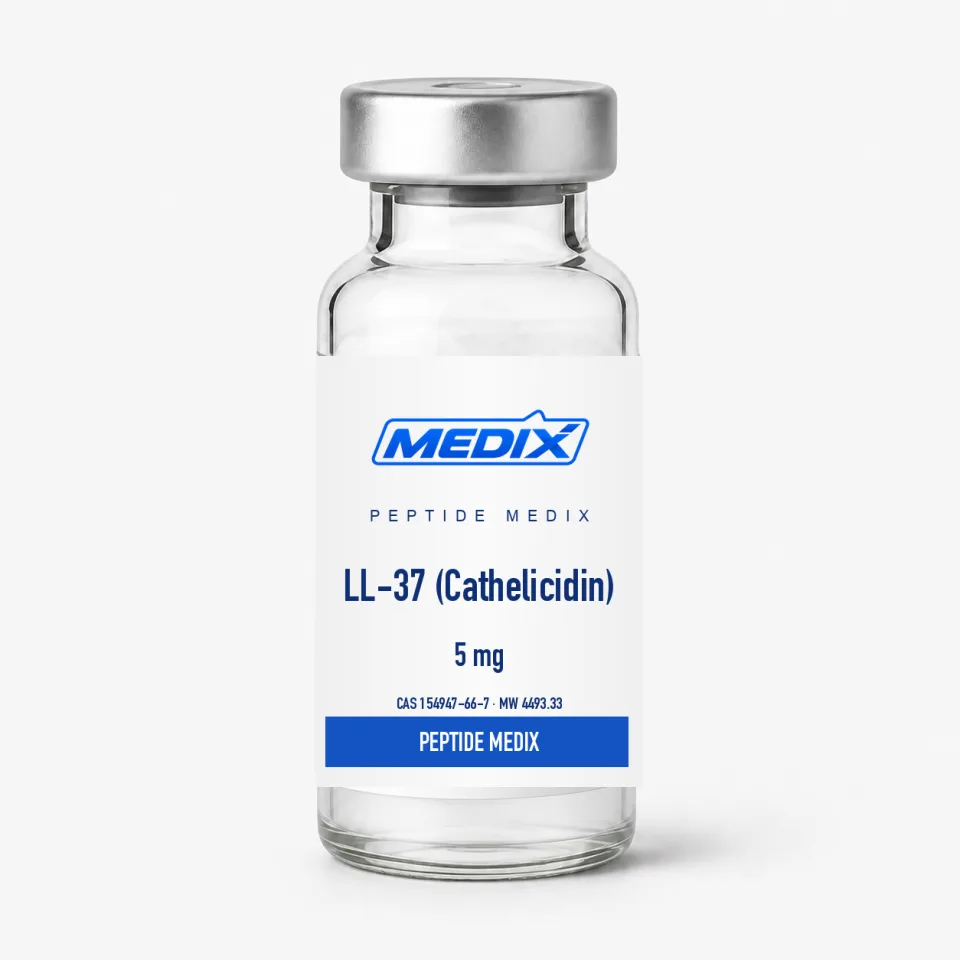
- ≥99% by HPLC
- Lot-matched certificate of analysis
- Ships next business day, tracked
LL-37 (Cathelicidin) Peptide
Human cathelicidin LL-37, a 37-residue antimicrobial host-defence peptide
- FormLyophilized powder, sealed glass vial with crimped stopper
- Mol. weight4493.33 g/mol
- Research areasAntimicrobial and antibiofilm assays, wound repair, immunomodulation, barrier immunity
Overview
LL-37 is the only cathelicidin-family antimicrobial peptide found in humans. It is released from the C-terminus of the precursor protein hCAP18 by proteinase 3 cleavage and takes its name from its length and its two leading leucine residues. Neutrophils, epithelial cells and keratinocytes all express it, and it sits at the interface between innate antimicrobial defence and the regulation of inflammation.
Structurally it is a cationic, amphipathic alpha helix of thirty-seven residues carrying a strong net positive charge. That geometry is central to the mechanism most often described in the literature: electrostatic association with anionic bacterial membranes followed by disruption of membrane integrity. The same amphipathic character makes it a demanding peptide to synthesise and purify, which is reflected in its price relative to shorter sequences.
Supplied as a lyophilized powder in sealed 5 mg and 10 mg vials, each lot is purified by reversed-phase HPLC to at least 99% with mass confirmation and a lot-matched certificate of analysis. Laboratories study it in antimicrobial assays, biofilm work, wound models and immunomodulation research. It is sold strictly for laboratory research use.
Specifications
Identity
- CAS number
- 154947-66-7
- Molecular weight
- 4493.33 g/mol
- Amino acid sequence
- LLGDFFRKSKEKIGKEFKRIVQRIKDFLRNLVPRTES
- Chain length
- 37 amino acids
- Peptide class
- Cathelicidin-family antimicrobial host-defence peptide
Supply & purity
- Form
- Lyophilized powder, sealed glass vial with crimped stopper
- Purity
- ≥99% by HPLC; lot-matched COA available
- Available sizes
- 5 mg, 10 mg
Handling & storage
- Storage (lyophilized)
- −20 °C, sealed and protected from light and moisture
- Storage (reconstituted)
- 2–8 °C, protected from light, used within the study window
Additional detail
- Precursor
- hCAP18; released by proteinase 3 cleavage of the C-terminal domain
- Structure
- Cationic amphipathic alpha helix with a strong net positive charge
- Research areas
- Antimicrobial and antibiofilm assays, wound repair, immunomodulation, barrier immunity
Working out the concentration
Reconstitution is where the arithmetic lives. The same vial made up with 1 mL or with 3 mL of diluent gives three-fold different numbers, which is why a reconstitution volume calculator is more use here than a fixed table: enter the vial mass and your diluent volume and read the concentration back.
Certificate of analysis
Every lot of LL-37 (Cathelicidin) is released against a certificate of analysis: the batch-specific laboratory data for that lot, not a generic document for the compound. The lot number on the certificate matches the lot number printed on the label you receive — the vial label itself, where the product is vialled — so the record and the material it describes can always be reconciled.
Purity: ≥99% by HPLC — the specification for this listing. The figure for the lot you receive is the one reported on that lot’s certificate.
No lot certificate is on display on this page at the moment. That is a publishing state and not a testing one: lots are released and documented as described above whether or not the document is posted here, and we will send what exists for the lot in stock, or for a lot already on your bench, by its number.
Certificates are available on request before you order as well as after, with no account and no charge. Request the certificate for this listing, read the testing and documentation policy in full, or see how to read a peptide COA.
Questions about LL-37 (Cathelicidin)
What is LL-37?
LL-37 is the only cathelicidin antimicrobial peptide expressed in humans, a thirty-seven residue cationic helix released from the hCAP18 precursor protein. It is supplied here as a lyophilized research powder for antimicrobial, biofilm, wound-repair and immunomodulation studies.
Why is LL-37 more expensive than shorter peptides?
At thirty-seven residues it is long by synthesis standards, and its amphipathic, highly cationic character makes both the coupling steps and the purification harder than for a short hydrophilic sequence. Yield per synthesis run is lower, and that cost is reflected in the price per milligram.
What purity do you supply and is a COA available?
Every lot is purified and analysed by reversed-phase HPLC to at least 99% with mass-spectrometric confirmation against the expected 4493.33 g/mol mass. A certificate of analysis matched to the lot number on your vial is available on request before or after ordering.
Does LL-37 need special handling?
It benefits from it. The peptide adsorbs to plastic and aggregates more readily than short hydrophilic sequences, so laboratories generally use low-binding tubes, avoid vortexing and prepare working dilutions fresh rather than storing very dilute stocks for long periods.
What research areas does LL-37 appear in?
Membrane-directed antimicrobial assays against bacteria, fungi and enveloped viruses; biofilm interference at sub-lethal concentrations; wound-repair models involving keratinocyte migration; and immunomodulation work covering lipopolysaccharide binding and dendritic cell responses, including its implicated role in psoriasis.
Related